


For forty years, the free world’s entire argument fit in one sentence: our people can leave.
Not elections. Not GDP. When Kennedy wanted to end the debate in 1963, he said it plainly: “We have never had to put a wall up to keep our people in”. The Berlin Wall was not just a border : it was, in its essence, a confession. A system that must lock its citizens in has already admitted it cannot win the argument.
I grew up on the winning side of that argument. So did you, probably.
Which is why you should look closely at what the winners are doing now. Germany already taxes some of its citizens for up to ten years after they leave, if their new country is deemed too cheap, and in 2025 it extended its exit tax to ordinary ETF portfolios1.
Norway taxes unrealized gains on the way out: 37.84% on paper profits, payable within twelve years, even if you never sell, even if the value collapses after you leave2.
And France's parliament has now twice voted, in committee, to tax people on nationality itself; the latest version died on the Assembly floor by a single vote3.
Taxing people on nationality itself… the American disease. I remember the first time a European bank made me sign a form swearing I wasn't a US person, I thought: what kind of country chases people who don't even live there? France's answer, apparently: ours, soon.
Wall after wall, going up. Not in concrete this time. In tax code. Call it what it is: the Fiscal Wall. Any law whose real purpose is not to raise revenue, but to raise the price of leaving.
This is not hypocrisy, and calling it hypocrisy would miss what makes it dangerous. Hegel had a better word: contradiction. The moment a system must violate its own founding principle to survive. Contradictions are not embarrassments to point at. They are load-bearing cracks. Map them, and you can read where the structure will break, and what will grow through the gaps.
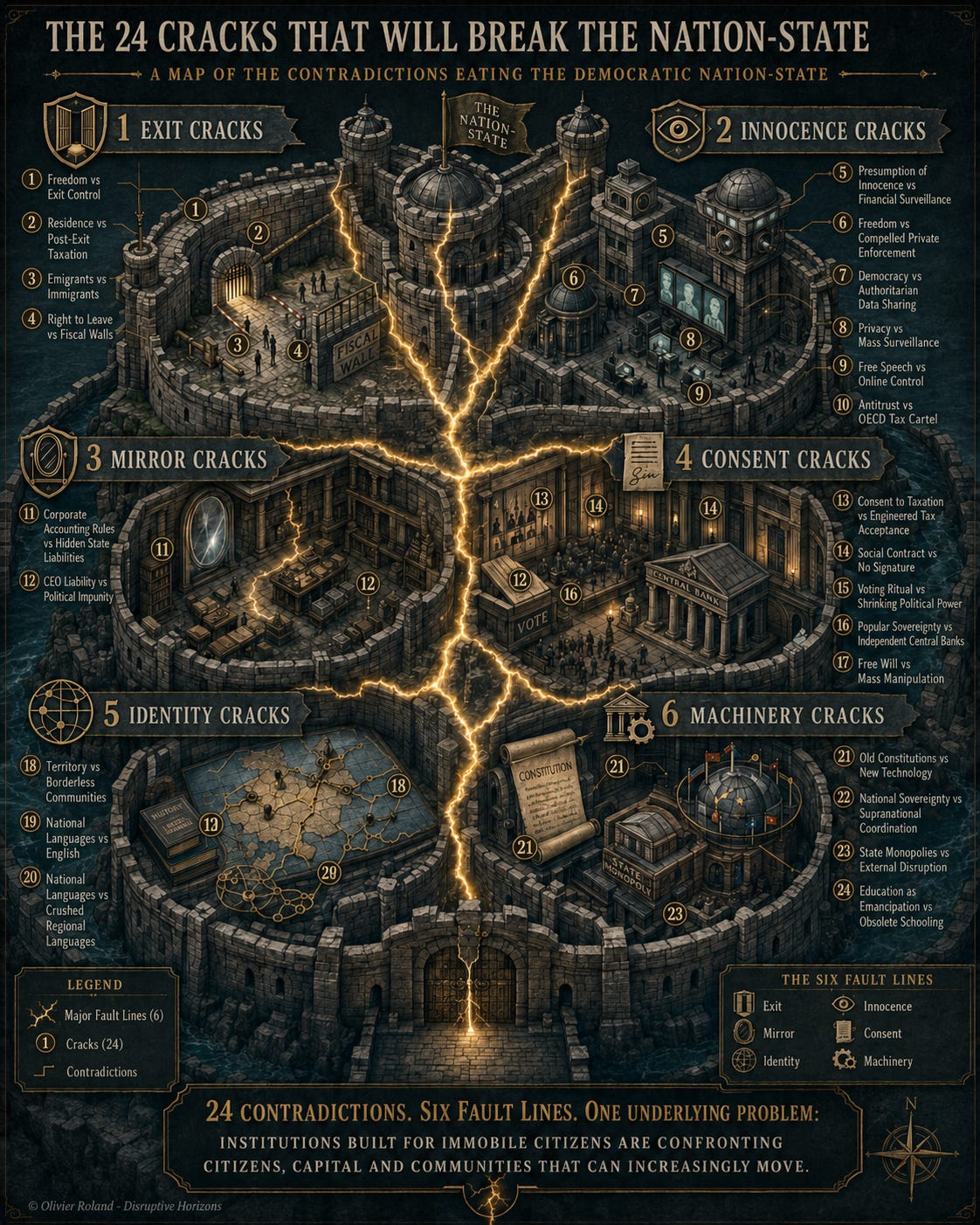
Here is the map. Twenty-four cracks in the democratic nation-state. The internet is widening every one of them.
“The Christian world was [subject to] contradictions. The classical example was the medieval city, which protected within it merchants and traders who constituted the germs of a capitalist economic order. Their superior economic efficiency eventually exposed the irrationality of moral constraints on economic productivity, and thereby abolished the very city that gave them birth. ”
Francis Fukuyama, The End of History and the Last Man, 1992
Load-Bearing Cracks: How Systems Collapse
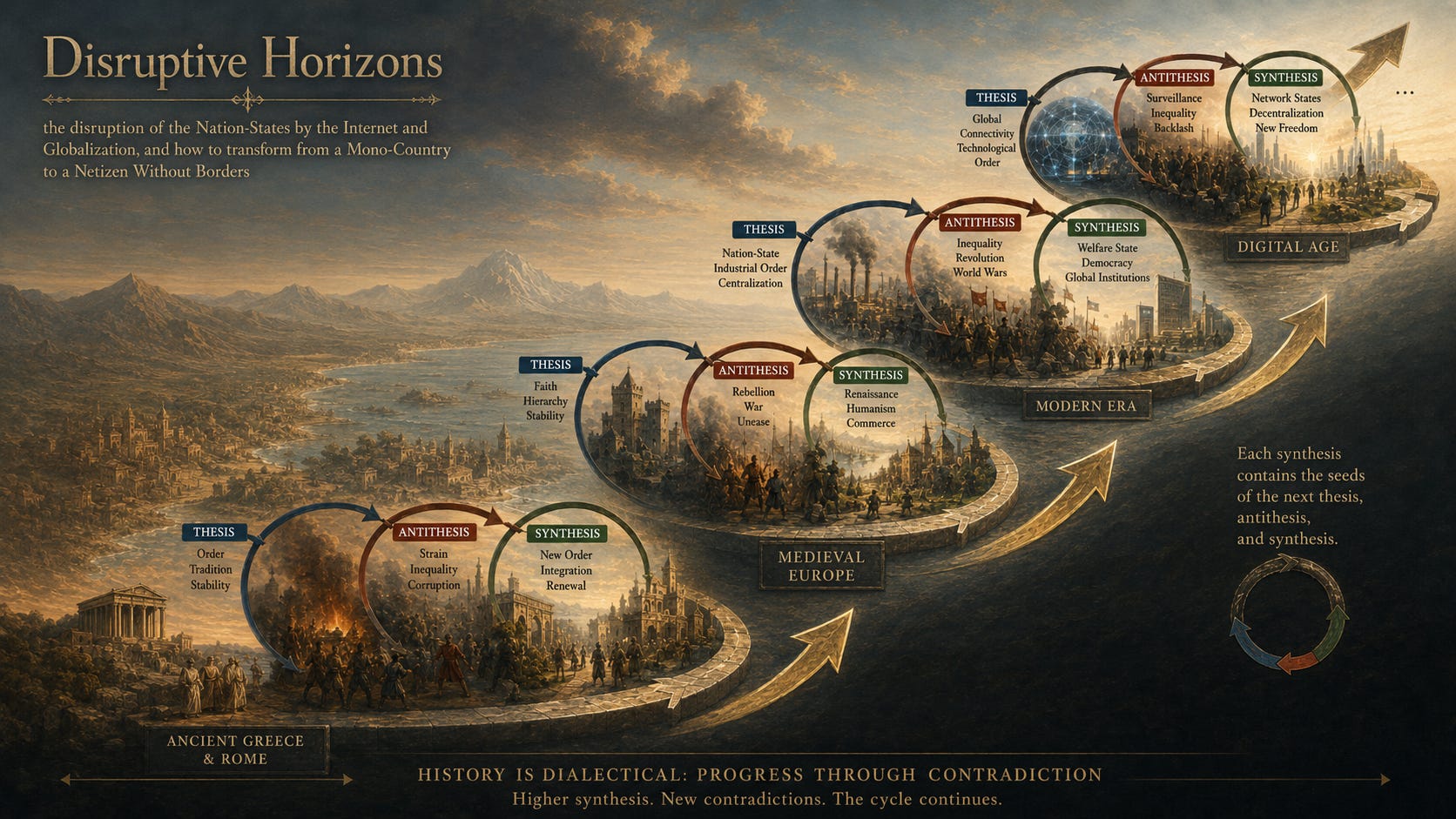
The German philosopher Hegel is known notably for his theory of historical dialectics.

For him, History does not progress in a simple and linear way, but through contradiction. The process is often summarized as thesis, antithesis, and synthesis.
The thesis represents an established idea or system that seems to function properly at first. However, over time, internal contradictions appear. These contradictions are aspects of the system that do not work well together and end up creating tensions.
These tensions give rise to the antithesis, an opposing force or idea that contests the established order. The antithesis highlights the flaws of the system in place by emphasizing the inconsistencies and problems it generates.
To resolve these conflicts, a synthesis emerges. The synthesis is a new idea or system that integrates the valid elements of the thesis and the antithesis while transcending their contradictions. This process allows History to move forward toward a more developed and coherent stage by eliminating the inconsistencies of the previous system.
For truth has a center of gravity: governments and even entire peoples may deny it for a time, but it always ends up attracting a certain number of people, populations, and states, and growing in influence until it becomes irresistible.
That is what grounds the essence of historical dialectics, and the fact that the further we advance through time, the more humanity maximizes its relationship to truth.
Each contradiction in a political, social, or philosophical system is therefore a sign of an incomplete truth, and an announcement that a more complete truth (and therefore a disruptive one) is ready to be discovered.
The Fundamental American Contradiction
A major and clear historical contradiction, for example, is found in the American Declaration of Independence of 1776:
“We hold these truths to be self-evident, that all men are created equal, that they are endowed by their Creator with certain unalienable Rights, that among these are Life, Liberty and the pursuit of Happiness”
wrote Thomas Jefferson… who owned some two hundred slaves at the time this document was drafted, a document signed by a majority of slave owners4.
Most of the Founding Fathers were fully aware of this contradiction, and some even attempted to abolish slavery from the very beginning of the United States, but this could not be done for various reasons - notably to avoid immediately shattering a fragile coalition of states with diverse interests, including the Southern states, whose economies were heavily dependent on this horrific institution5.
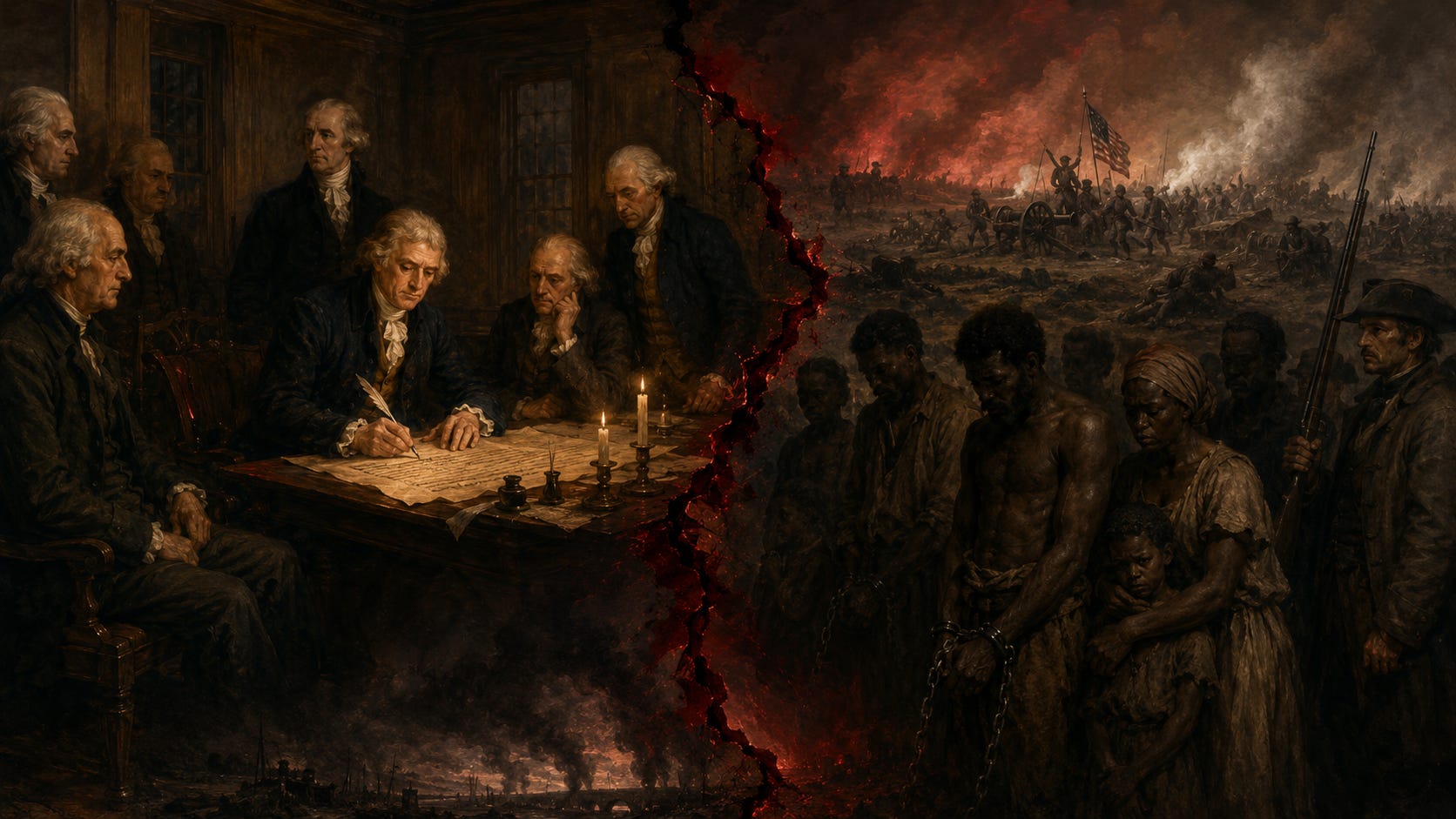
Such a glaring contradiction could not last forever, and it was resolved in blood a little less than a century later with the American Civil War (1861–1865), won by the Union, and resolved by abolition.
We thus see here an example of a war that stemmed directly from an internal contradiction within a system: this illustrates the danger of leaving such glaring contradictions unresolved, and reminds us of the 8th principle—“when conflicting narratives vie for existence in people’s minds, wars are sometimes necessary to decide which one will prevail.”
The Twenty-Four Cracks in the Democratic Nation-State
The Exit Cracks
It starts at the door. A system built on freedom cannot admit that it needs to lock the exits, yet everything else on this list eventually requires it to :
A contradiction between the individual freedom they are supposed to protect and their need to limit the geographical freedom of their population, especially its most mobile part, whose share is steadily increasing.
A contradiction between the fact that acceptance of the social contract is now conditioned on residence in a given territory and the fact that many nation-states try to limit the ability of the most mobile part of their population to leave, thereby forcing it to comply with the contract even if it no longer wants to.
A contradiction between how a state treats those who leave it, as deserters and tax dodgers, and how it celebrates those who arrive, though they are the very same people who deserted somewhere else.
A contradiction between the right to leave one’s country, a fundamental human right guaranteed by the UN Universal Declaration of Human Rights6, adopted in 1948, drafted against the regimes that walled their people in. Every democracy now building fiscal walls claims that right as part of its founding creed.
The Innocence Cracks
Locking the door requires watching everyone. So the presumption of innocence quietly inverts: every bank account reported, every message scannable, every citizen a suspect by default :
A contradiction between the principle of the presumption of innocence and the global financial-surveillance system that has been put in place, in which everyone is regarded as guilty until proven otherwise, at enormous cost, for results strikingly weak relative to the scale of the surveillance.7.
A contradiction between freedom elevated as a central principle and the growing obligations that force private entities such as banks to do governments’ work without being paid and while being punished if they fail to comply, which is a form of servitude.
A contradiction between the values of democracies and the fact that they set up international collaborations that allow non-democratic states to monitor and control their populations and dissidents more easily8.
A contradiction between protection of privacy, a fundamental right, and the expansion of surveillance technologies that massively collect personal data under the pretext of national security or commercial convenience.
A contradiction between freedom of expression guaranteed by democratic constitutions and increasingly restrictive laws on online speech, where censorship and self-censorship become commonplace under pressure from governments and large technology platforms (following the 3rd principle).
A contradiction between the antitrust laws that make it a crime for companies to fix minimum prices, and the states' own minimum-price agreement on taxation: the OECD's 15% global minimum tax, openly designed to end what its architects call the "race to the bottom", which is exactly what every cartel says about price competition.
The Mirror Cracks
The state's rules come with a one-way mirror: what lands an executive in prison is standard practice in government :
A contradiction between the accounting standards the state enforces on companies, which must carry every pension promise on their balance sheet, and the state's own pension promises, several times GDP, parked in supplementary tables that bind nothing and count in no official debt figure.
A contradiction between the legal liability of a CEO who materially misleads investors, and the total legal impunity of a candidate who materially misleads voters.
The Consent Cracks
A state that watches everything and exempts itself from everything eventually runs into the question it cannot answer: who agreed to this? And the state knows it, which is why it engineers around your consent rather than seeking it :
A contradiction between the principle of consent to taxation and the multiplicity of taxes and tax loopholes, as well as deliberate policies that measure the “pain threshold” and resistance associated with different kinds of taxes in order to focus on those that are better accepted.
A contradiction between the principle of the social contract, which lies at the base of democratic societies, and the fact that the contract is imposed on all residents of a country, that no one signed it, and that it can be modified unilaterally by the government.
A contradiction between the professed importance of voting and the fact that elected politicians have less and less influence over the fate of their country because of the difficult financial situation of most states, globalization, the Internet, and the growing importance of supranational bodies.
A contradiction between democracies' claim that all power flows from the people, and the deliberate design of their most powerful economic institution, the central bank, to be immune from the people's vote, a feature its defenders call its greatest virtue.
A contradiction between the concept of free will, a fundamental foundation of democracies, and the mass-manipulation strategies developed from the 20th century onward9.
The Identity Cracks
Meanwhile, the 'we' that made all of this feel legitimate is dissolving. The nation was held together by shared language and shared territory; the internet is dissolving both :
A contradiction between the importance of the nation as attached to a geographical territory and the fact that the Internet increasingly allows people to feel included in communities that transcend borders, and/or in which borders often no longer make sense.
A contradiction between attachment to a national language and the fact that English has won globally.
A contradiction between that attachment and all the regional languages that have been crushed in many countries so that the national language could prevail.
The Machinery Cracks
And the machine itself was built for another century - constitutions written before electricity, schools designed for factory work, monopolies facing competitors their founders could not imagine :
A contradiction between those states’ constitutions, often written before the emergence of digital tools and modern technology, and those same tools, which make it possible to circumvent the spirit of the constitutions by using them in situations their authors could never have imagined10.
A contradiction between the principle of national sovereignty and the need to coordinate internationally and cede part of that sovereignty in order to resist modern disruptions.
A contradiction between the search for state monopolies in public services and the fact that a monopoly situation is the worst possible terrain for having contradictions resolved by actors external to the state.
A contradiction between promoting education as a means of emancipation and the reality of an often obsolete school system, designed for the economic and social needs of the past and leaving new generations insufficiently prepared for contemporary challenges, as I discussed in detail in The Way of The Intelligent Rebel.
What the Cracks Predict
Look back at the list. Twenty-four contradictions, and not one of them is an accident or a scandal. Nobody designed them. Each one is the point where a principle written in one century met a technology from another, and lost.
This is why pointing at them and shouting “hypocrisy!” misses the target. The men who signed the Declaration of Independence saw their contradiction with perfect clarity. Jefferson named it, drafted its condemnation, watched Congress strike it out, and lived off it for fifty more years.
Seeing a contradiction has never been enough to resolve one. The beneficiaries are always holding, as Jefferson put it, “a wolf by the ear”: they can neither hold on forever nor safely let go.
So the cracks will not be resolved by lucidity, or by voting, or by op-eds. They will be resolved the way load-bearing cracks always are: by pressure, from outside, against the weakest point. In 1861, the pressure was an army. This time it is quieter. Every person who learns English, holds bitcoin, joins a borderless community, homeschools a child, or moves a life across a border is pressure on a crack. None of them thinks of it as history. Neither did the merchants in Fukuyama’s medieval cities.
The state sees it, which is why it is reaching for the one tool that always betrays a system's self-confidence. The Fiscal Wall is going up, brick by legislative brick.
But walls only ever proved one thing, and everyone East of Berlin knew it: a system that has to lock people in has already lost the argument.
The Berlin Wall looked eternal on the evening of November 8th, 1989. It took one night.
For further reading, here are the first articles of this series :


Germany's "extended limited tax liability" (§2 Außensteuergesetz) keeps German citizens who move to low-tax jurisdictions within the German tax net for up to ten years after departure. Since January 1, 2025, the Annual Tax Act 2024 also extended the exit tax to investment fund and ETF holdings above €500,000. See "Exit Tax Topic Hub", Grant Thornton Germany: and "Exit Tax on Private Assets 2026"
In force since January 1, 2025, applying retroactively to departures from March 20, 2024: 37.84% on unrealized gains above NOK 3 million, payable within 12 years whether or not the assets are ever sold; a post-departure drop in value does not reduce the tax. "Norway – Amendments to Exit Tax Rules Enacted", KPMG GMS Flash Alert 2025-027: and BDO Global
Amendment I-CF380 to the 2026 Finance Bill, creating a "targeted universal tax" based on French nationality for citizens relocating to low-tax jurisdictions, was adopted by the Finance Committee of the Assemblée nationale on October 17, 2025, then rejected on the Assembly floor by a single vote. A near-identical amendment had already been adopted in committee during the 2025 budget debates. See ASFE, "L'impôt universel ciblé : de quoi s'agit-il ?.
« The Founding Fathers and Slavery », Anthony Iaccarino, Encyclopedia Britannica
Jefferson was among them : his draft of the Declaration of Independence contained a furious paragraph condemning the slave trade as 'cruel war against human nature itself'. Congress struck it out to keep South Carolina and Georgia in the room.
“Universal Declaration of Human Rights,” Article 13, UN.

.jpg)
For example, the automatic exchange of tax information, which makes it easier to monitor and punish dissidents in authoritarian states: as I discuss in Chapter 4, two months after the outbreak of the war in Ukraine, the United States suspended the exchange of tax information with Russia. “U.S. suspends tax information exchange with Russian authorities,” Reuters, David Lawder, 2022
« Propaganda », Edward Bernays, 1928
For example, the fact that a customs officer who seizes everything you’re carrying at the border can now access entire aspects of your life, since digital devices can store amounts of data that would have seemed unimaginable just a few decades ago. Another example: the framers of the constitutions could not have imagined situations in which mass surveillance is technically feasible and economically viable, as is the case today.