

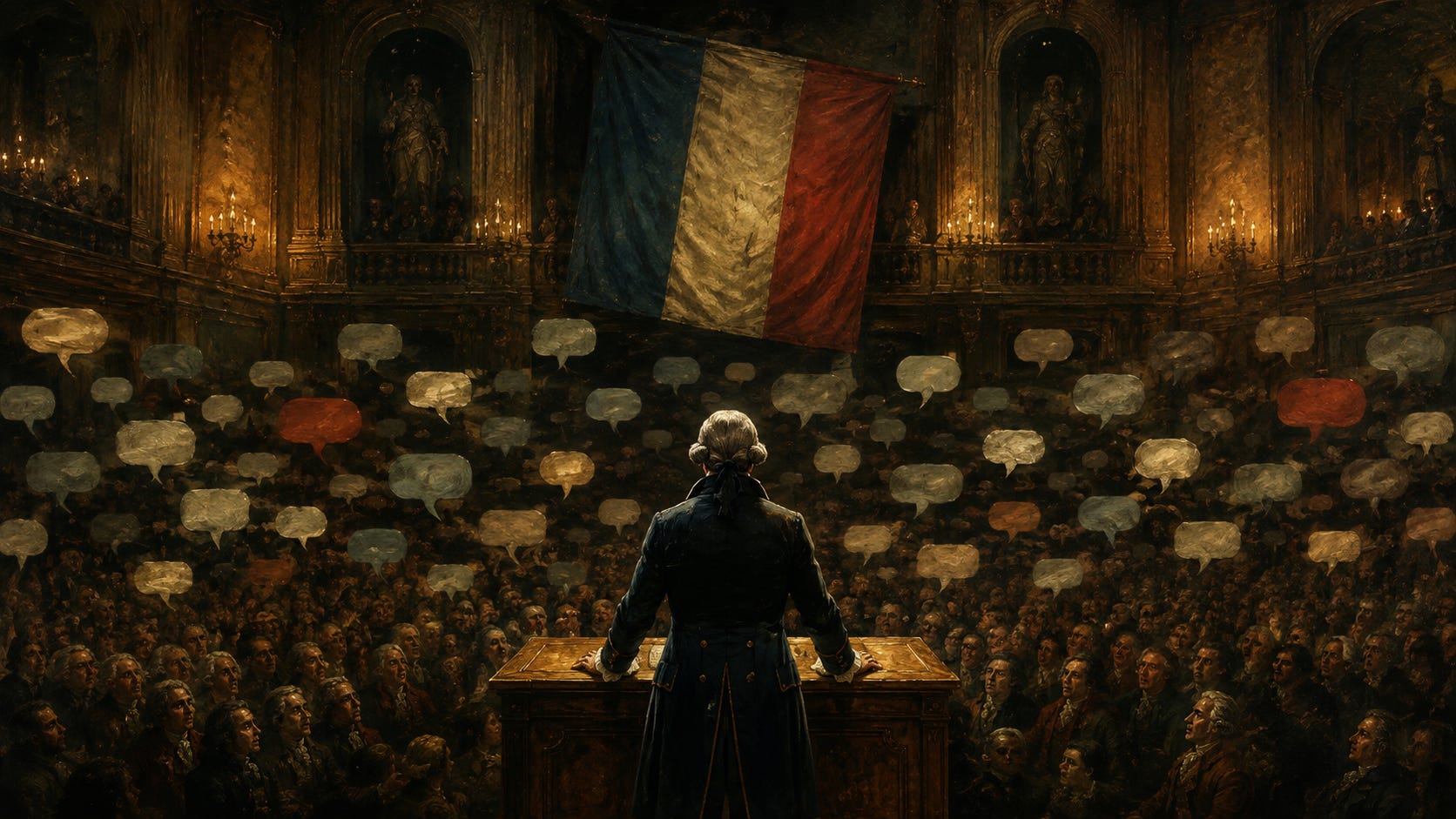
In June 1794, at the height of the French Revolution, a priest named Henri Grégoire stood before the National Convention and delivered an inconvenient finding. He had surveyed the languages spoken across France. Out of 28 million French citizens, at least 6 million did not understand French at all. Another 6 million could barely hold a conversation in it. Only 3 million spoke it well.
France did not speak French.
The nation you were taught to see as eternal had to be manufactured. It took a century of printing presses, state schools, newspapers, and conscription to turn peasants who spoke Breton, Occitan, and thirty other languages into Frenchmen willing to die for a flag. The same machine ran in Italy, in Germany, everywhere. Nationalism is not human nature. It is an industrial product, and it is younger than the steam engine.
I know, because I am running the machine in reverse. I am French. I write books in French. Yet I am writing this from Bangkok, in English, for readers in 125 countries. One of my passports says Antigua. Every technology that built national feeling in the 19th century now has a digital successor, and each one is pulling in the opposite direction.
Five forces manufactured nationalism. The internet is breaking all five.
“Nationalism tends to treat itself as a manifest and self-evident principle, accessible as such to all men, and violated only through some perverse blindness, when in fact it owes its plausibility and compelling nature only to a very special set of circumstances, which do indeed obtain now, but which were alien to most of humanity and history.
It preaches and defends continuity, but owes everything to a decisive and unutterably profound break in human history. It preaches and defends cultural diversity, when in fact it imposes homogeneity […].
Its self-image and its true nature are inversely related, with an ironic neatness seldom equalled even by other successful ideologies”
Ernest Gellner
As we saw in the previous series that led us to the 10th principle, nationalism - contrary to what most people believe - is a recent invention, just like the idea of being ready to die to defend the “homeland,” in the sense of an imagined community that goes beyond one’s direct community.
Picture François, a Breton peasant in 1400. He has never heard the word “France” spoken with reverence. He speaks Breton, one of the thirty languages Grégoire would later mark for destruction. The king in Paris speaks something else, and it does not matter, because François will never hear him. There are three things François would fight for, maybe die for: his village if raiders come, the oath sworn to his lord, and his God. The kingdom of France is not on the list. It is not his homeland. It is an abstraction that taxes him.
Four hundred years later, Grégoire’s survey showed how little had changed: most of the kingdom still could not understand the king.
Then, in a single century, everything changed. François’s descendants learned French, read the same newspapers, saluted the same flag, and died in the mud of Verdun for a nation their ancestor could not have imagined.
What happened in between? Five technologies.
1st Force : The Supremacy of a National Language
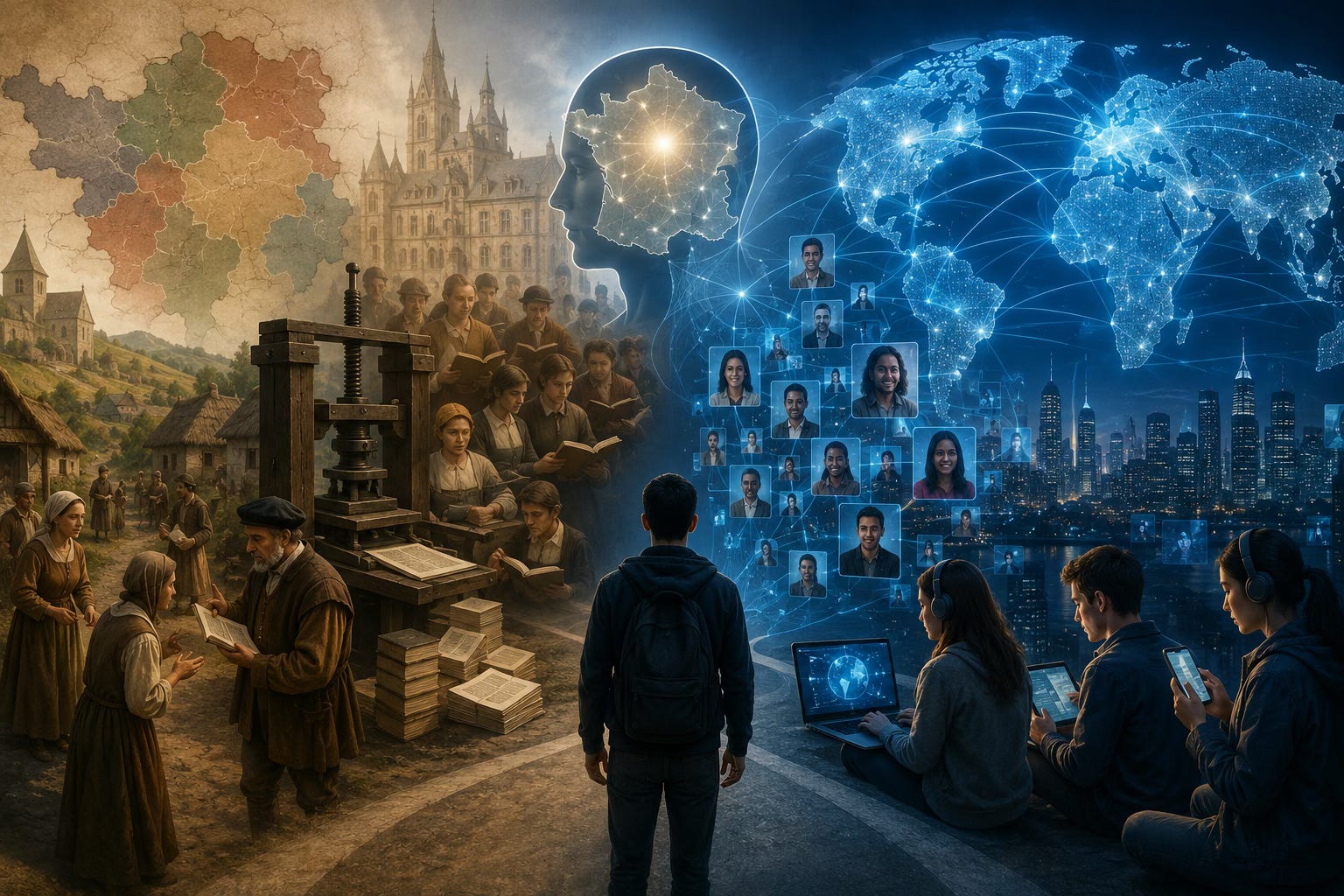
The printing press helped one language, among all the regional dialects of a given country, to spread, which allowed millions of people gradually to speak the same language rather than a more or less distant regional variant.
The Parallel with the Internet
When the Internet was born, English was already the most widely learned foreign language in the world, and the Internet greatly accelerated that trend: because more people learn English than any other language, people are more likely to communicate in English on the network of networks, because its borderless nature makes the use of a common language necessary.
Here is the share of websites in the 10 most popular languages on the web, in mid-20261:
English 49.5%
Spanish 6.0%
German 5.9%
Japanese 4.9%
French 4.5%
Portuguese 4.1%
Russian 3.4%
Italian 2.8%
Dutch 2.1%
Polish 1.8%
As you can see, English crushes every other language, with no comparison possible.
Now, national languages became useful only once the printing press began mass-distributing books: those books obviously had to be printed in the most popular language rather than in dozens of regional languages, for reasons of cost and market (the foundations of capitalism).
But the Internet abolishes borders and distances, making those national languages an obstacle to communication among all these connected people, just as regional languages were once an obstacle to communication among all the people connected by the printing press within a given country.
If someone speaks only Portuguese, he will have access to only 4.1% of the world’s websites instead of more than half if he also speaks English. Consider how infinitely poorer, less diverse, and therefore less sophisticated the content available to him will be (competition creates excellence).
He will also be able to communicate with only a tiny fraction of the people connected to the web, thereby reducing all the benefits the Internet brings.
That is the consequence of English’s supremely powerful network effect: because it is the most learned language in the world, and therefore the most spoken, it is the most worthwhile to learn; therefore more people learn it, and the more people learn it, the more its network effect strengthens.
The conclusion is inevitable: people who do not learn English will find themselves in the same situation as people who refused to learn the national language that was becoming dominant when the printing press developed - they remained confined to their regional patois, completely outclassed by the intellectual diversity and knowledge available to people who spoke the national language, and gradually cut off from their growing, all-pervasive state, which used the national language exclusively to communicate.
The evolution took place in three broad stages:
First, minimally educated people learned the national language as a second language in addition to their regional speech.
Then, gradually, and often helped by the national school established by the government of the country, which pushed toward unification, it was the national language that came to be spoken at home, while the regional language became secondary.
Then more and more people started speaking only the national language.
These three stages will repeat in the same order, except that there will be no institution pushing the second stage: rather, it is the Internet, globalization, and the network effect of English that will, out of necessity, motivate people to make the transition.
We are currently at the first stage: minimally educated people have learned English as a second language in addition to their national language.
This will have the same impact on nationalism as the transition from regional languages to national languages: regional identities gradually faded to the point of becoming secondary relative to national identity - François in 1400, whom we saw in this article, felt like a Breton who was also a subject of the kingdom of France, whereas François in 2000 feels like a Frenchman from Brittany, and perhaps also a European.
In time, the fact that everyone will speak English will weaken national consciousness, because we will perceive human beings from different countries as closer to us than if we had no common language.
I know that reading these lines may generate a lot of emotion in some people. I am fully aware of the attachment one can have to a language (I myself am very attached to French, and even though I consider myself bilingual in English, my command of French is infinitely better and subtler: I wrote my books in that language, after all).
But that is exactly what people felt when they saw their regional language crushed by the steamroller of the national language: their emotions could do nothing against the external factors that caused those changes, and the same will be true here.
The only factor that might prevent English from becoming the universal language everyone learns is the appearance of perfect simultaneous-translation systems, as in Star Trek, that allow everyone to speak in their native language and be understood by anyone, whatever their language.
The technology is already so powerful at the time of writing - and improving exponentially, especially with AI - that we will probably benefit from such systems in time.
But even that will have the effect of reducing the importance of our native language in our sense of national belonging, and of making us perceive human beings from other countries as closer to us than we do today.
2nd Force : The Birth of an Imagined Community
This process greatly accelerated with the development of the written press, liberated by the advent of democracies and freedom of expression, and by the establishment of compulsory schooling and thus access to literacy for all. In the 19th century, millions of people could thus consume at the same moment the same news adopting the same national point of view.
And it reached another level with radio and television in the 20th century.
This generalized and simultaneous access to similar books, newspapers, and identical radio and television programs had the effect of 1) helping individuals imagine themselves to belong to the same community of millions of people performing the same act in the same language (and therefore on national territory), at roughly the same time (books, newspapers) or even exactly the same time (radio, television), and 2) creating a common culture with common references for many people.
The Parallel with the Internet
The Internet makes it possible to connect with imagined communities of several million people who share at least one common interest.
This offers two major advantages compared with imagined communities based on pre-Internet technologies:
You have no geographical constraint. And if you speak English, you remove the biggest linguistic constraint as well.
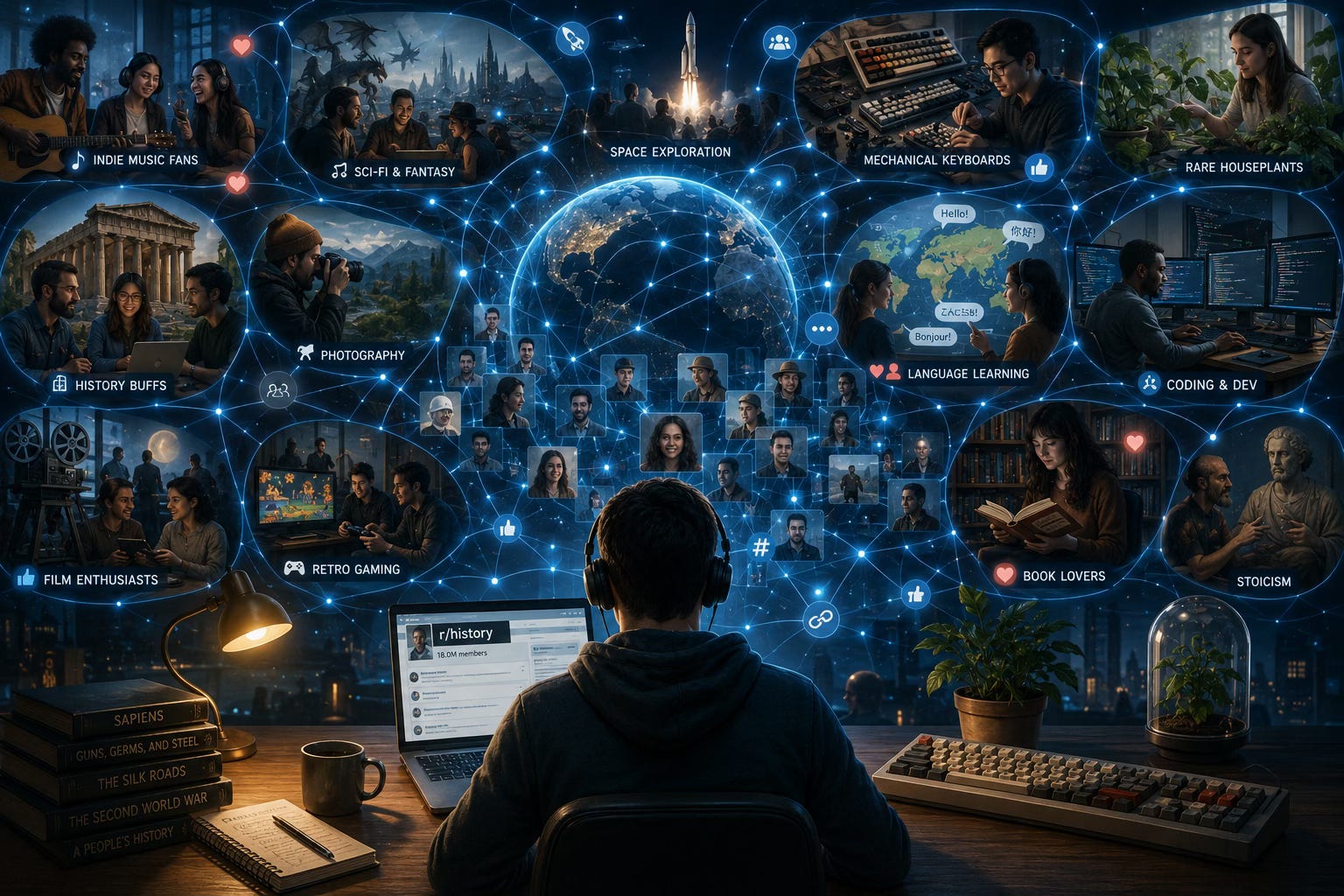
You can easily find communities around the most obscure subjects: are you passionate about 19th-century mechanical keyboards, or rare houseplants? Before the Internet, good luck finding someone in your city who shared your passion. Now it is as banal as typing words into a search engine.
Of course, if you have a popular passion, it was already easy to find others who shared it before the Internet. But your radius of action was very limited, whereas today you can in theory connect with every other enthusiast in the world who speaks the same languages as you - a community all the larger when your languages are widespread.
The Internet thus allows anyone, wherever they come from on the planet, to connect with dozens or hundreds of imagined communities around the subjects that fascinate them.
For example, if you are passionate about history and connect to the Reddit community r/history, you see that it has 18 million members, and you imagine yourself as part of a community of that size, passionate about the same thing as you, regularly performing the same actions as you - checking the group and perhaps even posting there - and that creates a strong sense of belonging.
Why is this disruptive? Today, some people feel closer to an online community of which they are members than to their next-door neighbor.
They therefore feel a stronger sense of belonging toward an international community than toward a fellow citizen with whom they nonetheless share many common points.
At a minimum, this reduces nationalist feeling.
But that is not all: some of these communities may already be “proto-network states,” meaning communities that may one day try to equip themselves with a state. We will discuss that in more detail in next series.
3rd Force: The Reversal of the Balance of Power Between Attack and Defense
Gunpowder reversed the balance of power between attack and defense, made castles obsolete, ended feudalism, and allowed monarchs to centralize their power, which enabled them better to homogenize their kingdoms.
The Two Parallels with the Internet
We have already mentioned them: the first is cryptography, which allows the development of encrypted communications that are very difficult, if not impossible, for states to crack.
That is one of the fundamental foundations of cryptocurrencies such as Bitcoin or Ethereum.
Cryptos are an attempt to separate State and Money, something already possible today for people who educate themselves enough and are willing to make a few sacrifices. The more this is democratized, the more individuals will have one less reason to be attached to any particular country, since they will have access to an international currency that will have arisen despite the state of the country in question.
The second is that the Internet makes the seven-flags strategy far easier to use, because adding borders is easy for digital nomads, but difficult for states to undo.
Many digital nomads are already applying that strategy partly without realizing it, like Monsieur Jourdain speaking prose; that already amounts to a population of millions of people, more numerous every year, and very difficult for states to control.
4th Force: Free and Compulsory Schooling
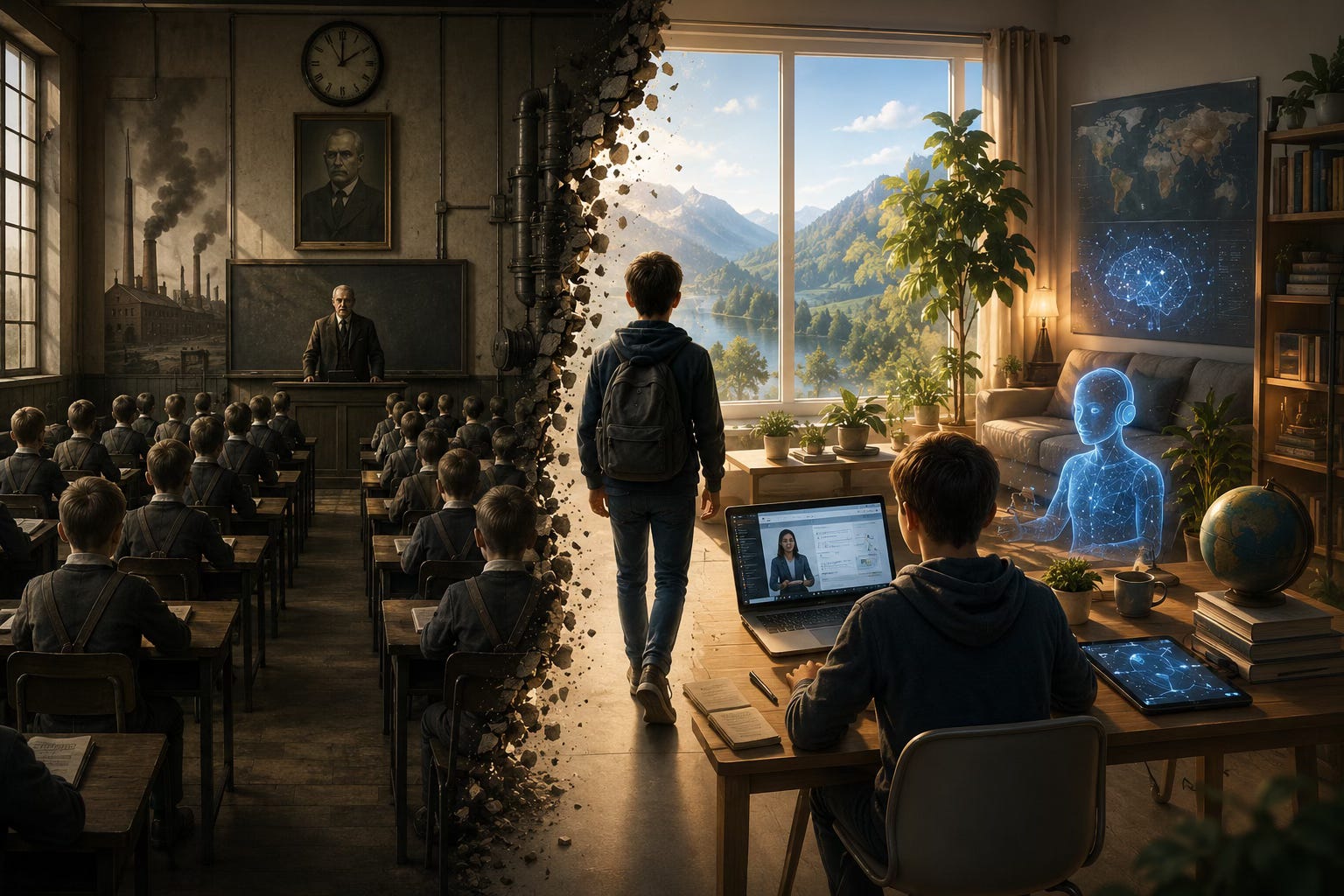
In “The Way of the Intelligent Rebel”, I detailed how national education systems were set up toward the end of the 19th century to create productive citizens for the industrial society of the time - in other words good workers, good employees, good soldiers, obedient to authority.
Here is an excerpt that summarizes my point:
“As a result, from the very beginning the system involved mass-produced education, with children seated in rows, subject to a supreme authority that gave instructions which had to be obeyed absolutely.
Since then, of course, the curriculum has evolved [...], but the basic principles that presided over the establishment of the system have remained the same.
That is probably why personal finance, creativity, and entrepreneurship are not taught in school: school does not want creatives, entrepreneurs, and people who know how to manage their budget and invest. School still wants docile employees who will be passionate about the idea of building a brilliant career, while being given knowledge still regarded as sacred and scarce.
Today - in an era when agricultural workers and factory workers now represent a minority share of total jobs in France (and the French-speaking world), when the Internet allows anyone to access the best courses in the world from home and to test business ideas with tiny investments of time and money compared with what was necessary a few years ago - school, which is supposed to prepare the young to enter 21st-century society, mass-produces employees with methods and a worldview dating from the 19th century.
What matters in this 21st century, and will matter more and more, is not the ability to obey instructions, nor the ability to learn tons of knowledge that one will mostly forget and that are accessible in two seconds through a phone. What matters is the ability to learn by oneself in order to keep up with accelerating technological change, the ability to create, innovate, and test the validity of one’s creations quickly and with little investment.”
So the gap between the vision and doctrine of the school system and the needs of individuals in the 21st century is widening, and that contributes to the decline of traditional education’s influence on people, who increasingly educate themselves from home, homeschool their children (to the point that its prohibition in one country may push some parents into exile), thereby accompanying the movement of digital nomads.
Moreover, the online publication of courses by universities or by ordinary individuals is developing at great speed, and recent progress in AI makes it possible to imagine in the near future computerized tutors boosted by the latest AI of the moment, which will make it possible to democratize inexpensive, effective private and personalized education more broadly.
The loss of prestige and effectiveness of national schooling will therefore contribute to the disintegration of nationalism.
5th Force: The Effectiveness of Armies
The first national armies, made up of conscripts fighting for the ideals of the nation, proved their superiority over traditional armies made up of professionals and mercenaries during the Revolutionary and Napoleonic wars, and that encouraged other emerging nation-states to intensify their nation-building process.
The Contrast with the Internet
Yes, because here it is not a parallel: the Internet will gradually undo what nation-building achieved, for all the reasons we have seen in this Substack.
The more national consciousness erodes, the less willing the population will be to fight to defend a territory or a country. In time, it is even conceivable to see network states whose population regards the loss of territory as unimportant: it would be just a few confetti pieces in a mosaic of territories spread across the planet, and even in space, and they would matter little more than the location of one point of sale for a multinational that has thousands of them.
It is difficult to predict the impact of such a development on army effectiveness: perhaps it will no longer matter because all armies will above all be robotic. Perhaps we will return to city-states hiring mercenary companies, as in medieval Italy. Perhaps it already no longer matters, because armies have become professionalized worldwide and already rely on the most nationalist 1% of the population.
So the machinery that built national feeling is running in reverse. Why does almost nobody see it? Because for many people, the nation-state isn’t a machine at all. It’s a god.
The Sacredness of the State
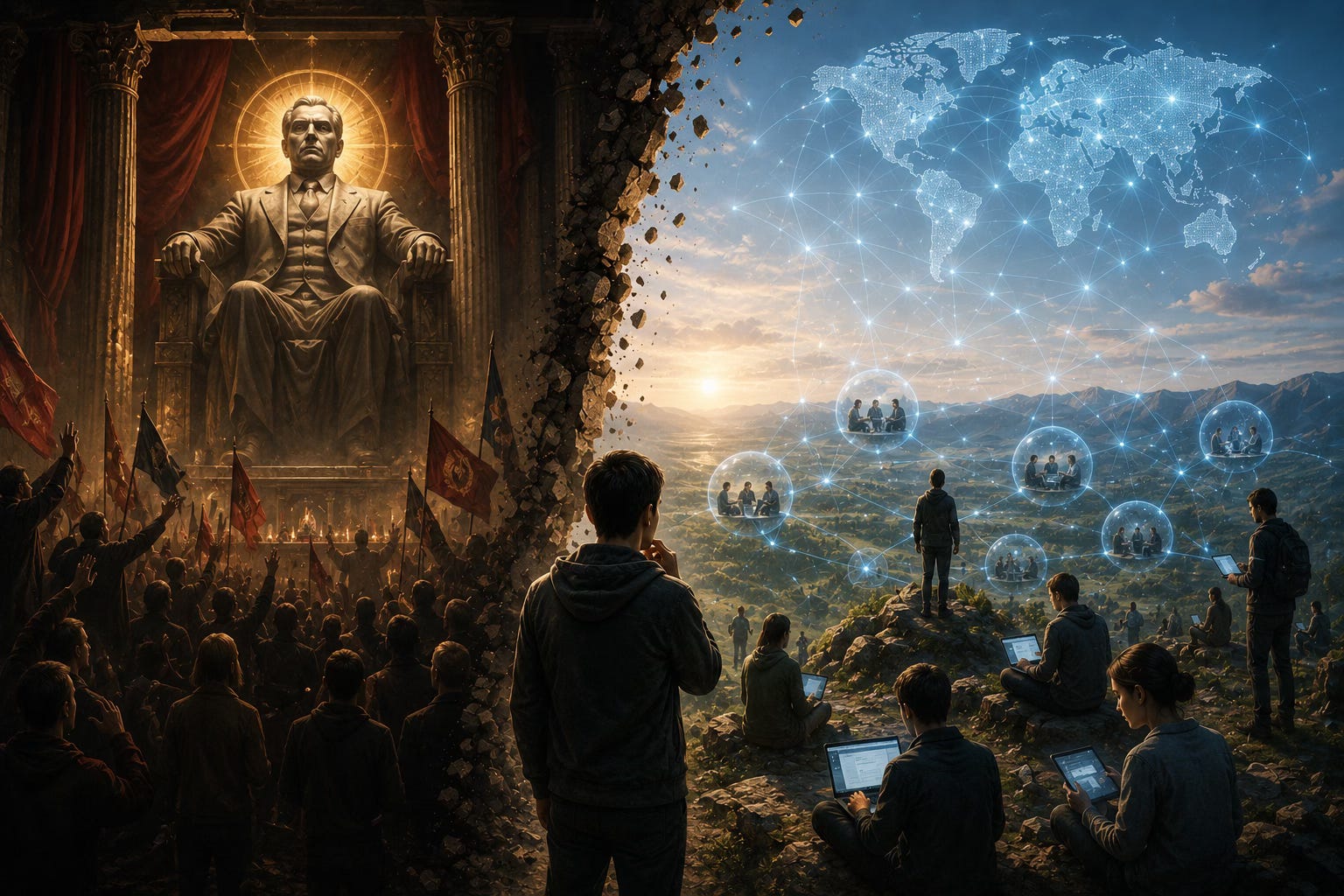
The more patriotic a person is, the more they display a quasi-religious fervor toward what I call the God-State. Like a believer who venerates his own god rather than his neighbor’s, the patriot privileges his own state and political system, the way a Catholic prefers the rituals of Rome to those of Constantinople.
This fervor rests on ignorance of how nation-states were actually built. And whoever doesn’t know the machine was assembled cannot imagine it being disassembled.
They resemble hunter-gatherers confronted with the first farmers: horrified by the inequalities agriculture created, longing for the equality of the old world, unable to see that an irreversible technological change had already made that world impossible.
The Internet, modern transportation, and globalization are doing to nation-states what agriculture did to hunter-gatherers. There is no path back that doesn’t require giving up the technologies themselves.
The denial this produces is easy to spot. It shows up as calls for the state to regulate obviously uncontrollable phenomena: ban the encryption, tax the exiles, stop the internet at the border. Politicians are the purest specimens. They combine maximum nationalist fervor with minimum understanding of the disruption, because acknowledging it would mean acknowledging their own shrinking importance.
Every one of these denials is an opportunity for those who see the machine for what it is.
Nationalism Will Follow Religion
Maybe you are not one of the deniers. Maybe reading this article simply makes you angry, the way watching someone appraise the family church for sale makes you angry.
That reaction comes from a precise place: the homeland is sacred, and any discourse that treats a country as a “jurisdiction” competing in a market of jurisdictions, with citizens as customers free to choose, is sacrilege. It turns the sacred into a commodity. The sacred sometimes deserves to be defended at the cost of one’s life. A commodity, much less so.
I understand that feeling. It is exactly what a medieval Catholic, convinced of papal infallibility and of the unique truth of Catholic dogma, felt when he met his first Protestant. Sacrilege, worth fighting. And fight Europe did: decades of religious wars, millions of dead. The killing only stopped when Protestantism was recognized as an official religion, and later when freedom of worship was established.
Notice what happened next. Religion did not disappear. It privatized. Faith became a personal choice with little consequence for public life, and the institution that once crowned emperors became what the Catholic Church is today: still present, still respected, and a shadow of its former power.
Nationalism will follow the same path. Everyone will remain free to be patriotic toward whichever country, or countries, they choose. But it will be a private matter, detached from any particular territory, and the nation-state will join the Church in graceful semi-retirement.
To be clear: you can love your country of birth and still refuse to be trapped by it. Millions of exiles from communist countries did exactly that for decades. Loving France is not the same as consenting to everything the French state decides.
Expect relapses along the way. Nationalism will flare up here and there, carried by populists elected by desperate populations who cannot understand why everything keeps getting worse, and who fall for impossible promises built on a world that no longer exists. These resurgences will be real, loud, and temporary. A counter-reformation, not a reversal.
The nation was manufactured by five technologies. It is being unmanufactured by one. And in that world:
The more powerless the state becomes, the less useful it is to vote for one political party rather than another, and the more useful it becomes to vote with your feet.
If this article changed how you see your own flag, share it with someone who still believes the flag is eternal. And subscribe to follow how the disruption of nation-states unfolds, and how to position yourself for it :


I would push back on the W3Techs data, because a fair amount of the argument rests on it. That metric counts websites, domains, each weighted the same whether it holds one page or ten million. It does not measure pages published, traffic, time spent, or anything one could call attention.
The absence of Chinese from that top ten should be read as evidence against the metric rather than evidence about Chinese. China is close to a fifth of the world's population with near universal internet access, and most of its content sits inside WeChat, Douyin, Weibo, Bilibili and Zhihu (walled platforms that a domain-level crawler cannot see).
The same distortion applies to Hindi and Arabic, where consumption is overwhelmingly mobile, video and in-app.
As you may know, English proficiency in Thailand is rather low (except for Bangkok, the city you are writing from, which is more cosmopolitan). Most Thai use apps like Facebook, Line, TikTok, Pantip so it would be counted as English based on W3Techs methodology, whereas the content is in Thai and should be counted as Thai.
The number that actually matters is the gap: English accounts for roughly half of websites but only about a quarter of internet users.
That divergence tells you English dominates publication (the open, crawlable, SEO-optimised, machine-translated, commercially-motivated layer of the web) while consumption remains far more fragmented and has been fragmenting further as the major platforms localise.
This matters for the thesis rather than just the footnote. Your argument is a network effect argument: English wins because everyone else is already there. But a network effect operates on where people actually spend their attention, not on where pages are hosted. If the world's largest online populations are conducting their lives in their own languages inside their own platforms, the network is more segmented than the W3Techs chart suggests and the mechanism that is supposed to dissolve national linguistic communities is weaker than you have assumed.
As I see the destructive power of nationalism as one of the major problems that faces humanity, I would love to agree. But while your view makes sense, it does not take into account some rather important aspects.
First, wealth is mostly not digital but material (toilet paper, sewage system, water, food, energy, etc).
Second, wealth is not flow but stocks and stocks need to be built by some organization (or nature). Who will build the public goods on which free enterprise depends if not nation states?
Third, voting with their feet would require a right to migrate, which is not on the horizon in any conceivable way.
Fourth, and most importantly, let us divide the world into two groups, those who have enough assets that they can live a free and secure life protected from upheavals like wars and inflation and shortages etc, and those who dont and who are hit hard each time a natural disaster or a war or an economic recession makes their lives more difficult.
What are the relevant percentages in this world of the owning class and the not-owning class? 10% v 90%, 1% v 99%, 0.1% v 99.9%?
Surely the not-owning class will have to organize to protect themselves. You are writing from the pov of somebody who can protect himself. But who will protect all the members of the not-owning class?
My prediction is that nationalism is on the rise again because the not-owning class has nowhere else to go than to their nation state. And no amount of digital technology will be able to change that.