


On March 6, 2025, Donald Trump signed an executive order forbidding the United States government from ever selling its bitcoin.
Roughly 200,000 coins, worth around $17 billion at the time, were consolidated into a new Treasury account: the Strategic Bitcoin Reserve. They now sit alongside gold, petroleum, and pharmaceuticals. Materials a nation-state stockpiles against catastrophe.
In 2020, this would have read as satire.
The expert consensus back then was clear. Bitcoin would be regulated into irrelevance, banned wherever it mattered, or simply outlived by the sovereign currencies that have run the world since 1971.
Hold on to 1971.
That August, Richard Nixon closed the gold window. The dollar became a pure trust instrument, backed by nothing but the credibility of the United States. It was a colossal bet, and it has held for fifty-four years.
In March 2025, the same government took a quiet step in the opposite direction. It declared a non-state, mathematically scarce asset to be a strategic reserve. It did not say “instead of the dollar.” It did not need to.
Every Leviathan has its native money. The medieval Church ran on indulgences and tithes, paid into a hierarchy that claimed jurisdiction over souls. The modern nation-state runs on fiat currency, printed at will and taxed everywhere, anchored in a monopoly over violence within fixed borders. A new Leviathan is now rising. The one Balaji calls Leviathan-Internet: global, decentralized, native to networks rather than to territories. It is finding its currencies.
A note on who’s writing this. I’m French by birth, based between Bangkok and Dubai, a citizen of Antigua. I left France for the same structural reasons I expect millions of mobile Europeans to act on over the next two decades.
My everyday wallet runs on the Lightning Network. I’ve paid in bitcoin in Próspera Free City in Honduras, in Jericoacoara in Brazil, in San Salvador. Not as a stunt. Because it works.
If you’ve heard Bitcoin payments take ten minutes and cost a fortune, you’re stuck in 2017. Lightning settles transactions in seconds for a few cents. It is as fast as a contactless card. The difference is that no bank, no government, and no payment processor sits between me and the merchant. That is the practical face of Leviathan-Internet’s monetary system. The Strategic Bitcoin Reserve is the political face. Both are accelerating.
Two cryptocurrencies, in my view, are most likely to anchor what comes next: Bitcoin and Ethereum. Each does something the other doesn’t.
If it is true that Leviathan-Internet will gradually prevail, then it will need currencies designed natively for itself rather than for Leviathan-State.
These currencies will take an ever larger share of the economy as the Network and new forms of governance emerge alongside it, which will directly affect their price and the frequency of their use.
I think the two cryptocurrencies most likely to play a major role in the future are:
Note : This article is the 4th article in a series exploring how technology, global mobility, and new power dynamics are set to disrupt nation-states, redefine the global economy, and reinvent governance in the 21st century. Here are the first articles in the series:
Bitcoin
The first cryptocurrency has many strengths that should reinforce its leading position in the years and decades ahead:

An “Immaculate Conception”
Its creator remained anonymous and then disappeared from the community, which gives it a mythical aura and strengthens its prestige and brand.
A Gigantic Network Effect
Because it was the very first cryptocurrency in history, it has had much more time to spread than the others, and it dominates them by a wide margin.
The network effect is a phenomenon in which the value of a product or service increases as more people use it. Imagine a social network: at first, if only a few people are on it, its usefulness is limited.
But as more people join, it becomes more and more valuable because you can interact with a larger number of friends, colleagues, or acquaintances. This effect creates a virtuous circle: the more users there are, the more attractive the product or service becomes to new users, reinforcing the growth and overall value of the network.
This network effect applies fully to cryptocurrencies, and it also has a direct impact on their price: the more users want the same limited number of units of a cryptocurrency (21 million in the case of Bitcoin), the more valuable each unit becomes.
Rapidly Growing Adoption by Major Financial Institutions Since 2024 and the Launch of Spot Bitcoin ETFs in the United States
Since the January 2024 launch of U.S. spot Bitcoin ETFs, institutional adoption has scaled at a pace nobody publicly forecast. Net cumulative inflows passed $53 billion by Q1 2026 — more than triple the $15 billion analysts predicted before launch.
BlackRock's iShares Bitcoin Trust alone manages roughly $54 billion in assets and holds more than 770,000 BTC, making it the largest single Bitcoin investment vehicle in existence. Bitwise projects that in 2026, U.S.-listed Bitcoin ETFs will purchase more than 100% of all new bitcoin issued by miners — a structural supply shortage with no historical precedent.
This adoption by institutional players further legitimizes Bitcoin as a reserve and investment asset, makes it accessible to a broader public, and strengthens its legitimacy in traditional financial markets. This dynamic creates a virtuous circle in which institutional interest boosts the confidence of individual investors, thereby consolidating Bitcoin’s position on the global financial stage.
Today these financial institutions broadly believe that most institutional investors should have 1% of their portfolio in certain cryptocurrencies, in order to diversify their assets and improve returns in a multi-asset portfolio.
Early but Rapidly Growing Corporate Adoption of Bitcoin as a Reserve Asset
Rather than cash, gold, or shares.
The best-known company pursuing this strategy is Strategy (formerly MicroStrategy), which began regularly buying bitcoins in August 2020.
As of April 2026, it holds 815,061 BTC for an aggregate cost of $61.56 billion, an average acquisition cost of $75,527 per coin.
Strategy now controls roughly 3.9% of all bitcoin that will ever exist, and Michael Saylor has publicly committed to reaching one million coins by year-end 2026.
The company added 34,164 BTC in a single week in April 2026 alone — its third-largest single purchase on record.
Other companies are following its example.
Tesla holds 11,509 BTC and has not touched its position in more than three years.
SpaceX holds 8,285 BTC and is reportedly preparing an IPO at a valuation near $2 trillion in mid-2026 — which would make it the largest U.S. IPO in history with bitcoin on its balance sheet.
Block, run by Twitter's creator Jack Dorsey, holds approximately 8,000 BTC.
By mid-2025, more than 140 public companies collectively held nearly 4% of total Bitcoin supply.
If Bitcoin becomes the default corporate reserve asset, that will lead to a massive increase in its use - and in its price.
Tentative but Promising Adoption of Bitcoin as a Reserve Asset by Nation-States for Their Central Banks
At the time of writing, only El Salvador, in Central America, and Bhutan, in Asia, have that strategy.
El Salvador has been buying one bitcoin per day since November 17, 2022, and Bhutan began mining it in 2019 using excess hydroelectric power, investing hundreds of millions of dollars in mining machines.
El Salvador’s experiment shows both faces of the disruption. In January 2025, under IMF pressure tied to a $1.4 billion loan, the Legislative Assembly voted 55-2 to strip Bitcoin of its legal tender status. Merchants are no longer required to accept it; tax payments in BTC are no longer authorized. By every standard reading, this looks like a defeat.
Read structurally, it confirms the thesis. A small state cannot impose a monetary alternative to the dollar while remaining inside the institutional architecture of Leviathan-State — the IMF made that explicit by writing the rollback into the loan conditions. What El Salvador kept is more interesting than what it lost: it kept buying. Holdings reached approximately 6,050 BTC by early 2025, and the strategy has shifted from “retail adoption” to “national reserve”. The legal-tender experiment failed; the treasury experiment is accelerating.
Bhutan tells a more nuanced story. From a peak of roughly 13,000 BTC in October 2024 — built quietly over years through hydropower-backed mining at near-zero marginal cost — its sovereign wealth fund Druk Holding and Investments has sold approximately 70% of its position in 18 months.
Holdings stood near 3,500 BTC by April 2026. The proceeds are funding Gelephu Mindfulness City, a planned special administrative region designed as a regional financial hub.
Bhutan is the only sovereign holder reducing its Bitcoin position in 2026 — but the proceeds are flowing into precisely the kind of jurisdictional experimentation this Substack predicts. The kingdom mined Bitcoin to fund a free-zone, not to hold a balance sheet trophy.
Many countries possess bitcoins following criminal-asset seizures, but most of them sell them relatively quickly after taking possession. I am betting that in a few years this will be seen as deep myopia and a gross mistake.
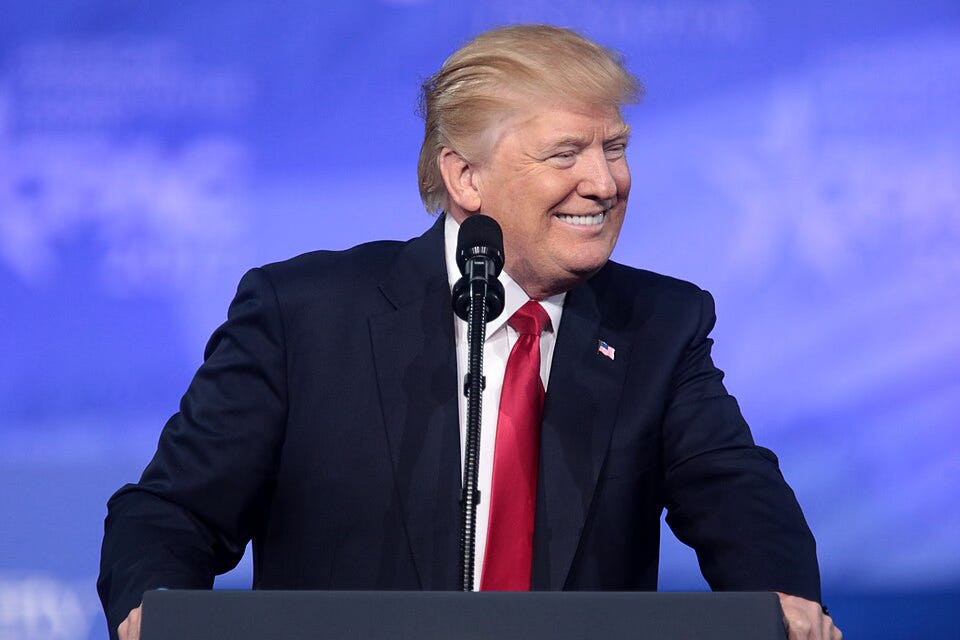
The clearest signal of Bitcoin’s political mainstreaming arrived on March 6, 2025. President Trump signed an executive order establishing a Strategic Bitcoin Reserve at the U.S. Treasury, capitalized with the approximately 200,000 BTC the federal government had accumulated through asset seizures (worth roughly $17 billion at the time of the order).
These coins cannot be sold. They are now treated, in the Order’s own language, as “reserve assets” — alongside gold, petroleum, and pharmaceuticals.
Senator Cynthia Lummis’s BITCOIN Act, currently making its way through Congress, would go further: directing the Treasury to purchase one million bitcoins over five years, equivalent to 5% of total supply and roughly mirroring U.S. gold reserves.
A nation-state holding bitcoin as a sovereign reserve asset, by executive order, in the most powerful country on earth, was not on anyone’s serious 2020 forecast. It is the 2026 baseline.
Growing Acceptance as a Means of Payment Around the World
To the point that there are already areas with circular Bitcoin economies, even if its use as money remains weak compared with fiat currencies.
Circular Bitcoin economy zones are places where enough people and merchants accept Bitcoin that it is no longer necessary to exchange your bitcoins for fiat money in order to live: you can simply spend your bitcoins to buy everything, or almost everything, you need, and sellers can do the same.
I have already had the opportunity to visit two of these places: the Prospera Free City in Honduras and Jericoacoara in Brazil. There are others: Bitcoin Beach in El Salvador, Lugano in Switzerland, Bitcoin Ekasi in South Africa, Bitcoin Jungle in Costa Rica, Bitcoin Lake in Guatemala, the Portuguese island of Madeira, and so on.
And until January 2025, bitcoin was legal tender in El Salvador. The status was rolled back under IMF pressure, but a brief twenty-four-hour visit in early 2025 showed me an impressive number of businesses accepting bitcoin payments — enough to sustain a circular economy whether the law mandated it or not
The scale shift came on November 10, 2025. Square — the payments platform owned by Jack Dorsey’s Block — turned on Bitcoin Payments via the Lightning Network for its four million U.S. merchants. Zero processing fees until 2027, then 1% — well below the 2-3% extracted by card networks.
In March 2026, Square switched the feature from opt-in to opt-out: bitcoin payments are now enabled by default across millions of small businesses.
The “where can I actually spend bitcoin” question, dismissed for a decade as a hobbyist concern, was answered in a single product release. Not by a cypherpunk project. By the same company that processes card payments at half the coffee shops in America.
If you have already heard someone say that bitcoin payments are impossible because they take ten minutes or more to confirm, that simply means the person is stuck in 2017 and has not looked into the matter since then: the creation of the Lightning Network, a Bitcoin layer-2 network, now allows instant payments costing only a few cents in transaction fees. I have personally used it many times in different countries without a problem: the transaction is as fast as a contactless card payment.
In short, my prediction is that Bitcoin has a bright future ahead of it, and that this will accompany the decline of nation-states’ power and the rise of alternative forms of governance.
Risks to Bitcoin
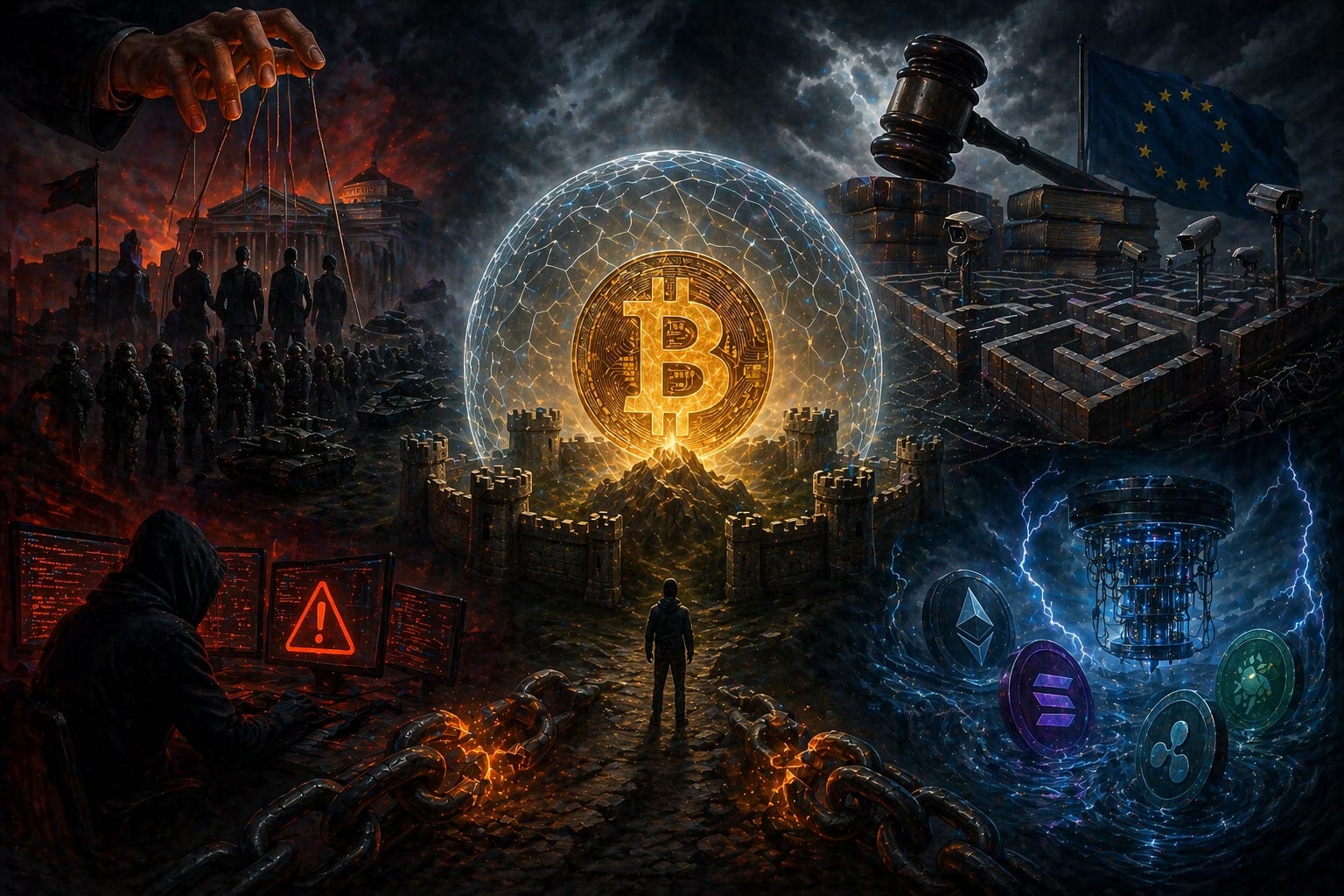
That does not mean there are no risks. We can already discard the threat that for years was seen as one of the greatest: an outright ban by Western democracies. All the elements listed above show that it is far too late for that. Some autocratic countries have already banned it or will do so, which will simply create what always happens when a government bans a product or service for which there is demand: a black market.
We can also dismiss the risk caused by the future invention of quantum computers capable of breaking Bitcoin’s strong cryptography: years before such a machine appears, it will be possible to update Bitcoin’s protocol to protect it against that threat, which even without such an update would be limited.
Here are the main remaining risks:
Capture, in one way or another, by one or more nation-states, which could then strip it of the characteristics they dislike, notably the ability to use it without permission and without prior identification.
Smothering it through regulations, which is a favorite sport of nation-states, especially the European Union, as we saw in this series.
A technological evolution that benefits other cryptos but not Bitcoin, to the point of making it obsolete.
I have little faith in the first two points, for the reasons we saw in this series, but the risk is not zero.
Note, however, that even if those two scenarios occur, that would not affect Bitcoin’s use by traditional institutions. It is simply that network states, free cities, seasteads, and so on would probably use another cryptocurrency as their main currency if such capture took place.
The third point also seems unlikely: although the Bitcoin community is clearly conservative compared with the followers of other cryptocurrencies when it comes to adding new features, Bitcoin has received many new functions since its first version in 2009 and has therefore proved capable of evolving without losing the characteristics that make it strong.
So if major innovations are implemented in other cryptos that expose Bitcoin to a risk of obsolescence, nothing prevents those innovations from being integrated into Bitcoin.
In short, these risks do not change my prediction.
Ethereum
Bitcoin’s main drawback is that, at the time of writing, it is not “Turing complete,” meaning that it is not possible to carry out on the Bitcoin blockchain every operation that can be carried out on a computer.
That seriously limits the possibilities for smart contracts on Bitcoin, which are indispensable for entire swaths of DeFi (decentralized finance).
It was precisely to overcome those limits that Vitalik Buterin invented Ethereum.

Yet Buterin was initially a fervent defender of Bitcoin, even co-founding the famous Bitcoin Magazine in 2011.
In 2013 he tried to convince the developers and the Bitcoin community to evolve it so that it would be compatible with smart contracts, without success.
He therefore decided to solve the problem himself, briefly working on a Bitcoin layer 2 that would allow this functionality, before deciding to create Ethereum.
This cryptocurrency very quickly enjoyed spectacular success, becoming the second-largest by market value and one of the most widely used.
An increasing share of traditional-finance services is already available on Ethereum, most of them fully decentralized and therefore uncensorable:
The possibility of obtaining loans or making loans to earn interest, for example on Aave and Compound.
The possibility of exchanging currencies (tokens) on the Ethereum blockchain for any other token on that blockchain, for example through Uniswap.
Stablecoins, whose purpose is to keep a value identical to the fiat currency they represent. There are centralized stablecoins (with censorship risk, but low risk of decoupling from the currency they represent) such as USDT and USDC, and decentralized ones (without censorship risk, but with a higher risk of decoupling) such as RAI or LUSD.
Decentralized insurance products, such as Nexus Mutual or InsurAce, which allow users to insure themselves against various risks, including smart-contract failures, hacks, or loss of funds in DeFi protocols.
Ethereum also serves as the basis for interesting non-financial decentralized services:
Ethereum Name Service (ENS) allows users to replace long and complex Ethereum addresses with simpler, memorable names, similar to domain names on the Internet.
It can also be used to create a completely uncensorable domain name for a website, because it exists on the Ethereum blockchain.
Used together with IPFS or Arweave, which are decentralized online storage services not tied to Ethereum, it allows the creation of absolutely uncensorable websites.
DAOs (Decentralized Autonomous Organizations), which we discussed in this series and which enable the creation of completely decentralized and anonymous associations and companies, even if that is not their only use.
Prediction markets such as Augur or Polymarket, which we discussed in the previous series.
NFTs (non-fungible tokens), which enable the creation, exchange, and ownership of unique digital goods, whether works of art, music, virtual goods in games, and so on. OpenSea and Rarible are examples of platforms where such transactions take place.
Note that many of these services are extremely useful to Leviathan-Network while disrupting Leviathan-State. They will therefore feed Leviathan-Internet in its battles.
If the thesis of this series is correct, Leviathan-Network will eventually prevail, just as Leviathan-State once prevailed over Leviathan-Church. Today Ethereum is the blockchain best positioned (apart from Bitcoin) to benefit from the rise of the new Leviathan through all the services it provides.
I therefore think there is a good probability that Ethereum is headed for a bright future, though with less certainty than Bitcoin, for a reason I will now explain.
Risks to Ethereum
Just as with Bitcoin, the risk that it will be banned by democratic states, or that it will suffer an attack from a quantum computer before it can be updated to protect itself, is extremely low.
The possible attack vectors are the same as for Bitcoin (capture by one or more nation-states, smothering through regulation, risk of obsolescence), and they are just as unlikely.
Moreover, because the Ethereum community embraces change much faster than the Bitcoin community, there is even less risk that this crypto will one day become obsolete.
So what is this risk that makes Ethereum’s future more uncertain?
Most of its value comes from all the services, financial or otherwise, that exist on top of it.
And why do they exist on Ethereum rather than on Bitcoin?
Because, as we have seen, Bitcoin is not Turing complete: you cannot execute just any smart contract on it. This was a design choice by Satoshi Nakamoto to limit the risks of hacks and software bugs, and that choice was then perpetuated by the Bitcoin community.
However, Ethereum implemented mechanisms to allow the execution of smart contracts while protecting itself against the dangers Nakamoto had anticipated.
Ethereum’s success in this domain therefore raises a question: will the Bitcoin community not one day evolve and accept that Bitcoin should itself become Turing complete?
If that happens, all the services currently used on Ethereum could emerge on Bitcoin. The companies and DAOs that run those services on Ethereum might even be the ones to build them on Bitcoin, thereby accelerating the establishment of the ecosystem.
Now Ethereum does not really have any other advantage over Bitcoin: it too is optimized for security more than for speed, and therefore cannot beat Bitcoin on transaction speed.
So there is a real risk that if this evolution of Bitcoin occurs, it will make Ethereum much less indispensable.
That remains to be seen, however: Ethereum already has a rich ecosystem and a well-developed infrastructure for smart contracts, which gives it a competitive advantage that may be difficult to overcome, even for Bitcoin. And the Bitcoin community has so far shown itself truly reluctant to make it natively compatible with smart contracts.
If Bitcoin never becomes Turing complete, then Ethereum is also headed for a bright future and will probably provide many services to Leviathan-Internet.
If Bitcoin does become Turing complete, that future is less certain, though still possible. Everything will depend on the vitality of Ethereum’s ecosystem, its capacity to innovate and adapt, and the amount of friction involved in launching existing services on Bitcoin.
Monero
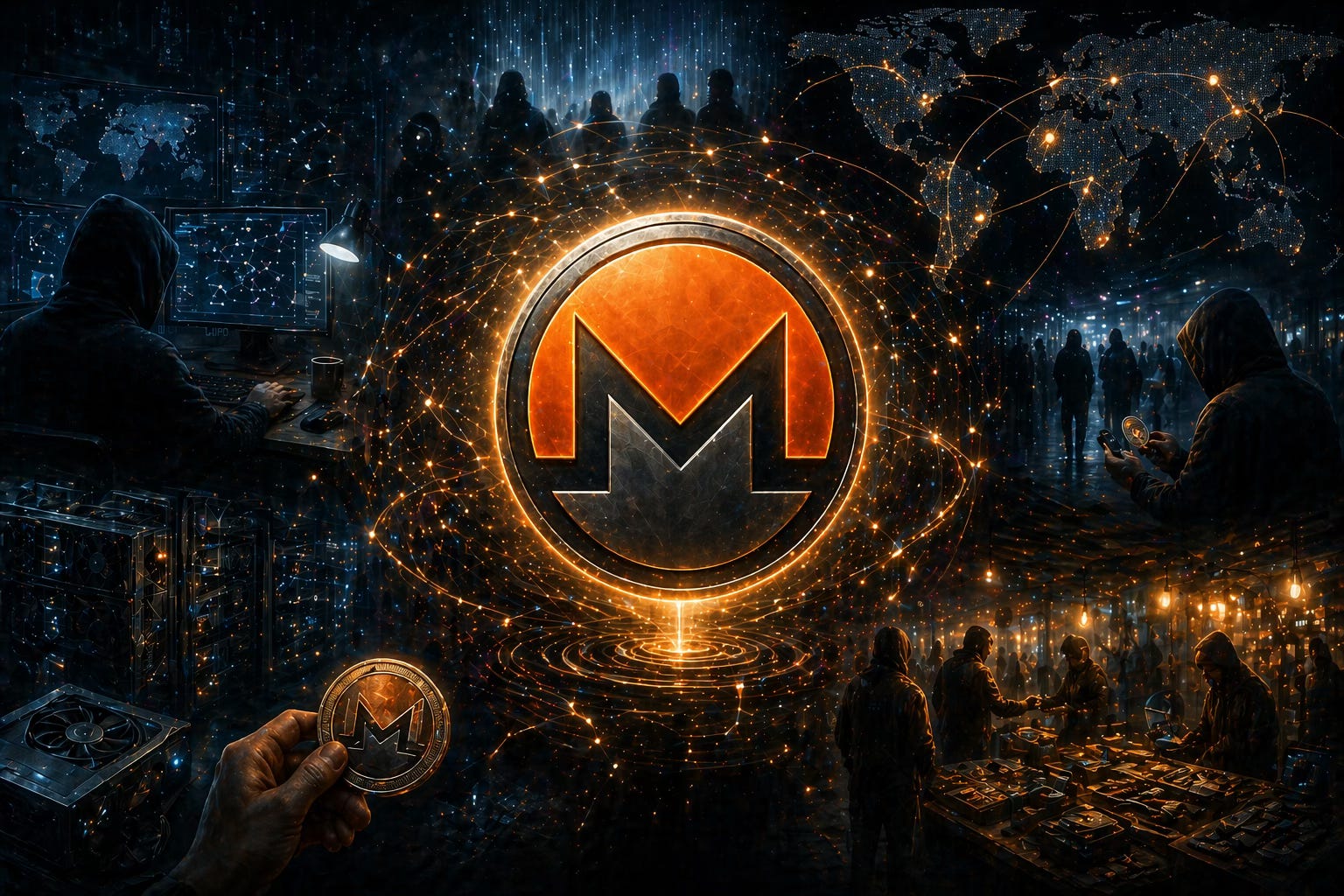
I predict that this cryptocurrency will remain a niche currency, but that it will play an important role in the crypto ecosystem for one reason: it is absolutely untraceable.
It was designed from A to Z to provide maximum privacy for its users, and in such a way that even Homer Simpson could not make a mistake likely to betray his identity while using it.
And its very existence increases the security and privacy of all other cryptos.
How? As I explained in this series, to break the link that allows your bitcoins, your ether, or any other crypto to be identified (after buying them on a centralized exchange, for example), all you have to do is exchange them for Monero, and then exchange them back into the cryptocurrency you first exchanged.
If you wait a bit (a few hours, for example) and make sure not to exchange exactly the same amount back (better to make two or more transactions), then that is it - Monero has abruptly stopped any surveillance.
Example: you buy one bitcoin on a centralized exchange that holds a copy of your passport and your contact details. You send that bitcoin to one of your wallet addresses. The exchange gets hacked, and all customer data ends up on the dark web: identity, postal address, and the crypto addresses used.
Anyone who has access to that data therefore knows that the Bitcoin address at which you received 1 BTC belongs to you, and can monitor how you spend it.
To protect yourself against that, you exchange that bitcoin for its Monero equivalent through a wallet such as Cake Wallet, which offers this option.
The next day, you exchange the Monero amount corresponding to 0.39393 bitcoin through another service than the one you used the previous day (Cake Wallet lets you choose among several). You send those bitcoins to a never-before-used address that belongs to you.
The day after that, you send the rest to another address.
All the hackers can see is that you sent your BTC to a crypto exchange service, but they cannot know 1) which crypto you exchanged it for, and 2) what you did afterward.
If the service that exchanged your BTC for Monero gets hacked, all the attackers will be able to see is that you received Monero, but they will be unable to go any further, because Monero is completely opaque.
After that, it will be possible to see that two exchanges of Monero for bitcoin took place one and then two days later, but it will be impossible to know that they came from the same person who exchanged 1 BTC for Monero a short time earlier.
I do not think, however, that Monero will make a good store of value. So buying it is not really of much interest.
Moreover, you can increase your anonymity without going through Monero by using mixers that combine the crypto of several dozen people to muddy the trail - Wasabi Wallet for Bitcoin, and Tornado Cash on Ethereum, for example (which was briefly sanctioned by the U.S. Treasury before a federal court struck the sanctions down in November 2024).
This crypto is so untraceable that it will probably eventually be banned in most countries. The first step will be to prohibit centralized exchanges from listing it: they have already been forced to delist it in the European Union.
The first move was to force centralized exchanges to delist Monero. By late 2024, this was complete: Kraken delisted XMR across the European Economic Area on October 31, 2024, citing the incoming MiCA regulation; Binance and OKX had already done the same.
The result was the opposite of what regulators intended. Monero reached an all-time high of $470 in November 2025, up roughly 80% on the year, while its mining hashrate hit record levels. Trading shifted to peer-to-peer networks and decentralized exchanges. Pushed off the surveillable rails of centralized exchanges, the asset became more — not less — suited to the use case that prompted the ban in the first place.
But I think Monero will continue to exist: this crypto is simply unstoppable. Miners can use only ordinary computer processors (GPUs are not efficient, and ASICs - specialized machines - are impossible to use), so good luck to the authorities trying to identify them as well: they blend into the mass of ordinary computer users.
It will end up replacing cash and being used to pay for products and services in the many black markets of the world.
Coming soon
In the next article, we will explore the growing trend toward censorship, and how states, faced with increasingly uncontrollable communication technologies, attempt to regain control over narratives, platforms, and the flow of information.
Stay tuned! In the meantime, feel free to follow Disruptive Horizons on X/Twitter, and join the tribe of Intelligent Rebels by subscribing to the newsletter:


