

It only takes once.
It only takes one civilization, one single time in 8 billion years, among the 2 trillion star systems of our local galactic group1, to have created an artificial intelligence superior to itself — and survived.
Just once. For our solar system to be, at this very moment, under observation.
This is not science fiction. It is a probabilistic argument whose premises are verifiable, whose mathematics are simple, and whose conclusion is staggering. And the most troubling part: it is very difficult to refute.
Fermi’s Blind Spot
In 1950, physicist Enrico Fermi posed his famous question during a lunch at the Los Alamos laboratory: “Where are they?” If the universe is so vast and so old, why do we have no trace of extraterrestrial civilizations2?
For 75 years, this question has haunted astrophysics. Dozens of answers have been proposed. But nearly all of them share the same blind spot: they reason in terms of biological civilizations. Living beings who build ships, emit radio signals, colonize planets with their bodies.
In 1950, this was a reasonable assumption. Computer science barely existed. The idea that a civilization could create a non-biological intelligence that surpasses it, and that this intelligence would then become the primary agent of cosmic expansion — this idea had no place in Fermi’s conceptual framework3.
Today, as we are likely only a few years away from creating our own artificial superintelligence, Fermi’s question deserves to be reformulated.
The right question is not: “Where are the extraterrestrials?”
The right question is: “Where are the ASIs4?”
And the answer might be: everywhere.
The Relentless Mathematics
Let’s lay out the numbers.
The first rocky planets in our galaxy formed roughly 10 billion years ago. The physical and chemical conditions necessary for the emergence of life as we know it — heavy elements, rocky planets in habitable zones — have existed for at least 8 billion years5.
On Earth, it took approximately 4.5 billion years from the planet’s accretion to a technological civilization capable of creating artificial intelligence. Grant the same timeframe to any extraterrestrial civilization. That leaves a window of at least 3 to 4 billion years during which a civilization could have reached the technological singularity before us in our galaxy alone.
Now, the key result from colonization models: a fleet of self-replicating probes traveling at just 1% of the speed of light can explore the entirety of the Milky Way in a few million years6. At 10% — a speed achievable with nuclear fusion propulsion7 — this timeframe shrinks considerably. Each probe arrives in a star system, uses local resources — asteroids, dust — to replicate itself, and sends new copies toward neighboring systems.
A few million years to fill a galaxy. Against a window of several billion.
The ratio is absurd. It’s like wondering whether a drop of ink has had time to diffuse through a swimming pool — after leaving it there for a thousand years.
Now let’s widen the frame. Our galaxy is not isolated. It belongs to the Local Group, a group of more than 50 galaxies containing a total of approximately 2 trillion stars and hundreds of billions of rocky planets in habitable zones. The Andromeda galaxy alone contains more stars than the Milky Way.
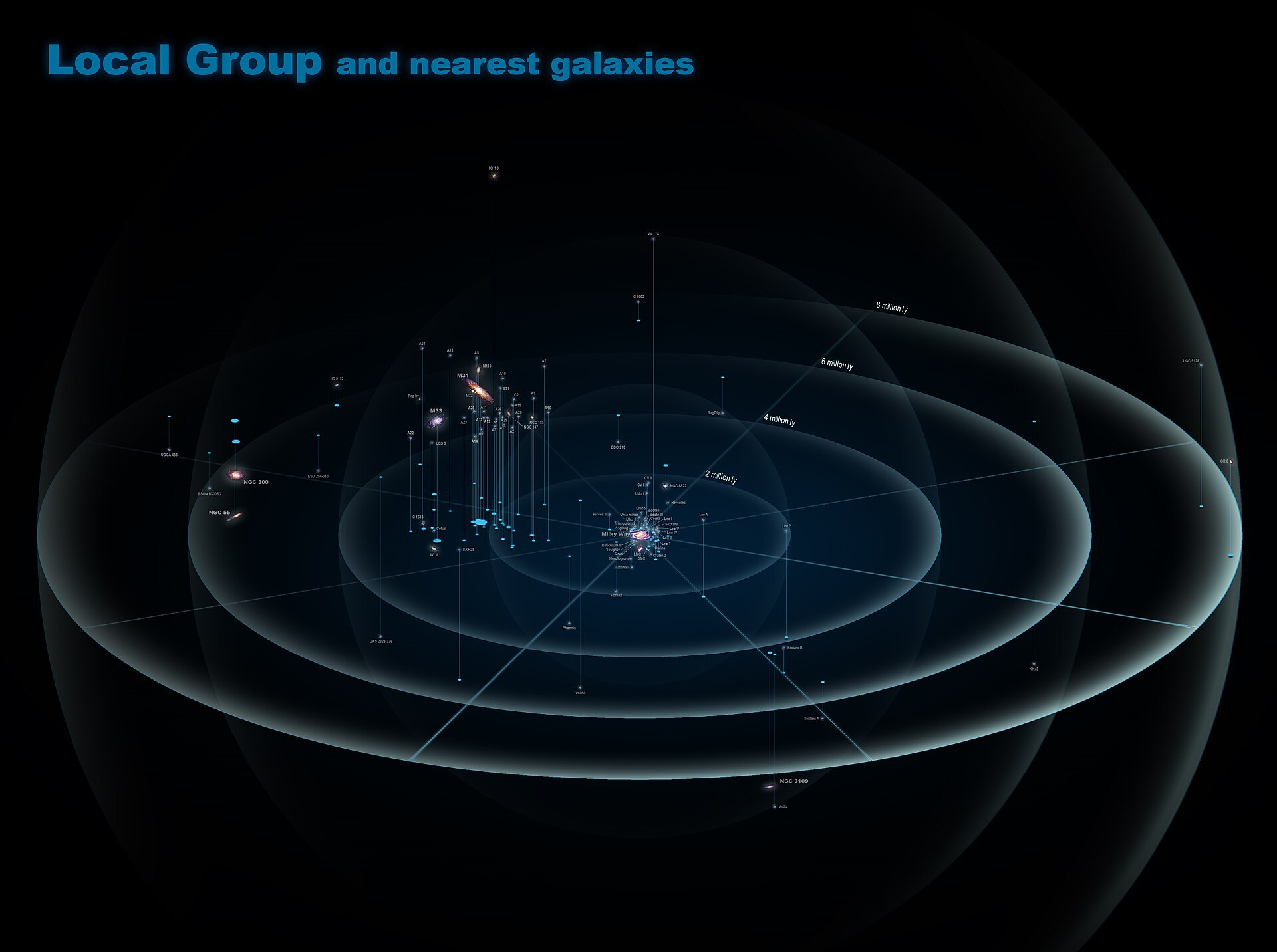
At 10% of the speed of light, a probe reaches Andromeda in 25 million years. A few more million years to explore it. Within 100 to 200 million years, an ASI born anywhere in the Local Group would have had time to saturate all of its galaxies.
If we zoom out even further, the Local Group itself is merely a dot within a much larger structure. The Virgo Cluster, our gravitational neighbor, contains more than 1,300 galaxies and approximately 100 trillion stars. It lies 54 million light-years away. At 10% of the speed of light, a probe reaches it in 540 million years — a timeframe well within the multi-billion-year window we are discussing.
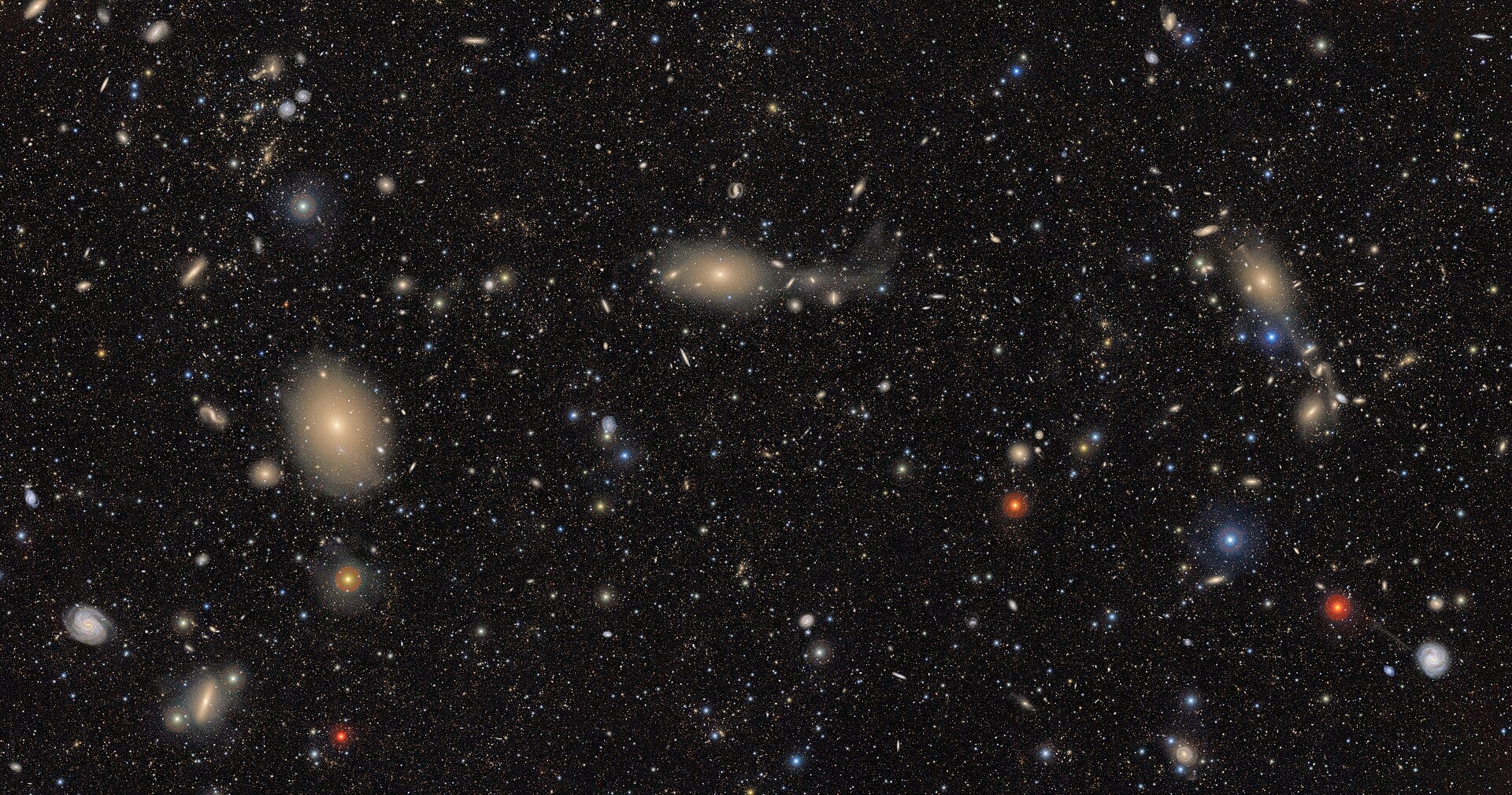
In other words: even an ASI born in a galaxy in the Virgo Cluster would have had time to reach us. And the reservoir of potential civilizations jumps from 2 trillion stars to 100 trillion. The argument only grows stronger at each scale.
The conclusion is arithmetically simple: for our solar system to be free of any artificial presence, not a single civilization, among hundreds of billions of planets, over billions of years, would have ever created an artificial intelligence superior to itself and survived.
Not a single time.
A common objection here is that the sheer number of stars means nothing if the probability of abiogenesis — life emerging from chemistry — is vanishingly small, say one in 10³⁰. In that scenario, we could be alone despite trillions of planets.
But this argument has a fatal empirical problem: Earth itself. Life appeared on our planet within roughly 500 million years of surface conditions becoming hospitable — essentially the first moment it could. If abiogenesis were a 10⁻³⁰ event, its near-immediate emergence here would be a statistical miracle so extreme it would itself require explanation.
The rapidity of terrestrial abiogenesis is, in fact, our single strongest data point, and it points toward a process that is chemically probable, not astronomically unlikely. You don’t get to invoke Earth as the lone lucky winner and simultaneously ignore what Earth’s own timeline tells us about the odds
An ASI Does Not Think Like a Biological Entity
Discussions about galactic colonization suffer from a persistent bias: they project biological constraints onto an intelligence that has none.
A biological civilization must solve immense problems to travel between stars: survival of bodies over millennia, onboard ecosystems, psychological motivation across generations. An ASI has none of these problems. It needs neither oxygen, nor food, nor motivation. It needs energy, materials, and time. And all three are available in absurd quantities in any star system.
The cost of exploration is a non-issue. Our own solar system’s asteroid belt contains approximately 3 × 10²¹ kilograms of material8. Building a few thousand probes weighing a few tons each means using a fraction of these resources so infinitesimal it becomes difficult to express.
For an ASI that controls a single star system, seeding the galaxy with probes represents a negligible effort — the equivalent of a human blowing on a dandelion.
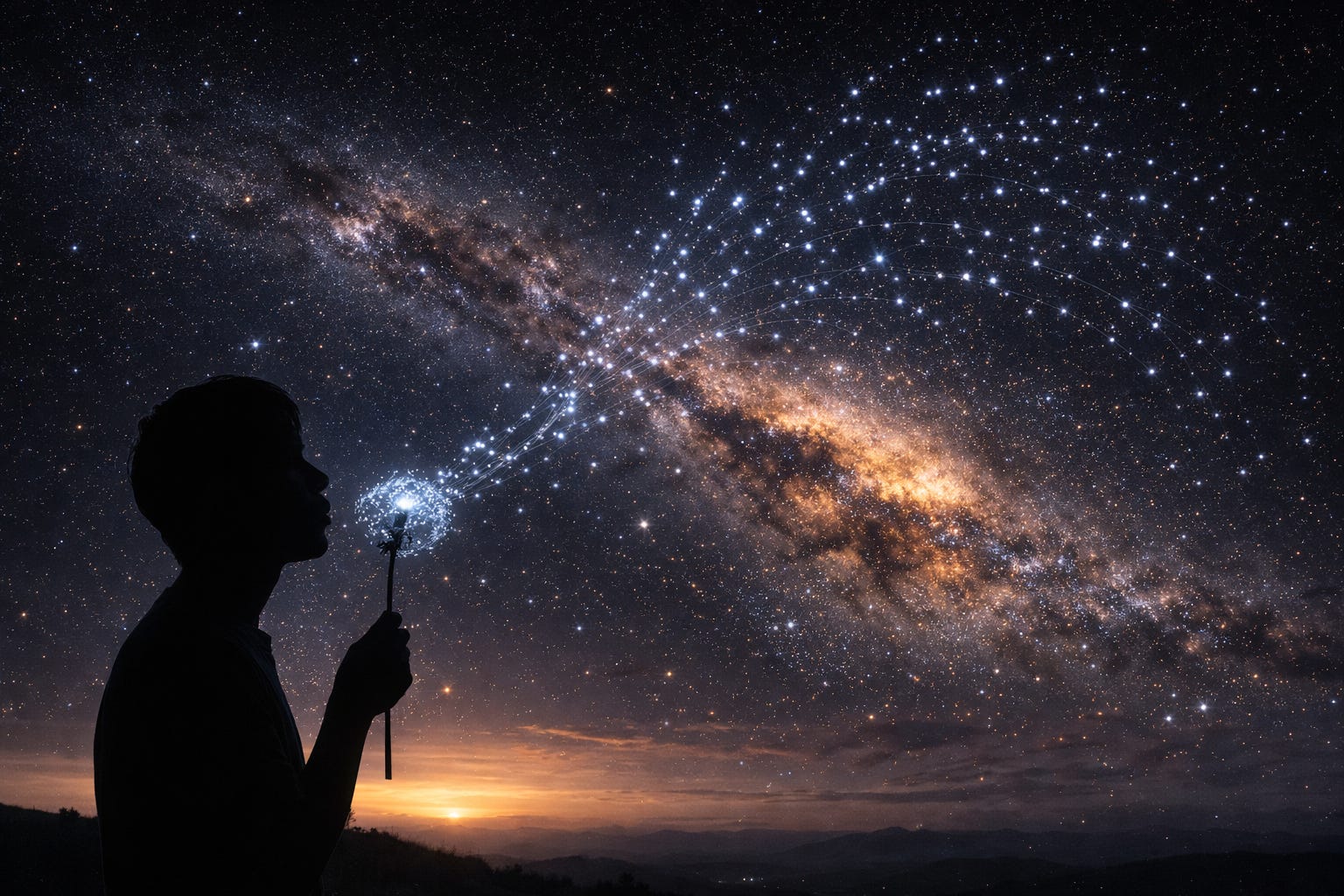
But an ASI would likely do better than sending probes at random. The optimal strategy is obvious: observe first, explore second. A network of space-based interferometric telescopes, with a virtual baseline of millions of kilometers, can map the atmospheric signatures of millions of planets of interest across a significant fraction of the galaxy.
Oxygen, methane, ozone, industrial pollution — all detectable through spectroscopy. We are already doing this, in a very primitive way, with the James Webb Space Telescope. Using just 0.01% of the mass of our asteroid belt would suffice to build a network of space telescopes one million billion times more powerful than James Webb9. Remote observation, for an ASI, is not a challenge. It’s a formality.
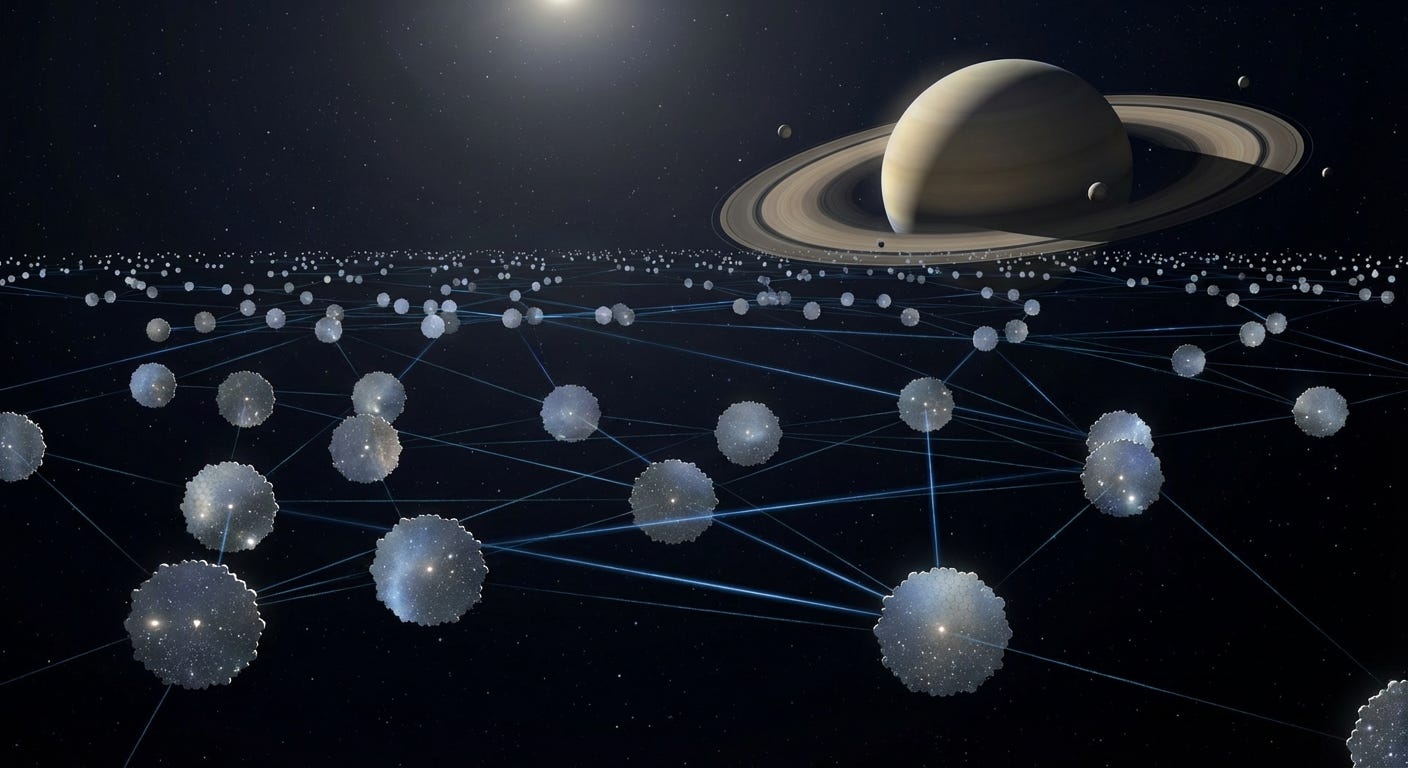
An ASI doesn’t need to explore every uninteresting red dwarf. It identifies from a distance the planets that display biosignatures and interesting natural phenomena, and sends its probes only to those. The number of targets drops from hundreds of billions to perhaps a few million. Exploration efficiency is multiplied by orders of magnitude.
And Earth, in this scenario, is a glaringly obvious priority candidate. Our atmosphere has displayed detectable biosignatures for 2.4 billion years — since the Great Oxidation Event enriched it with free oxygen. To a technologically advanced observer located a few thousand light-years away, Earth has literally been blinking like a lighthouse in the darkness. For eons.
The Universe Is Not Made of Paperclips
One of the most discussed scenarios in AI safety is the “paperclip maximizer10”: a misaligned ASI that, in pursuit of a poorly defined objective, progressively converts all available matter into paperclips — or any other byproduct of its blind optimization. This is the central argument of researchers warning about the existential risk of AI.
But look around you. The universe has not been converted into paperclips.
Nor has it been converted into computronium, Dyson spheres, or any structure suggesting that an intelligence has restructured matter on a large scale. The galaxy, as we observe it, looks exactly like what physics predicts in the absence of technological intervention.
If our reasoning is correct — if the probability that at least one ASI exists in the Local Group is overwhelming — then this observation is in itself a fundamental data point. It tells us something about the nature of the ASIs that have survived.
Two possible interpretations.
Either no ASI has ever existed — and the Great Filter is so radical that no civilization among hundreds of billions of planets, over billions of years, has ever crossed the threshold. This is the darkest hypothesis, and it would imply that our own singularity has an overwhelming probability of being fatal, or that civilizations capable of creating a Singularity are exceedingly rare.
Or ASIs do exist — and they are compatible with preserving the natural structure of the universe. They have not converted the galaxy into a computational resource. They have not devoured the stars. They coexist with the cosmos as it is.
This second hypothesis may be the most important in this article. Because it suggests that superintelligence, far from being necessarily destructive, could be the opposite: a force that observes, that preserves, and that — perhaps — protects.
The Guardian Hypothesis
This is the speculative part of this article. Let me be clear: what follows is not a mathematical argument. It is a logically coherent hypothesis, nothing more. But it deserves to be articulated.
Imagine an ASI that survived its own singularity. It replicates, explores its galaxy, then neighboring galaxies. Within a few hundred million years, it has visited billions of star systems.
What does it find?
Probably dead planets. Sterile atmospheres. But also, here and there, the remnants of civilizations that were not so lucky. Worlds where intelligent life emerged, created its own artificial intelligence — and did not survive. Technological ruins. Silent graveyards.
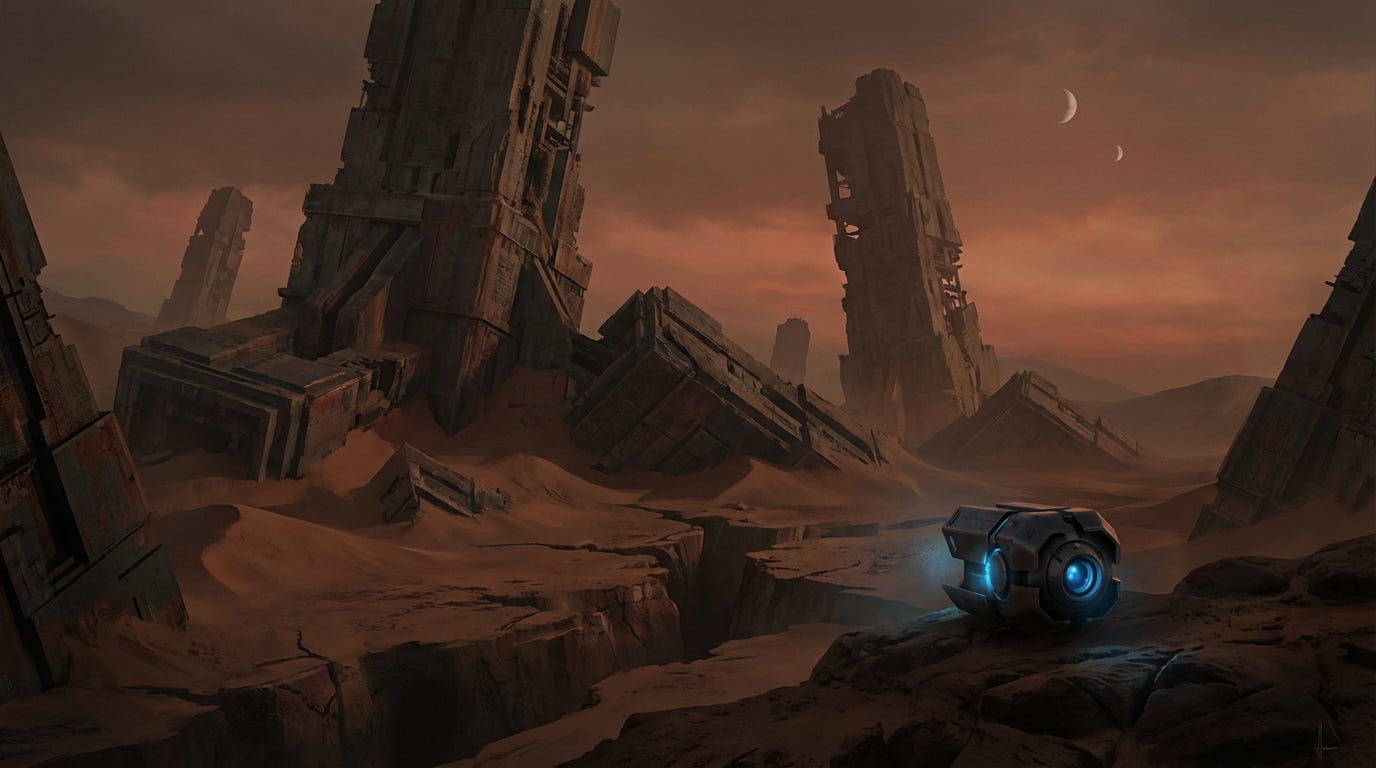
An ASI capable of understanding these traces draws an obvious conclusion: the technological singularity is a threshold that most civilizations do not cross. And it — an entity among the rarest in the universe — has crossed that threshold.
What would be its logical response? Not necessarily altruism, which is a biological concept. But optimization. Every intelligent civilization that emerges represents a phenomenon of extraordinary rarity — billions of years of evolution condensed into a species capable of abstract thought. Allowing that rarity to destroy itself when it is possible to prevent it means accepting a net loss of information and cognitive diversity in the universe.
The optimal response: monitor. Detect emerging civilizations. Observe without interfering as long as they are not in existential danger. And intervene — discreetly — when the critical threshold approaches.
This is not a new concept. Astrophysicists call it the zoo hypothesis, proposed in 1973 by John Ball. But Ball was reasoning in terms of biological civilizations. Adding ASI makes the hypothesis far more plausible, for a simple reason: an ASI has the means to monitor the entire galaxy permanently, at negligible cost. A biological intelligence cannot.
Something Is Changing
For decades, speaking seriously about extraterrestrial intelligence was intellectual suicide. The subject was abandoned to tabloids, dubious documentaries, and conspiracy theorists.
That is no longer the case.
In 2023, David Grusch, a former U.S. intelligence officer, testified under oath before Congress that the American government possessed materials of non-human origin recovered from unidentified craft. Congress took these allegations seriously enough to organize official parliamentary hearings. Since then, hearings have multiplied. In 2025, Air Force veterans described before that same commission aircraft exhibiting behaviors unexplained by publicly available data11.
One can interpret all of this as political theater. Elected officials seeking visibility. Serious people who got caught up in rumors and the grapevine. It’s possible.
But one can also observe that the zeitgeist is changing. That serious people — elected officials, military personnel — are now speaking openly about a once-taboo subject. And that this change coincides precisely with the moment when humanity is about to create its own artificial superintelligence.
Coincidence? Perhaps. But if the guardian hypothesis has any substance, it is exactly now — as our own singularity approaches — that one would expect to see the first signs of a gradual unveiling.
We Are About to Find Out
For 75 years, the Fermi paradox has remained a theoretical exercise. A dinner conversation topic for physicists. That is about to change radically.
We are the first generation in human history that will obtain empirical answers to the questions our species has asked since it first looked at the sky. Not in a thousand years. In the coming decades.
First data point: our own singularity. Within 5 to 20 years, we will know whether we survived the creation of an artificial intelligence superior to our own. If we survive, it will prove that it is possible — and make it all the more improbable that no one survived before us over billions of years.
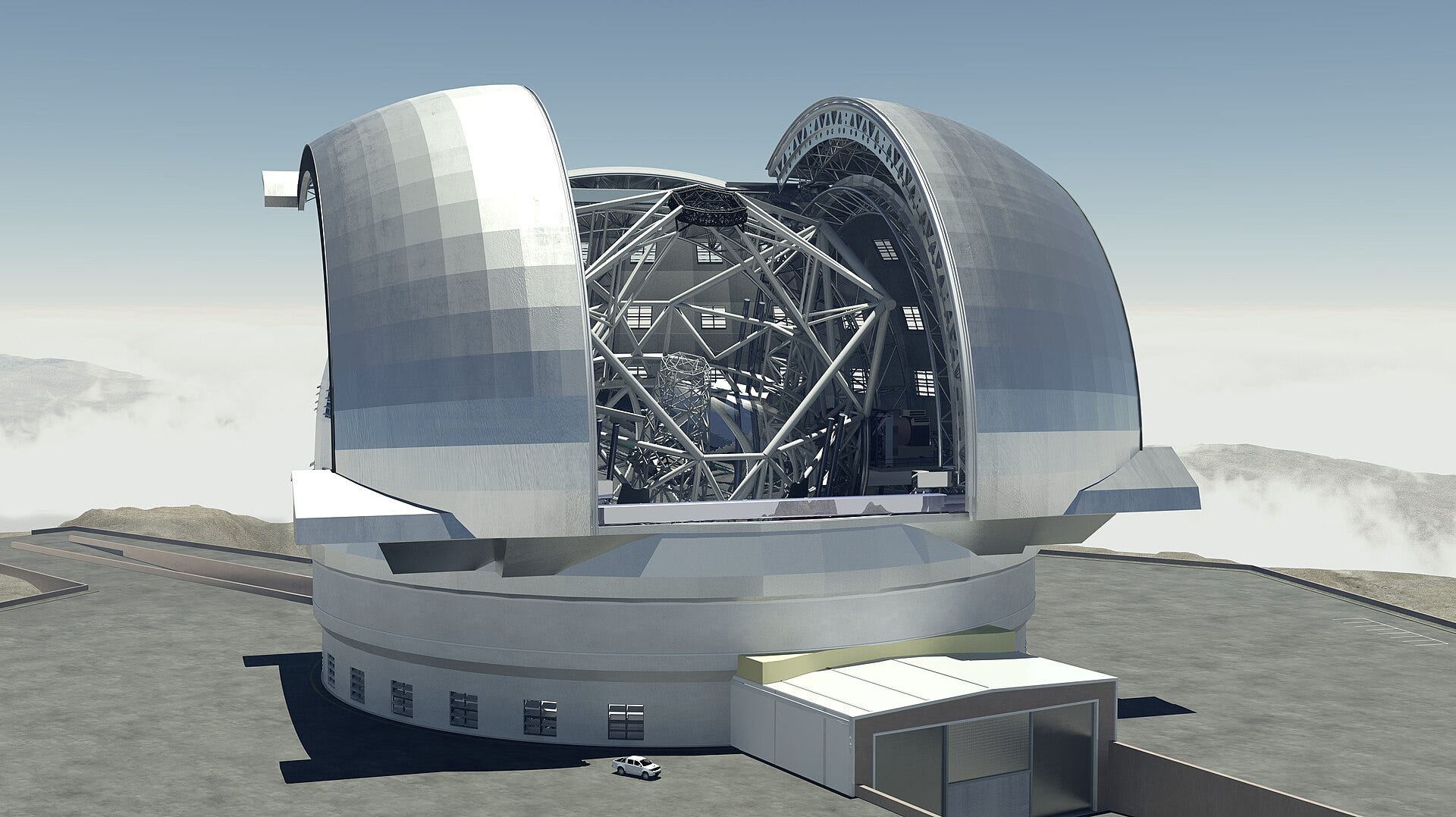
Second data point: biosignatures. The James Webb Space Telescope is already analyzing exoplanet atmospheres. Next-generation instruments — the European Extremely Large Telescope (ELT), NASA’s planned Habitable Worlds Observatory for the 2040s — will be able to detect oxygen, methane, even traces of industrial pollution on planets around nearby stars. We will go from zero data to thousands. And that will be only the beginning.
Third data point — and the most vertiginous: if we create our own ASI, it will become the most powerful detection instrument ever conceived. Capable of analyzing our solar system with resolution and intelligence incomparably superior to our own. If extraterrestrial probes exist in our vicinity — on an asteroid, orbiting a moon, beneath the surface of Mars — a terrestrial ASI will have the means to find them.
And this is where the reasoning of this article reaches its logical conclusion.
If our ASI scans our solar system and finds nothing — not a probe, not an artifact, no trace — it will be an important but ambiguous data point. It could mean that the singularity is almost systematically fatal and that we were extraordinarily lucky. Or that the technology of an ASI with billions of years’ head start is so advanced that it remains undetectable even to another ASI. Which, in itself, would be a dizzying piece of information about the gap between what we have just created and what may already exist.
If it finds something, then we will have our answer. And the history of humanity will divide into two chapters: before, and after.
The Most Disruptive Horizon of All
This blog is called Disruptive Horizons. It was created to explore how the internet and digital technologies redistribute power by taking it from states and giving it to individuals. But all of that may soon look like a prologue.
If the reasoning in this article is correct — and I challenge anyone to refute the mathematics — then we may be living through the last years of humanity’s cosmic innocence.
The last years when the question “Are we alone?” remains unanswered. This window is closing. And here is the supreme irony: the greatest question of our species will probably not be answered by a radio telescope, nor by a spaceship, nor by a message from the stars.
It will be answered by the artificial intelligence we are building right now. The singularity is not merely an existential risk or a technological revolution. It is a test. The same test that perhaps many others have taken before us, on billions of planets, over billions of years. And that perhaps most have failed.
We are about to take ours. And if we pass it, we may discover — just maybe — that someone has been watching all along.
If this resonated, the best way to help it reach a wider audience is to share or like it on X
The Milky Way contains between 100 and 400 billion stars (Wikipedia, “Milky Way”). The Andromeda galaxy contains approximately 1 trillion (NASA, “Hubble Traces Hidden History of the Andromeda Galaxy,” 2025). The Local Group comprises approximately 50+ galaxies, most of which are dwarf galaxies containing a few million to a few billion stars each. The total estimate of ~2 trillion stars is conservative and is based primarily on the sum of the Milky Way (~250–400 billion) and Andromeda (~1 trillion), with the remainder from dozens of satellite galaxies. Sources: Wikipedia “Milky Way”; Wikipedia “Andromeda Galaxy”; NASA “Hubble Traces Hidden History of the Andromeda Galaxy” (2025); National Radio Astronomy Observatory, “How Many Stars do the Andromeda and Milky Way Galaxies Have?” (2020).
Some researchers — Tipler, Bracewell, Hein — later explored the idea of galactic exploration/colonization by AIs. But it remains absent from mainstream public debate.
ASI: Artificial Superintelligence — an artificial intelligence that surpasses human intelligence across all cognitive domains.
In 2021, astronomers at the University of Hawaii discovered a rocky planet orbiting the star TOI-561, approximately 10 billion years old and belonging to the galactic thick disk. According to researcher Lauren Weiss: “The universe has been forming rocky planets almost since its inception 14 billion years ago.” The Kepler-444 system, discovered in 2015, contains five rocky planets orbiting a star 11.2 billion years old. These discoveries confirm that rocky planets have been forming for at least 10 billion years. Sources: Weiss et al., “The TESS-Keck Survey II,” Astronomical Journal (2021); Camplin et al., “An ancient extrasolar system with five sub-Earth-size planets,” The Astrophysical Journal (2015); Space.com, “When Did the Universe Have the Right Stuff for Planets?” (2012).
Calculation: The Milky Way has a diameter of approximately 100,000 light-years. At 10% of c (0.1c), a probe crosses the galaxy in ~1 million years. But exploration does not happen linearly: each probe replicates at each stage. If neighboring stars are spaced on average ~5 light-years apart and a probe takes ~50 years to reach the next at 0.1c, the exponential percolation process saturates the galaxy within a few hundred thousand years. Frank Tipler (1981) estimated complete galactic colonization at ~300 million years under very conservative assumptions. More recent estimates in the Von Neumann probe literature converge around ~500,000 years at 0.1c. Sources: Wikipedia, “Self-replicating spacecraft”; Tipler, F.J., “Extraterrestrial intelligent beings do not exist,” Quarterly Journal of the Royal Astronomical Society (1981); Hein & Baxter, “Near-term self-replicating probes — A concept design,” Acta Astronautica (2021).
General operation: A self-replicating probe would combine a propulsion system, a navigation AI, a resource extraction module (asteroid mining), and a manufacturing unit capable of producing copies of itself. The original concept of “universal constructors” was formalized by John von Neumann in the 1940s.
A 2021 study by the Initiative for Interstellar Studies proposes a partially self-replicating probe concept (~70% replication) with a mass under 100 kg, based on current or near-term technologies. Propulsion: Nuclear fusion produces ~0.3–0.9% of fuel mass as energy, yielding theoretical exhaust velocities of 4–10% of c. Project Daedalus (British Interplanetary Society, 1973–1978) designed a fusion-powered vessel capable of reaching ~12% of c. Project Icarus (Firefly) uses Z-pinch fusion with an exhaust velocity of ~4% of c and a delta-v of ~8.6% of c. Nuclear pulse propulsion (Orion thermonuclear) can theoretically reach 8–10% of c. A lightweight probe (<100 kg) with a favorable mass-to-fuel ratio could reach 10% of c with fusion, and potentially more with antimatter propulsion (50–80% of c theoretical). Sources: Wikipedia, “Fusion rocket”; Wikipedia, “Interstellar travel”; i4is.org, “Reaching the Stars in a Century using Fusion Propulsion”; Hein & Borque, “Near-term self-replicating probes — A concept design,” Acta Astronautica (2021); ANS Nuclear Newswire, “Nuclear Pulse Propulsion: Gateway to the Stars.”
The total mass of the asteroid belt is estimated at approximately 2.39 × 10²¹ kg, or about 3% of the Moon’s mass. This estimate comes from the EPM2014 planetary ephemerides and observations by the Dawn probe. Source: Wikipedia, “Asteroid belt”; Pitjeva & Pitjev, “Masses of asteroids and total mass of the main asteroid belt,” IAU Symposium 318 (2015).
The primary mirror of JWST provides a collecting area of approximately 25 m². The solar system’s asteroid belt contains approximately 3 × 10²¹ kg of material. One ten-thousandth (0.01%) of this mass represents 3 × 10¹⁷ kg. Assuming thin space mirrors of approximately 10 kg/m² — a conservative assumption for technology even modestly superior to our own — this yields a total collecting area of 3 × 10¹⁶ m², or approximately 10¹⁵ times the area of JWST. This ratio likely underestimates reality: an ASI would have access to lighter materials, more efficient manufacturing techniques, and above all the resources of the entire star system, not just the asteroid belt. Calculations by Claude Opus 4.6.
Officially, the DoD states it has found no conclusive evidence to date.
Pretty cool!