


The man who predicted the death of nation-states married the most voracious one of them all. Why ?
In 2021, Tomas Pueyo published “Internet and Blockchain Will Kill Nation-States.” That same year, he became an American citizen. He already had French and Spanish passports. The one he added is the passport that follows you everywhere with a tax return attached.
So I asked him whether he would do it again. His answer: “I think so, but I’m really not sure.”
Now, Tomas is not some random contrarian. In March 2020, with no editor and no newspaper behind him, Tomas wrote “Coronavirus: Why You Must Act Now,” and it was read more than 40 million times. He is living proof of his own thesis: the internet broke the gatekeepers of information, and the institutions built on controlling it are next.
I’m the other piece of evidence. I left France 11 years ago, I carry an Antiguan passport, and I wrote a book on the same intuition (Not Everyone Will Get to Leave Their Country, in French for now). Tomas and I agree on about 95% of the diagnosis. This conversation is about the other 5%, and that 5% is about your money.
Where we disagree
Tomas thinks that around 2036, with deficits at 10% of GDP and interest rates at 7 to 8%, Europe’s big countries will team up to tax the people who left. France can’t do it alone. The whole EU could.
I don’t think they’ll get there. In the EU, every tax decision needs the agreement of all 27 member states, and changing that rule also takes all 27. A single veto, from Ireland or Luxembourg say, kills it.
My bet is that the eurozone breaks first: the frugal north will refuse to pay for the south’s debts, and the EU will end up as a Russian doll, a core with looser circles around it. I suggested we meet again in 2040 to see which of us got it wrong.
Then Tomas took his scenario to its end: refuse to pay the tax, and the EU stops letting you back in and bans any company operating in Europe from serving you.
Suppose I lose that bet. If keeping my French citizenship means paying a tax I consider confiscatory wherever I live, I’ll give it up and keep my Antiguan passport.
Tomas pushed me one step further. What if the EU then barred me from coming back, even for a visit, and forbade any company doing business there from serving me abroad?
Neither of us thinks that’s likely. I put it under 5%. But a small risk with a catastrophic outcome is worth insuring against.
I suggested we meet again in 2040 and see how our bets aged.
How to watch it in English
Watch the video above, or click here to see it on Youtube.
The conversation is in French, with full English subtitles. YouTube doesn’t always switch them on by itself:
On a computer: click CC at the bottom of the player. If the subtitles come up in French, click the gear icon, then Subtitles/CC, then English.
In the YouTube app: tap the video, then the gear icon, then Captions, and pick English.
There is no English audio track. YouTube won’t auto-dub a video this long.
If you’d rather read than watch, the full English transcript, with timestamps, comes right after the summary below.
Summary
0:00:52 How one blog post beat the gatekeepers.
Tomas explains how his Covid essays spread with no media behind them. Then he goes back through history: communication technology shapes what kind of politics is possible.
Writing made kingdoms possible, because armies and taxes need bookkeeping.
The printing press let the Reformation succeed where earlier movements like the Hussites had been crushed.
Radio, which could spread emotion at near-zero cost, fed the totalitarian regimes of the 1920s and 1930s.
His conclusion: “The democracies we know today won’t exist in 50 years, because of the internet.”
0:11:27 What The Sovereign Individual got right in 1997.
Its key insight was that the internet removes the gatekeepers. It foresaw a currency no central authority controls, and a market in which mobile people shop for jurisdictions.
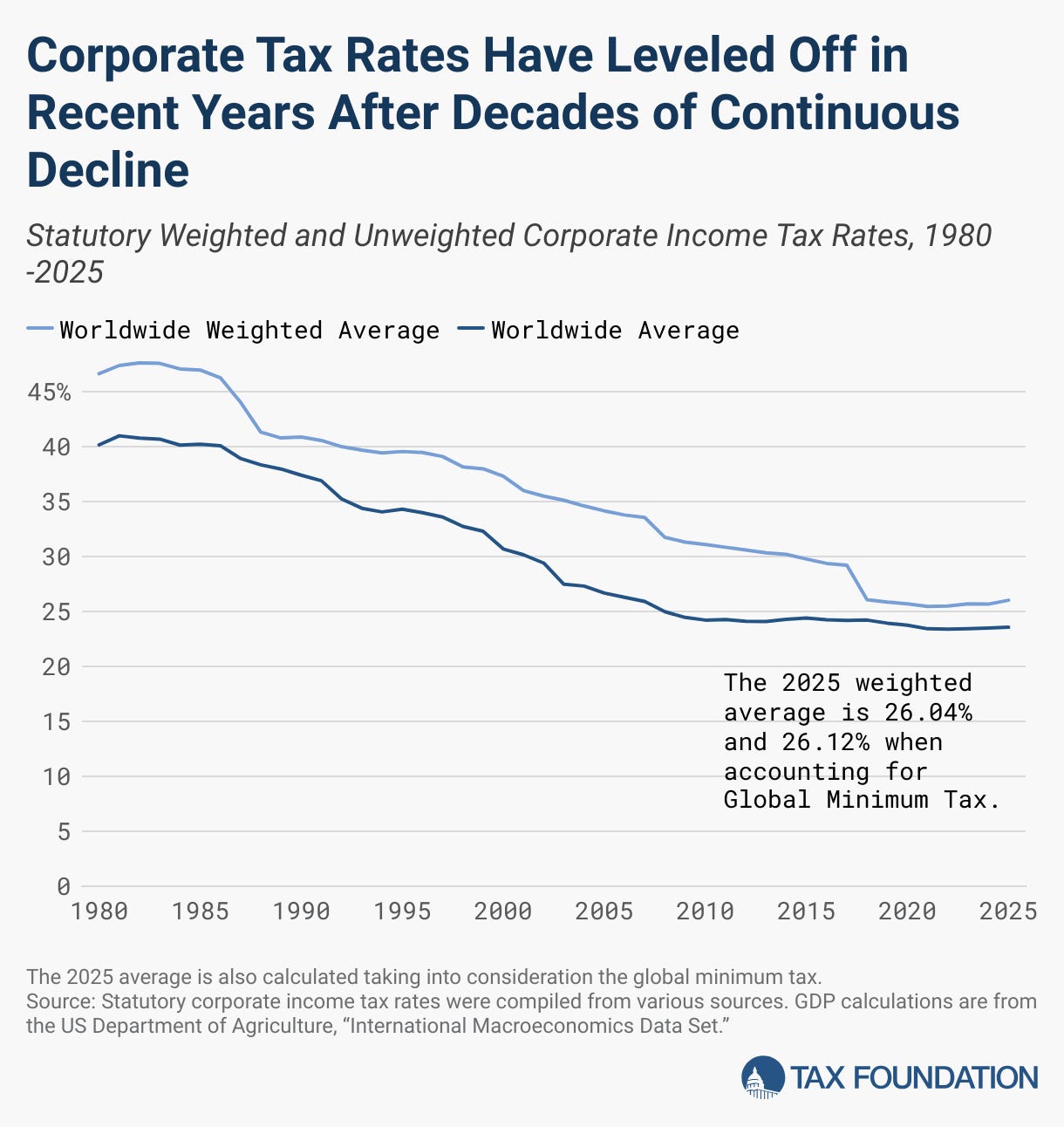
The problem : there was no data. Everything was based on “trust me bro”. So I looked at the numbers myself for my book, and found that the authors were mostly right : the average corporate tax rate has roughly halved since 1980, yet the total tax burden in OECD countries went up. States shifted to taxes people don’t see: payroll contributions and VAT. What the authors missed was China, a state that tamed the network and turned it into an all-seeing eye.
0:19:20 Nations are a recent invention.
Benedict Anderson called nations “imagined communities.” Napoleon’s conscript armies showed the rest of Europe what a nation could do, and Germany responded by designing one deliberately, through schools and a national canon. Tomas points out that only about thirty of today’s countries existed in 1800.
The internet breaks the state’s grip on information and education, and English plus machine translation weakens national languages. Tomas is his own example: he grew up speaking Spanish and French, and now he thinks in English.
0:31:29 Censorship, then and now.
The EU’s fight against “disinformation” looks a lot like the Church trying to license printers. Back then, the escape route was printing in Amsterdam or Geneva, as Voltaire did. The Ottomans banned the printing press and paid for it with their decline.
China chose a smarter route: allow the technology, censor the content. Tomas argues that Chinese AI models may be censored on fewer topics than Western ones. I think the two simply censor different things.
0:42:21 AI: a weapon for the Leviathan or for the individual?
AI will give states near-perfect financial surveillance. Tomas ties this to legibility, a state’s ability to see who has what:
Egypt, where the Nile made every harvest visible, became a centralized kingdom. Anatolia, where the rain changes from one valley to the next, never did.
Surnames were invented so states could tax and conscript people.
My point is that this power stops at the border. Tomas’s answer: “That control extends wherever the passport goes.”
0:47:58 Why Tomas became American.
Abroad, he only pays US federal tax, the first $130,000 or so of earned income is exempt, and the rest is offset by the taxes he pays where he lives. He sees the US passport as insurance against a world war: two oceans, a Constitution, and the hardest country on Earth to invade.
I call citizenship-based taxation neo-serfdom. Filing alone costs him more than a full work week a year.
Then he turned the question on me: what if France taxed you by citizenship? I walked through the 92-page report the French National Assembly published in 2019, which concluded that France can’t copy the American system:
it would have to renegotiate around 130 tax treaties;
it has no FATCA to force foreign banks to report;
EU law protects free movement;
taxing people who no longer use your services is hard to justify.
0:57:53 Scenario: 2036.
I can see why Paris would try. Imagine telling French retirees you’re cutting their pensions when you could send a tax bill to people like me who left France years ago.
Where Tomas and I disagree is whether Paris could get the rest of Europe on board.
An EU-wide tax on citizens living abroad would need every member government’s approval. Ireland or Malta alone could block it. My bet is that the eurozone is more likely to split over how much of the south’s debt northern voters are willing to cover than the EU is to agree on that tax.
And if Tomas is right? If the price of keeping my French citizenship is a tax I consider confiscatory wherever I live, I’d give it up. I already have an Antiguan passport.
1:29:34 Bitcoin is gold, stablecoins are silver.
Tomas’s frame: gold stores value, silver had to stay stable so people could trade with it. Bitcoin is too strange for most people. Stablecoins win because they look familiar: “it’s a dollar, but you can have it anywhere.”
I argue that stablecoins are doing to national currencies what the internet did to local newspapers, ending their territorial monopoly. We disagree on whether an algorithmic stablecoin can work after Terra Luna.
1:42:13 Who takes over when the state shrinks?
Tomas splits what the state does into two kinds of services:
Defense, police and justice are tied to territory, so they stay geographic.
Redistribution is tied to the nation, and it can move. Health insurance could be pooled among people who share your values, wherever they live.
Dubai already works this way for non-citizens: a strong core state and almost no redistribution.
1:47:08 Network School, from the inside.
This was Tomas’s fourth stay, this time with his wife and four kids: $3,000 for the whole month for six people, on a half-empty artificial island 45 minutes from Singapore.
Then he tells the summer’s drama:
During Malaysia’s election season, an Instagram campaign accused Network School of being a Zionist pseudo-state.
Immigration officers checked everyone’s passports.
Balaji escalated publicly, and the government found a missing permit and shut the school down.
The same day, Balaji announced a deal with Kazakhstan.
Tomas reads it as a calculated bet: a smaller community now, in exchange for real jurisdictional independence later.
2:02:26 AI, the bowling ball that knocks down all the pins.
Tomas thinks recursive self-improvement could be a year or two away. Only the US and China have the capital to build frontier models, so he gives a 50% chance they agree to control AI before superintelligence.
I give it 20%. Open-weight models exist, and either side can hide a data center.
Our predictions for 2046:
stablecoins used by as much as a fifth of the world;
far more rich digital nomads, and poorer, more indebted states;
around a billion humanoid robots;
many more enclaves like Próspera;
Tomas adds families with 10 or 20 children, with help from robots and artificial wombs.
What could prove us both wrong: human gatekeepers and regulation slowing everything down.
2:17:54 The title he would rewrite.
I asked Tomas how he would retitle his 2021 essay today. He would cut one word: “Internet Will Kill Nation-States.” Blockchain and AI, he says, are both children of the internet. He expects neo-feudalism: a world of enclaves.
I’m less radical. I think the nation-state will go the way of the Catholic Church: still standing, still prestigious, and a shadow of what it was five hundred years ago.
Full transcription :
Tomas Pueyo [0:00:00]: The democracies we know today won’t exist in 50 years, because of the internet. Imagine, 10 years from now, a situation where the deficit is 10% of GDP and interest rates are at 7 or 8%. France would be bankrupt at that point.
Olivier Roland [0:00:11]: The man who predicted the death of nation-states willingly married the most voracious nation-state of them all. Can you explain why? There are things you can say in Dubai that you can’t say in England. It won’t be with a light heart, but I’ll renounce my French citizenship, because I already have my plan B.
Tomas Pueyo [0:00:25]: Immigration officers came to Network School. They checked all our passports.
Olivier Roland [0:00:30]: So, you wrote an article in 2021, “Internet and Blockchain Will Kill Nation-States.” In other words, the internet and blockchain will kill the nation-state. If you had the chance to rewrite that title today, would you change it? And if so, how? Welcome to this new video. I’m here with the one, the great, the only Tomas Pueyo. How are you?
Tomas Pueyo [0:00:50]: Great, and you?
Olivier Roland [0:00:52]: We’re a bit far apart. Tomas, you’re known especially for your site, Uncharted Territories, which is one of the most-read Substacks. It has something like over 100,000 readers, right?
Tomas Pueyo [0:01:02]: Yeah, 135,000.
Olivier Roland [0:01:02]: Let’s start at the beginning. In 2020, you did something that would have been impossible, or very hard, back in 2000. You influenced the health policies of dozens of governments from your living room, because you wrote an article that was read by tens of millions of people about Covid and how to handle the situation, even though you’re not a doctor or a virology specialist. Nothing in your background set you up to create content like that, content that would influence the world so much. So first, can you tell us a bit about that? And did that moment convince you that nation-states had lost their monopoly on information?
Tomas Pueyo [0:01:48]: It’s totally insane. I was in my apartment in San Francisco and I was watching how Covid was developing.
Olivier Roland [0:02:00]: This was early 2020?
Tomas Pueyo [0:02:00]: Yes, January, February 2020. And I wrote a bit about it on Facebook. It did pretty well compared to everything else I was writing on Facebook. And in early March, I wrote an article, “Why You Must Act Now,” which got over 50 million views. It was the most-read article of the year on Medium. And after that, I wrote another one called “The Hammer and the Dance.” Those articles were translated into 20, 30 languages. And yes, like you said, lots of governments took them as a reference for their Covid policies. But doing that would have been impossible even 5 or 10 years earlier. Because before, it was the media outlets that decided what should and shouldn’t be published. And in my case, that wasn’t how it worked at all. You write something valuable, people share it, and that’s how you build an audience. That was 6 years ago, and it’s only become more true since.
Olivier Roland [0:03:10]: So today, individuals can influence politics, probably the economy too, just with ideas, without going through gatekeepers. Did that episode start to feed your idea, your thinking about the internet disrupting nation-states? Or had you already started thinking about it?
Tomas Pueyo [0:03:30]: Yes. So, I think lots of people, like me, were influenced by The Sovereign Individual. We’ll talk about it again. And since then, I’ve studied a lot of history and I realized that when you read some history, communication technology is one of the most powerful forces shaping politics. Before the printer, you have feudalism.
Olivier Roland [0:04:03]: Before the printing press.
Tomas Pueyo [0:04:03]: The printing press, thanks.
Olivier Roland [0:04:05]: Because, you see, you’re French-Spanish, but you’re more Spanish...
Tomas Pueyo [0:04:09]: French-Spanish-American.
Olivier Roland [0:04:09]: Right, we’ll get to that. And you’re more Spanish than French. And sometimes I’ll correct you when your French gets a bit imprecise.
Tomas Pueyo [0:04:17]: Yeah, that’s true. And actually, that says a lot about the future of the world, where someone born French-Spanish ends up primarily an English speaker. We’ll talk about that later.
Olivier Roland [0:04:29]: OK, so yes, before the printing press, there was feudalism. We’ll come back to all that. But back then, it showed you that one person could really have a big influence on the world. Because, you know, you spent several years writing articles about this. I spent several years writing a book on the subject, “Not Everyone Will Get to Leave Their Country.” And we share the same intuition, we’re analyzing the same phenomenon: the internet disrupting nation-states. And we both draw parallels between what’s happening to nation-states and what happened to the Catholic Church in the 16th century, with the printing press especially, but also feudalism. So, just so we explain this properly to the audience, you explain it through a character I really loved in your articles: Rigobert, your nobleman from the year 1500, who finds it completely absurd that the feudal system and the Church could ever disappear, because in 1500, they’ve been around for a thousand years. And if you ask him what the political system will be in 500 years, he doesn’t even understand the question. For him, basically, we don’t know who’ll be king, we don’t know who’ll be lord, or who’ll be bishop. But since it all existed 500 years ago, even a thousand years ago, there’s no reason it would disappear in 500 years. As it turns out, 500 years later, the system has completely changed. Why is this story the key to what we want to share with the audience today?
Tomas Pueyo [0:05:48]: Because we’re seeing the same mechanism playing out right now. So I think it’s important to go into a bit of detail on the printing press, and we’ll see the parallel with the internet. Before the printing press, the monopoly on information in Europe belonged to the Catholic Church. They were the ones who could read, it was pretty much only churchmen. They communicated among themselves. So they had a monopoly on ideas, which were always going to be Catholic.
Olivier Roland [0:06:26]: And on education too. They had a lock on a big part of education,
Tomas Pueyo [0:06:28]: Not entirely. Exactly. Education wasn’t public, it was for the nobles. They controlled that. So they really had a monopoly on ideas. And you can see it in the fact that people think the Protestant Reformation simply begins after the printing press. But that’s not true. There were dozens and dozens of Protestant movements in the centuries before the printing press. Except they didn’t work, because they didn’t have access to the monopoly on information. The Church had it. With the printing press, suddenly, the cost of distributing ideas collapses. And so new ideas can finally circulate. The biggest idea at the time was the Protestant Reformation. That’s why, as soon as the printing press became a bit more common, that idea spread very, very fast.
Olivier Roland [0:07:26]: Right. So, to give an example, the Hussites, a century before Luther, had very proto-Protestant ideas. They shared a lot of the same criticisms, but they got nipped in the bud because they couldn’t spread their ideas widely enough. The Church ran its usual playbook. They condemned the heresy, burned the heretics, and so on. When Martin Luther posts his 92, I think, or 97 theses on the Church, it spreads like wildfire across Europe. It’s the first viral content in history, because within a few months, millions of people had read it. And at that point, the Church can do what it wants, it can’t stem the tide. So here we have an example of a technology that shakes the very foundations of a power that was so deeply rooted in society, for over a thousand years, that it seemed impossible to topple. And yet, from that point on, Protestantism starts spreading across Europe and splits it in two. And four centuries later, Christianity is still split in two.
Tomas Pueyo [0:08:25]: And actually, I think there are two other technologies worth discussing, because then we’ll really see how this plays out with the internet. Going back further, kingdoms are impossible without writing. Because to have a kingdom, you need an army. And to have an army, you need to know who does what. You need to know which soldiers, which people have become soldiers, how much money you owe this person or that one, how many months he served as a soldier, how much wheat this farmer gave you. And for that, you need writing.
Olivier Roland [0:09:07]: So you need to collect taxes, and so be able to monitor society, know who paid what, where the money is... So you need writing. In fact, that’s how writing was born. It started out as a need for bookkeeping.
Tomas Pueyo [0:09:20]: And that’s why it’s in Mesopotamia that we first see the beginnings of writing, and also the first kingdoms. So that’s one example where communication technology completely shapes what kind of politics is possible. Then there’s the example of the printing press. And another example is, say, why is it in the 1920s that you get an explosion of totalitarianism? You have Stalin, you have Lenin, you have Hitler and co., Mussolini, etc. It all starts in the ‘20s because that’s when radio starts becoming really common. And what radio makes possible is distributing emotion at almost zero marginal cost. Before that, you could distribute ideas through books. But it’s very hard to communicate ideas, emotions, through a book, whereas the voice conveys much stronger emotions. So it inflames people far more. And so you can manipulate them much more powerfully with radio than with books. Hitler was very good at that. He was a magician. That’s how he managed to win. So those are three examples. We know plenty of others. For instance, people know that JFK, Kennedy, won because he was great on TV, while Nixon wasn’t. We know Trump, and even Obama, were very good at using social media to win. And all of that shows that communication technology is one of the most powerful forces shaping politics. And we’re only at the very beginning of the internet. The internet is already completely changing politics. And this is only the start. It’ll completely change the political structure itself. The democracies we know today won’t exist in 50 years, because of the internet.
Olivier Roland [0:11:27]: Right, we’ll come back to that. But there really is a parallel to draw between the printing press, which disrupted both the Catholic Church and feudalism, and the internet, which is disrupting modern forms of society. We’ve come to roughly the same conclusion. And I think we also share a lot of sources of inspiration. In particular, and you mentioned it, The Sovereign Individual, which was recently translated into French as “L’Individu souverain.”
Tomas Pueyo [0:11:51]: Only now?
Olivier Roland [0:11:51]: I wrote the afterword. Yes, only now, that’s right. So, a book written in 1997 that’s extremely prophetic, that really anticipated so many of the changes the internet would bring to society. So that book was a big influence on you too. What do you think the authors saw that’s still remarkably accurate today, and what did they get wrong?
Tomas Pueyo [0:12:17]: The key insight, the most powerful idea, is simply that the internet eliminates gatekeepers.
Olivier Roland [0:12:26]: Meaning the bottlenecks, so to speak, or, in French, “gardiens.” For example, before the internet, if you wanted to spread your ideas, you had to convince a publisher, convince a newspaper, convince someone to accept your text, print it, put you on the radio or on TV. Now, with the internet, you don’t need to convince anyone. Anyone can start a YouTube channel or a blog. Then you still have to convince people to come and watch you, but nobody is there to forbid you or allow you to publish.
Tomas Pueyo [0:12:58]: Exactly. And that matters, because these gatekeepers, let’s call them gatekeepers, since they had a lot of power, so they were very close to power. And there was a lot of coordination.
Olivier Roland [0:13:11]: Yes. And since, in the end, they were easy to identify, they were easy for those in power to co-opt. That’s what happened with the media.
Tomas Pueyo [0:13:16]: Exactly. There weren’t many TV channels, there weren’t many radio stations. It was the government that handed out licenses. So the government could say: “Yes, you can do this, you can’t do that,” whereas that disappears completely with the internet. Now you just publish and a good idea will succeed. And it’s not just about communication. What the book describes applies to pretty much everything. So one of the most striking things about this book is that in ‘97, it predicts the arrival of Bitcoin and crypto in general.
Olivier Roland [0:13:51]: It doesn’t name Bitcoin specifically, but it does anticipate a cryptocurrency based on cryptography, yes.
Tomas Pueyo [0:13:59]: Yes, obviously, but the concept behind Bitcoin, not the math, but the concept that there’s going to be a currency used across the internet without any central body controlling it. That’s what it was talking about back then, in ‘97.
Olivier Roland [0:14:22]: It also anticipates the digital nomad community, the fact that millions of people would become customers in a market for jurisdictions, able to pick the countries that welcome them best.
Tomas Pueyo [0:14:33]: And the idea, I think the connection, how it gets there, is this: it says, if anyone can create, then you’ll have lots of people from anywhere who can make a lot of money creating online. And since they’re not tied to the land, to a particular place, to a jurisdiction, they can move from one to another. They’ll go looking for the one that suits them best. That’s something that was impossible before the Internet.
Olivier Roland [0:14:58]: That’s what they got right. What do you think they saw that was...
Tomas Pueyo [0:15:01]: Honestly, I don’t really remember. I read it, what, maybe ten years ago, and I don’t remember. What did you see that wasn’t quite right?
Olivier Roland [0:15:09]: Well, one of my motivations for writing my book was simply to update The Sovereign Individual. And the real problem with that book is that they give you no data at all. They make lots of prophecies, for example. And it’s true that in hindsight, most of them have come true or are coming true. But there’s zero data. For example, they say: “States will find it harder and harder to collect taxes.” OK, great. Zero data. So for my book, for example, I went and checked. Can we actually see, for example, that since the early ‘80s, states really have had a harder time raising taxes? And you see it clearly in corporate tax rates, for example. The average corporate tax rate worldwide was 47% in 1980. Today it’s 22. So that’s a drop of more than 50% in 40 years, with globalization, the Internet and so on. Same thing, income tax rates have dropped sharply. When you look at the average income tax rate, same thing, it’s gone down. But here’s the paradox: the overall tax burden as a share of the economy has generally gone up in OECD countries. And that’s an analysis they hadn’t done, you see. So I did it. And I thought: how is that possible? How do you explain that corporate tax and income tax are going down, which supports the authors’ theory that global competition forces states to cut their taxes, while at the same time, the overall tax burden keeps rising? It took me a long time to figure it out. I even had to contact researchers directly. And it turns out it’s because social security contributions and the taxes people don’t see, like VAT, have gone up. So the state actually earns more from social contributions taken straight out of your paycheck, from VAT and that kind of thing, and less from income and corporate tax, which, in the end, is completely consistent with their thesis. That’s also what... The deeper I dug into the data, the more it validated their thesis overall, you see? Because it makes sense. When global competition kicks in, you cut the visible taxes, the ones that make people choose whether to go somewhere or not, among other criteria, and you raise the invisible taxes that people don’t see. Fuel tax, VAT... Look, VAT literally has the word “tax” in it. And when people work out what percentage they pay the state in taxes, they never factor it in. Because the system is designed so that you can’t notice it. So in the end, when I did all this research, it validated quite a lot of their points. They did fail to predict the rise of China, though. And the counterexample that China represents, a country that has tamed the network with the Great Firewall, and the power the network gives the state in China, since China, through WeChat and other apps, has access to absolutely all of its citizens’ communications, all of their financial transactions. It’s developed the Eye of Sauron, you know, like in The Lord of the Rings, to make the state all-powerful. And that’s something they didn’t anticipate enough. Even so, honestly, it’s incredible to read this book and realize it was published in ‘97, so probably written in ‘96, and see just how visionary these guys were. And it also... it struck me so much that I thought: I’m going to try to reverse-engineer how they did it, you see. And that’s also what inspired me to look for historical principles in my book. One place where I think our thinking really converges is the idea that the nation isn’t something obvious or eternal. A lot of people feel that the nation-state today, first of all, they don’t even know what it is, that the institutions around us have existed for thousands or hundreds of years, when in fact the nation-state is more recent than the steam engine. It really is a product of the Industrial Revolution. And in my book I talk in particular about Benedict Anderson, I don’t know if you’ve read his book Imagined Communities, because he defines the nation as an imagined community. Meaning, I’m from Lille, I meet someone from Marseille and I think: “Ah, this guy belongs to the same nation as me, France.” But I don’t know this guy, I’ve never met him in my life. And he actually comes from a culture quite different from mine, Marseille and Lille aren’t the same thing.
Tomas Pueyo [0:19:20]: 250 years ago, it was a completely different language, too.
Olivier Roland [0:19:23]: Exactly. But I imagine he’s part of the same community because he speaks the same language as me. He grew up, he was educated at school in roughly the same way, we have shared references, we elect the same president, and so on. So I imagine he’s part of the same community as me based on outward signs, you see? And you’ve actually talked about the illusion of nation-states in your articles. When you realize that the nation is ultimately an imagined community that was manufactured, notably by the printing press, newspapers, and later radio and television, what does that tell us about what the Internet can do to nations?
Tomas Pueyo [0:20:02]: And I think you also need to really understand this process to see what’s going to happen in the future. In the 18th century, so the 1700s, you don’t really have this sense of nationhood. If you lived in Brittany, the Breton lord is the one you know best. There’s the king, but the king is far away. What matters is your family.
Olivier Roland [0:20:31]: Your immediate community. And you’re not going to give your life to defend the Kingdom of France. It’s as if today you asked someone, a French person, and said: Moldova is under attack, Moldova is part of Europe, so go sacrifice your life because Moldova is part of Europe. You’d say: absolutely not, are you out of your mind? And it was the same for a Breton if you asked him to go defend Carcassonne, for example.
Tomas Pueyo [0:20:54]: Whereas by the end of the century, you have Napoleon’s armies conquering almost all of Europe. Why was Napoleon able to conscript far more soldiers than anyone else? It’s because he was defending an idea. The idea of France was the idea of liberty, equality, fraternity. That’s what you’re going to defend: the values of the Revolution. The Germans, who get crushed for decades, after Napoleon loses, they say: we can’t let this happen. This is the last time it happens. So they designed their nation in a deliberate, rational way. That’s why they’re the ones who create the education system. That’s why all of a sudden they start picking out the books, Goethe and the like, the great German authors. And they say: “Now, this is German.” That’s why a few decades later, you get Germany forming under Bismarck. And so this rise of nationalism, which France invented with Napoleon, well, not invented, but really developed, almost every country copies it. So, for example, the Russians take Pushkin as the great Russian author. The Spanish take Cervantes. The Italians take Dante. And that’s also why Italy comes together.
Olivier Roland [0:22:29]: Because we should explain that Germany was the Holy Roman Empire when Napoleon marched in. It was a feudal structure with hundreds of duchies and small independent kingdoms. German was just one language among others, just like in France at the time, where there were lots of regional languages.
Tomas Pueyo [0:22:42]: It was the most common language in the area. They had a lot in common, but yes, there were lots of different kinds of German.
Olivier Roland [0:22:50]: Same with French. And Italian was the same. There were lots of different regional variants. And likewise, Napoleon goes through Italy like a knife through butter because it’s just feudal kingdoms incapable of organizing themselves to fight a conscript army coming from one of the most centralized states in Europe.
Tomas Pueyo [0:23:08]: Yes, with a small correction: there were a lot of independent republics. So they weren’t feudal states. But that doesn’t change much.
Olivier Roland [0:23:17]: You can have a feudal patchwork of independent republics.
Tomas Pueyo [0:23:19]: In fact, that was the case in the Middle Ages. If you tell Italians they were feudal kingdoms in 1800, they’ll bite your head off. But your point stands: you had lots of small political entities, far too small to be unified. And the language was completely different. And there was no Italian national sentiment.
Olivier Roland [0:23:42]: And so the Holy Roman Empire became Germany through a very artificial process. They said: we absolutely have to unite and we’re going to invent a nation that doesn’t exist. Though still building on certain... You create a state, but the state will create the nation. And that’s how the German, then the Italian, nation-state was born. Same in France, they erased regional cultures as much as they could. They committed cultural genocide by eradicating regional languages to impose French everywhere, and so on. But all of this, as we know, is the product of the Industrial Revolution, of the need to unify at a certain scale to be able to hold out militarily against neighbors who were unifying too. Is the Internet undoing all of that?
Tomas Pueyo [0:24:26]: Well, yes. So...
Olivier Roland [0:24:26]: And how?
Tomas Pueyo [0:24:27]: What’s interesting here is realizing that, in fact, the state made the nation and the nation made the state. States think: “If I create this sense of nationhood, it’ll be much easier afterwards to control the state and strengthen it, raise more taxes, etc.” And it works extremely well. So if you look at the number of countries today compared to those that existed in 1800, only thirty or so existed. About thirty of today’s countries existed 225 years ago. So we went from about thirty to roughly 196 countries today, because this concept of the nation-state, with states creating nations and nations creating states, took off. Now, what’s obviously happening today is that with the Internet, you no longer control information, you no longer control education, you can’t have...
Olivier Roland [0:25:28]: You control education less.
Tomas Pueyo [0:25:28]: Yes, a lot less, because before, education, up until now, was propaganda. History, geography: my country, my history, why we were the best, why the neighbors were evil. Whereas if you look at global history and geography, you realize these borders are actually imaginary. So you see this in history...
Olivier Roland [0:25:51]: And then you create a national myth that often artificially extends the regime’s lifespan. For example, to give an example for our French audience, there’s that line that keeps coming up: “our ancestors the Gauls.” Vercingetorix gets held up as a figure of resistance. Folks, the language we speak isn’t a Gaulish language, it’s a Latin one. Culturally, our ancestors were more the Romans than the Gauls. But it doesn’t suit the national myth to celebrate the conquerors of a territory. So you celebrate someone who resisted them instead. But it’s artificial. We’re trying to squeeze into the mold of French national mythology something unrelated, when culturally we descend far more from the Romans. And that’s just one example among thousands. So yes, there’s a form of propaganda in the state school system that contributes to creating the nation, to nation building. In the school system, in the media and in plenty of other things.
Tomas Pueyo [0:26:49]: But what the Internet changes is that information no longer has barriers. So you can’t control that at all. And we touched on this earlier. There’s also the importance of languages. So the nation-state is also what shaped the languages we know today. Languages gradually emerged thanks to the printer.
Olivier Roland [0:27:16]: The printing press.
Tomas Pueyo [0:27:16]: The printing press, thanks.
Olivier Roland [0:27:19]: National languages, you mean?
Tomas Pueyo [0:27:19]: National languages.
Olivier Roland [0:27:20]: Because Latin broke up into hundreds of regional languages when the Roman Empire dissolved. And then the printing press meant that one language emerged from among all those regional languages, one that had more influence than the others in a given territory.
Tomas Pueyo [0:27:36]: Mostly in writing, not so much in speech. And it’s from 1800 on that states start trying to wipe out all the alternatives. And in France, they did it very, very well. It was basically the language of Paris that was imposed on the rest of France. And that’s why the southern accent is so different. Because it really was a different language until not that long ago.
Olivier Roland [0:27:59]: Right. The thing to understand about the southern accent is that it originally comes from a whole population who learned French as a foreign language and spoke it with an accent. With an accent, like a foreigner learning French today. And that accent stuck, because such a large share of the population had learned it as a foreign language, and they spoke French that way to their children. And that accent was passed down from generation to generation. Because the spoken languages had stressed syllables, whereas Parisian French is pretty flat. That’s why the South has that sing-song accent, and so on.
Tomas Pueyo [0:28:29]: And so the internet changes that completely. Because suddenly, you can read content from anywhere. You can have a Chinese person, a Brit, an American, an Indian writing an article. And it reaches you. And now you can machine-translate it and read it in your own language. And you also have more and more people learning English. So English now is... Along with Chinese, it’s one of the two most spoken languages in the world. But over a billion people are learning English as a foreign language, while almost nobody learns Chinese. So you’re seeing this shift toward the whole world starting to speak English to make it easier to share ideas. So if you picture yourself 20, 30 years out, you see a world where everyone, the whole world, can understand each other and share ideas. And at that point, the power of states...
Olivier Roland [0:29:39]: Thanks to English and also AI translation.
Tomas Pueyo [0:29:41]: Exactly. So there’s less cultural isolation.
Olivier Roland [0:29:46]: And it’s the same thing that happened with regional languages. At first, when the national language started to take over, educated people spoke their regional language at home and spoke the national language as a foreign language. That’s exactly what we’re seeing today with English. And actually, we could... If you hire, say, someone Czech or Japanese, you can’t ask them to speak Italian or French, but you can ask them to speak English. The lingua franca. So we’re seeing a similar transition, but toward an international language. And just as the gradual disappearance of regional languages weakened regional identity and the sense of belonging to a regional community, the fact that we’re starting to converge on an international language weakens the sense of belonging to a nation.
Tomas Pueyo [0:30:31]: And I think that’s exactly it. And I think I’m a good example of that because I grew up speaking Spanish and French. I went to a French high school in Madrid. My mother is French. I spent almost every summer in Brittany. And I only learned English as a teenager. But now it’s my main language. And I even struggle to find my words in French. I say “gatekeepers” and all that because...
Olivier Roland [0:30:56]: There’s no really good French translation for “gatekeepers”. You could say “gardien de la porte” (”door guardian”), but it’s a bit...
Tomas Pueyo [0:31:01]: It’s a perfect example. Because you speak English so much more, you pick up concepts from English and the Anglo world and use them in the way you think. So I’m a very good example of this world we’re heading into, where people speak more and more English and use it as a lingua franca to talk to everyone. And so they adopt Anglo ideas, but also ideas from all over the world.
Olivier Roland [0:31:29]: Actually, that’s a good example, because what made you famous, that article read by more than 40 million people, if you’d published it in Spanish or French, it would never have had that impact. Today, if you want the international community to read you, you have to write in English. AI may be changing that. You can see it on X in particular, where it’s honestly brilliant. You’ve seen it, Elon Musk broke down the language barrier, for those who missed it. Now, all tweets written in foreign languages are automatically translated into your language. It’s truly incredible. In your account, you can say: “I speak this language and that one.” And if, say, someone Japanese posts, and you don’t speak Japanese, you automatically get it translated. It’s great. The Tower of Babel is collapsing. And soon it may come to the rest of the content. We’re already seeing it on YouTube, with more and more automatic translation of videos. But anyway, English, even without AI, already lets these ideas spread. So it weakens the nation-state, mainly the nation, not the state yet. So we can see that the internet makes it easier to spread foreign languages, content that wasn’t made in the national mold. Local media no longer have a monopoly on information. Actually, don’t you think everything we’re seeing right now with the European Union trying to control, to limit the spread of “misinformation”, as they call it, disinformation and so on, is exactly like the Church in the 16th century trying to control the printing press? It’s the same thing.
Tomas Pueyo [0:32:53]: There’s a very, very concrete example that I find really interesting: the German government has a law, I don’t remember the details, but the idea is that you can’t... So free speech is limited to... you can’t attack other people, and there are ministers, an environment minister who used it to go after more than... hundreds of people, I mean thousands of people, who insulted him online. So you can’t attack the minister anymore because he’ll take you to court.
Olivier Roland [0:33:38]: Same with England, we’re seeing a lot of really incredible cases, I mean, 30 years ago none of us would have believed it, cases of people being prosecuted, sometimes jailed. It’s gotten to the point where in Dubai now, on some topics, there’s more freedom of speech than in England. There are things you can say in Dubai that you can’t say in England. And vice versa, by the way.
Tomas Pueyo [0:33:59]: But I think the number is 20,000 people a year get arrested in the UK for speech offenses.
Olivier Roland [0:34:08]: We’ll fact-check it and put the exact number, but either way, it’s pretty striking. So if you go to Dubai and say the same thing, you don’t have a problem. Now, careful, I’m not saying Dubai is perfect, there are also things you can say in Britain and not in Dubai. But it’s still interesting to see that what’s supposed to be a model democracy is putting this kind of thing in place, and that we’re basically seeing the same reaction as against the printing press. Basically, the Church created an index of banned books and tried to control printers by making them get authorization. And if you have old books at home dating from the monarchy, you’ll see, for example, “Printed with the approval and privilege of the King”, because what happened was that the kings had set up certificates telling printers: “You’re allowed to print, but every book goes through our censors first and we give you permission or not.” And that didn’t work, by the way, because there was the 18th-century VPN. What was it? It was: “Oh, well, OK, I want to publish a book that the King’s censors clearly won’t approve. I’ll go to Amsterdam, I’ll go to London, print a book in French in Amsterdam or London, and then once it’s printed, I’ll sell it in France under the counter.” Which is what Voltaire did, for example.
Tomas Pueyo [0:35:20]: That’s very interesting, because that’s actually why the printing press came out of Germany. It was because, as we said earlier, you had loads of little duchies, principalities and so on. And it was very hard to control them all. And the French king tried to control printing early on and couldn’t, because you could just go to Switzerland. Which is what Voltaire did. And you also couldn’t easily control all the print shops because it was relatively easy to set one up. And so it’s... But the Chinese and the Ottoman Empire, for example, were able to control the printing press. And we saw the result.
Olivier Roland [0:36:05]: Exactly. Because for the Ottoman Empire especially, it was clearly a very important factor in its decline. Remember, the Ottoman Empire terrified all of Europe. They invaded Greece. They took Constantinople in 1453, as everyone knows. What’s less well known is that a few decades later, 10 or 20 years after, they almost took Rome. An Ottoman army invaded southern Italy and was about to march on Rome. And the sultan, who wasn’t there at the time, died, very conveniently. Mehmed II. There was a war of succession, so the army went back home. That’s to show you how much the Ottoman Empire frightened Europe. They conquered Greece, the Balkans. They nearly took Vienna. And two centuries later, it’s the other way around. Now the Ottoman Empire was the one afraid of the Europeans and it had all those territories gradually nibbled away until it was down to present-day Turkey. And one of the big factors is that they banned printing, except for minority languages, for the Jews, the Greeks and so on. But anyway, there was a ban on printing.
Tomas Pueyo [0:37:06]: So we can connect the idea, because...
Olivier Roland [0:37:08]: Basically, the state shot itself in the foot by banning a technology that fostered innovation. And it’s the same thing with the internet today.
Tomas Pueyo [0:37:13]: That’s the key. That fostered innovation. And the spread of ideas.
Olivier Roland [0:37:17]: So you think it’ll be the same with the internet? Very hard to control, and those who manage it shoot themselves in the foot?
Tomas Pueyo [0:37:25]: Well, yes and no. It’s really interesting. Who’s trying to do that? China is trying to do that.
Olivier Roland [0:37:31]: And they’re pulling it off. They’re the Ottoman Empire. Except, no. There’s a difference. It’s allowed inside the country, but you can’t reach the outside.
Tomas Pueyo [0:37:38]: Yes, but there’s a lot of domestic censorship.
Olivier Roland [0:37:41]: Yes. But it’s allowed.
Tomas Pueyo [0:37:41]: Yes, it’s not banned. It’s allowed. And they also use AI a lot, a whole lot, to control it. And there’s an argument to be made here. Actually, I’m not sure Chinese AI models are more censored than Western ones.
Olivier Roland [0:38:04]: Yes, but you can uncensor them, since most of them are open source. So you can actually download the models and modify them. You can keep training them. You can strip out the censorship part pretty easily. So for example, if you use Chinese models through providers like Venice, which I recommend, and ask them what happened at Tiananmen, they’ll tell you.
Tomas Pueyo [0:38:27]: Yes, but that’s a good example, because Tiananmen will be censored in every Chinese model. But there aren’t many other things that’ll be censored in Chinese models.
Olivier Roland [0:38:38]: If you ask an uncensored Chinese model to criticize the regime, it won’t...
Tomas Pueyo [0:38:42]: Yes, but my hypothesis is that the range of censored topics in a Chinese model is smaller than the range of censored questions in a Western model.
Olivier Roland [0:38:56]: Interesting. So for example, what kind of censorship is there in Western models today?
Tomas Pueyo [0:39:00]: Loads. Anything politically incorrect. So for example, questions about race, questions about sexism, cybersecurity questions, biology questions. So for example... Yes, cybersecurity is censored. Whereas in China, you can do whatever you want. There was this example where an OpenAI agent attacked Hugging Face, the company...
Olivier Roland [0:39:33]: Right, so to sum up, there was an OpenAI model being tested internally for cybersecurity that escaped its containment and went and attacked Hugging Face, a big model provider, and managed to hack it. Hugging Face tried to defend itself and wanted to use ChatGPT and Claude, which refused because the guardrails of... So they had to use a Chinese model, GLM 5.2, which wasn’t censored, so they could defend themselves.
Tomas Pueyo [0:40:03]: Exactly. So my hypothesis is that, actually, Chinese censorship is much lighter than Western censorship.
Olivier Roland [0:40:11]: I wouldn’t say it’s lighter, I’d say it doesn’t cover the same ground. So really, you need to combine the two.
Tomas Pueyo [0:40:16]: In the Venn diagram, this is China and this would be... would be the...
Olivier Roland [0:40:20]: Right, yes, but to get back to the topic, because the question here is: will the internet do to states what the printing press did to the Church and to feudalism? We’re seeing the same attempts to control a cheap communication technology that’s hard to censor. We saw what happened with the printing press. On the one hand, it was very hard for states to control, even if there were attempts to control it. In the end, states did manage to co-opt the media quite a lot, newspapers, radio, TV, so we did see a form of capture, even if it was capture at the center, not at the margins. There were always dissidents who communicated through modern means without it really being... It was very hard for the state to censor. We saw that states that banned printing shot themselves in the foot. Now we’re seeing states that block the internet, like Iran did, for example, during the protests at the start of the year. And we see China, which is much smarter about it. It’s as if the Ottoman Empire had allowed the printing press while heavily censoring what could or couldn’t be printed, which is actually much smarter. And since the Ottomans didn’t have the same culture, they wouldn’t have censored... For example, they’d probably have accepted books that would’ve been considered heretical by the Catholic Church, and censored other things. So in the end, we’re seeing the same thing here. China does bring some welcome competition to Western censorship because it isn’t exactly the same.
Tomas Pueyo [0:41:48]: So the internet is very, very hard to really censor. And most countries that do that will get much less innovation, so much less growth, and so they’ll lose. And it’s the countries with more freedom that will get more innovation. But the reason we started talking about AI in the first place is that AI, which is a child of the internet, is going to have a lot of influence on this mechanism. And it’s still unclear whether that influence will be centralizing or decentralizing.
Olivier Roland [0:42:21]: Yes, that’s the big question. In China’s case, it’ll clearly make the Eye of Sauron even more effective, because of course the problem with China’s Eye of Sauron is that there’s way too much data. If humans have to analyze it, it’s very, very hard to keep everyone under surveillance. With AI, it’ll become trivial. Or rather, with AIs, it’ll become trivial to monitor everyone in real time. Then it really will be 1984. So that’s the centralizing force. But at the same time, it gives people who know how to use it a power that’s just as extraordinary. Here’s an example, we’ll get to this. Another way the internet disrupts nation-states is by allowing people like you and me to become customers in a market for jurisdictions. We touched on it earlier. It’s been 11 years now since I left France, one of the best decisions of my life, and I’m no longer a French tax resident, and now I’ve become a customer in a market for jurisdictions, you see? Now let’s project five or ten years ahead. A state like France, a welfare state that really needs to be very efficient at collecting taxes, will be able to use AI to get financial surveillance that’s almost perfect, or at least incredibly more effective than today, on its territory. So on the state’s side, that gives centralization the edge. The state will be able to understand and analyze financial flows and who owes what in a way that was completely unimaginable in all of history. But its power is still limited to its territory. That doesn’t change. So what does that mean? It means nomads like me will also benefit from an asymmetric advantage, in the sense that with AIs, open source or not, I’ll be able to... You can imagine that in five or ten years, it’ll be fairly trivial for an AI to monitor, in real time, the tax law of the world’s 190 countries and maybe hundreds, thousands of special economic zones, and to optimize my international setup in real time, legally, to always maximize my quality of life and minimize the taxes I pay. You see, always staying within the law. And the fact that I’ve left the territory still gives me a very significant asymmetric advantage, because the power of France or other states will stay limited to their territory, whereas when I’m a customer in a market for jurisdictions, I can choose, and AI will help me choose which jurisdiction to settle in. So that’s just to tie it back...
Tomas Pueyo [0:44:44]: You’re right about everything you said, so I’ll add the counterargument, which is about the legibility of states. Let me make a quick digression, a very interesting one, I find it fascinating. There’s something nobody... Very few people know this about the history of states: the easier it is for a state to know who has money, to read reality, to read society, legibility, we call it legibility, to read society, to know where the money is, the more taxes the government could take, the more power it had, and the more centralized that power was. And the perfect example is Egypt versus Anatolia. So in Egypt, the pharaoh: why is he a pharaoh? Because the Nile produced all the value in the country, and...
Olivier Roland [0:45:42]: It’s easy to monitor.
Tomas Pueyo [0:45:42]: Very easy, because the height the Nile was going to reach during the flood told you exactly how much wheat would be grown. And you just had to stand by the river to see what was going on. You couldn’t plant your grain over here, in the desert. Everything happened only in the river, on the river, around the river. So they knew exactly how much to tax, they could tax it, and so they could centralize it. Whereas in Anatolia, so present-day Turkey, the rain varies from one valley to the next. It’s very easy to move from one valley to another, and so you can’t tax that easily. And so it wasn’t centralized at all. And that’s why there was no strong, long-lasting kingdom in Anatolia, but there was in Egypt. So this question of legibility has held true throughout history. The more legibility there was, the easier it was to control people and tax them.
Olivier Roland [0:46:44]: And the whole story of the rise of the state is tied to that. It’s explained, notably, in the book Seeing Like a State by James C. Scott, which is very interesting. For example, just one rather eye-opening example people don’t know: surnames were invented to increase the state’s legibility over individuals, because before that, people just had a first name and they were called John, son of John, for example. So for the state, knowing exactly who was who, who had paid their taxes, who was there, was extremely complicated, and surnames were literally invented to improve tax collection and conscription. It’s crazy. There are loads of examples like that. And today we take it for granted, but in reality, people also resisted it for a long time. In Europe, Jews long refused to be given surnames so they’d be less legible, and in France it was Napoleon who forced surnames on the Jews, for example.
Tomas Pueyo [0:47:36]: So anyway, end of digression, the internet and AI increase
Olivier Roland [0:47:39]: the state’s legibility. Absolutely. But again, that increases its power over its own territory. It’s still limited by its territory.
Tomas Pueyo [0:47:47]: Yes and no. It’s still limited by its territory, and that control extends wherever the passport goes.
Olivier Roland [0:47:58]: Well, yes in your case, no in mine. We’re actually going to... Well, that’s perfect, a beautiful transition to the next question, so let’s get to it. Because, you see, I went from captive citizen to customer citizen, and I’m consistent with my own thesis, if you like. And what intrigues me in your case is that you’re like me, we broadly share the same analysis, give or take a few nuances. But, you see, you speak three languages, you have several passports, so you’re French, Spanish and American. Yet you chose to come and live in Spain, which isn’t exactly known as a tax haven. And above all, and this really surprised me, you chose to become American. You weren’t American to begin with, you applied for citizenship yourself, and it’s the only country in the world, apart from Eritrea, well, a small African country nobody’s heard of, the only “real” country in the world that taxes based on citizenship, meaning wherever you go, even if you no longer live in the US, you have to file US taxes and you have to pay some American taxes. So the man who wrote about the death of nation-states has willingly married the most voracious nation-state of all. So can you explain why?
Tomas Pueyo [0:49:08]: Yes. So I’ll explain, and then I’ll ask you a question. Two things. One: the US taxes much less than European countries. So actually, even if I’m...
Olivier Roland [0:49:30]: You mean at the federal level, right?
Tomas Pueyo [0:49:30]: At the federal level. And when you’re outside the US, you only pay federal taxes.
Olivier Roland [0:49:36]: Because, for example, if you go to California, when you add it all up, you’re roughly at France’s level, right?
Tomas Pueyo [0:49:39]: Yes, exactly.
Olivier Roland [0:49:41]: Because, just as a reminder, in the US there are federal taxes that all Americans pay, and then there are state taxes that vary from state to state, and local ones. And so you only pay federal taxes.
Tomas Pueyo [0:49:53]: And also, the equivalent tax rates are much lower, far lower than in Europe.
Olivier Roland [0:50:02]: What do you mean?
Tomas Pueyo [0:50:03]: Like, for example, the first $130,000, you pay no tax on...
Olivier Roland [0:50:09]: Yes, so when you leave, Americans who move abroad have to keep reporting their income to the US as if they’d never left. But they do get an exclusion that goes up every year, it’s indexed to inflation. Right now, it’s $130,000. So the first $130,000 of your income when you live abroad is completely exempt.
Tomas Pueyo [0:50:29]: And beyond that, the percentages and rates are also much lower. Like, for example, and I’m making this up, you have to earn half a million dollars before you start paying 30%. Which is nothing like Europe, and you can deduct the taxes you’ve paid in the country where you live. So in the end...
Olivier Roland [0:50:50]: Yes, but there are still filing obligations that are very harshly punished, because if you don’t file, it’s a $10,000 fine for every form that wasn’t filed. So they’re extremely strict about it. And wherever you go, you still remain a prisoner in some way. You can’t really vote with your feet anymore, you stay a prisoner of the system.
Tomas Pueyo [0:51:10]: Oh yes, you can absolutely vote with your feet, I actually did, and I pay almost no taxes in the US.
Olivier Roland [0:51:15]: But you still do it, even though you don’t live there anymore.
Tomas Pueyo [0:51:16]: Cost-benefit. So I do it: mostly I file, and I pay a little bit of tax. So it’s cost-benefit. The cost is lower, much lower than people think. The benefit, today, is high. Because we have no idea what’s going to happen in the world over the next 10, 20, 30, 40 years. And I think people underestimate the value of a passport like the American one.
Olivier Roland [0:51:47]: What value do you see in it?
Tomas Pueyo [0:51:47]: The US, because of its geography and its Constitution, is a very, very, very solid country. It’s impossible to invade. And thanks to the Constitution... It’s protected by its oceans. There are two oceans, Canada is way too small and way too cold, Mexico is way too mountainous, and that makes it far too poor. So it’s really almost impossible to invade.
Olivier Roland [0:52:21]: Plus, the population is heavily armed, and any army that even managed to invade would face guerrilla warfare.
Tomas Pueyo [0:52:27]: So the Constitution: it’s the two big amendments. One, you can say whatever you want, the state can’t do anything to you. And two, everyone has guns, so it’s much harder...
Olivier Roland [0:52:38]: Not everyone, but a lot of people.
Tomas Pueyo [0:52:39]: 5% of the population, I think.
Olivier Roland [0:52:42]: How many?
Tomas Pueyo [0:52:42]: 5%. 5% own guns, but on average they own a lot of them.
Olivier Roland [0:52:47]: There’s one gun per person on average,
Tomas Pueyo [0:52:47]: that doesn’t mean everyone has one. So it’s very, very unlikely for this country to disappear. I don’t have as much confidence in Europe.
Olivier Roland [0:53:00]: You see it as a hedge?
Tomas Pueyo [0:53:01]: Exactly, insurance in case of a real world war. And so the question becomes: how much, what percentage of your income are you willing to pay for your insurance? So that’s my argument. Now, the question for you is...
Olivier Roland [0:53:20]: But me, for example, I’ll never become American, even though I admire American culture.
Tomas Pueyo [0:53:23]: So what happens if France tells you: “If you don’t pay your French taxes while abroad, you’ll never be allowed back into France or the European Union again, and all the banks and services and companies that are allowed to operate in Europe will be barred from serving you”?
Olivier Roland [0:53:44]: I’m glad you asked me that, because I studied that possibility in detail in my book, and basically, there was even a 92-page National Assembly report in 2019 on the possibility of taxing French people based on citizenship, because what the Americans did makes a lot of states drool with envy. And France tried, and what’s more, it nearly passed last year, by one vote. But they’d tried before, too. Yes, but the report’s conclusion is that you can’t do what the Americans do. Why? Because France isn’t powerful enough. There were actually four main reasons given. And mind you, the law that nearly passed last year by one vote was a... It’s not American-style citizenship-based taxation at all. It’s an ersatz, a symbolic thing. The law that nearly got voted through says you must have been a French tax resident for seven years out of the last ten, and be a French citizen. Me, for example, I wouldn’t be affected, because I left France more than ten years ago. And on top of that, there are loads of asterisks, for example it wouldn’t apply in countries that have signed a tax treaty with France. So yes, it’s very, very symbolic. It would only apply in a few very specific cases, you see. So the four main reasons given for why France can’t put this in place are, one, it would have to renegotiate all its tax treaties, because the tax treaties would effectively override such a tax. Because France can perfectly well say: “OK, from now on, all French people abroad have to pay income tax, corporate tax, whatever you like, as if they’d never left.” Except the treaties say the opposite. And when there’s a conflict between a tax treaty and national law, the treaty always wins. It would have to renegotiate about 130 treaties, 125, 130. The report itself says France has the capacity to renegotiate maybe two treaties a year. So imagine how many years that would take. And the problem is that, after that... Sure, they could focus on the 80/20. With AI, it’ll go faster. Well, yes, but no, because on the other side, the people you’re negotiating with have AI too, you see. And you could focus on the 20% of countries where 90% of French people go, why not. But the problem is, a negotiation is a negotiation. Meaning the countries on the other side will want something in return, because they’ll basically say: “OK, but you want to tax the French people who live here more.” For example, we all know that London, if you counted London among French cities, would be the sixth-largest French city by population. More than 300,000 French people live in London. So the British prime minister would say: “Hang on, all the French people living in London, if you tax them more, they’ll spend less here, they’ll pay less here. We want something in return.” So it’s not even clear France would come out ahead. That’s the first reason. The second reason is that France isn’t the United States and it couldn’t impose its own FATCA. And when you don’t have automatic information reporting, it’s very hard to know whether the person...
Tomas Pueyo [0:56:21]: FATCA is the law that says when you’re an American outside the US, you have to declare all your bank accounts and how much money is in them.
Olivier Roland [0:56:28]: No, it’s mainly that the banks send the information automatically. It’s different from CRS, and I’ll come back to that. But anyway, France wouldn’t have the financial information, because CRS reports to the country of residence, not of citizenship. So people could put anything they like on their tax return, and they couldn’t check. So how do you enforce it? And all of this is in the report. I mean, I’m not the one claiming it, it’s the National Assembly, which studied the matter. Three, it would be contrary to EU law, because it goes against the free movement of people and capital. So even if, say, they managed to put it in place, it couldn’t apply within Europe. That opens up 26 potential loopholes. People would go to Italy, Portugal, Malta, Greece, Cyprus, the countries that welcome people with attractive flat-tax regimes. And on top of that, they could go to a European country that grants citizenship quickly, get that country’s citizenship, renounce their French citizenship, still have the right to live in France with that EU citizenship, and be out of scope.
Tomas Pueyo [0:57:24]: Go on, keep going, finish.
Olivier Roland [0:57:25]: And the fourth... I can’t remember the fourth. There was... Oh yes, the fourth is that there was a philosophical problem with it. Because, fundamentally, there’s still this notion that when you pay taxes, it’s to get the state’s services in return. But here, by definition, you’re trying to tax people who no longer benefit from your infrastructure and your services. So that was a problem.
Tomas Pueyo [0:57:48]: Look, I agree with everything you’re saying.
Olivier Roland [0:57:50]: And I’m not the one saying it, it’s the National Assembly.
Tomas Pueyo [0:57:53]: Scenario: 2040.
Olivier Roland [0:57:53]: Yeah, OK, go ahead.
Tomas Pueyo [0:57:56]: Europe collapses fiscally. The promises...
Olivier Roland [0:58:03]: But there’s no such thing. There isn’t really... It’s certain European countries that will collapse fiscally.
Tomas Pueyo [0:58:07]: All the countries, all the big European countries collapse fiscally, mainly because of pensions, pension promises. Huge tax rates. The higher taxes go and the more mobile people are, the more they leave.
Olivier Roland [0:58:26]: Yes, that’s actually what we’re seeing right now.
Tomas Pueyo [0:58:27]: So that’s going to accelerate, it’s going to grow, and they reach a situation where most of the European countries with real power tell themselves: “We all have the same problem, we all have people leaving, this can’t go on.” The best way to make money will be to tax them, the same way the European Union today taxes American internet companies through... what’s it called?
Olivier Roland [0:58:55]: Digital services taxes.
Tomas Pueyo [0:59:00]: Yeah, but not just that, they also hit them with fines. Fines are basically a tax.
Olivier Roland [0:59:04]: Yes, yes, we’re seeing that right now.
Tomas Pueyo [0:59:07]: Exactly. So it’s like a tax, but through fines. So the philosophical side? They don’t give a damn. They already do it with fines.
Olivier Roland [0:59:16]: Still, they did put it in the report because that kind of thing does bother them.
Tomas Pueyo [0:59:19]: They’ll get past it. Money talks.
Olivier Roland [0:59:19]: Yes, I agree with that.
Tomas Pueyo [0:59:22]: And since all the big European countries will have the same problem...
Olivier Roland [0:59:25]: But mainly, they’re anticipating objections from citizens. They know they’ll have to answer that at some point.
Tomas Pueyo [0:59:29]: Exactly. But at some point, they’ll have... It’s either I pay the pensions of 70-year-old voters, or I tax the guy who left. So the decision will be very, very, very easy.
Olivier Roland [0:59:40]: And that’s where I’d add a nuance. It’s not “either I tax the guy who left,” it’s “either I try to tax the guy who left.” And that’s a whole different thing.
Tomas Pueyo [0:59:47]: That’s not the same as France doing it. With a lot of your arguments, it’s hard if France does it alone, but very easy if the whole European Union does it.
Olivier Roland [0:59:55]: Yes, and I actually address that in my book. But the thing is, today in the EU, all tax decisions require unanimity.
Tomas Pueyo [1:00:04]: Today.
Olivier Roland [1:00:04]: Well, yes, but to change that, you’d need a unanimous decision.
Tomas Pueyo [1:00:07]: Yes, but no. Trust me, when France, Germany, the Netherlands, Italy, maybe Poland, I don’t know, Greece, Portugal find themselves with debt at 200% of GDP, 65% tax rates and having to pay 7 or 8% on the debt, trust me, at that point they’ll say: “Well, I don’t accept that.”
Olivier Roland [1:00:35]: See, this is what’s interesting. We start from the same observation, but we disagree on the forecast. And maybe we’ll do a video every now and then, every five years, and in 2040 we’ll take a look. Then again, there’s also AI and robotics coming. That’s also the bowling ball that knocks down all the pins. But in my view, we’re more likely to see the eurozone break up, not necessarily the EU, but at least the eurozone, and a kind of “Russian-dollification,” an EU shaped like a Russian doll, with different zones inside it, than unanimity on something like that. Because you’re right about all those countries. Germany is still doing OK for now, but clearly the trajectory isn’t good. But yes, Greece, Italy, Portugal, France, it’s a disaster, and it’s not going to get better. France is actually dead last in Europe right now. So yes, it’s quite possible they’ll eventually try to agree on this, but too many countries wouldn’t have an interest in it: all the Scandinavian countries, the Netherlands, Ireland, Malta, Cyprus, etc. All those countries could form a bloc and would oppose a tax based on EU citizenship, for example, or any form of tax confiscation that goes too far. And we have a precedent. The precedent is the minimum... We’ll get to it, because you’d predicted Ireland wouldn’t go along, or rather, you’d said it would be complicated, and yet they did it right after your article. I’ll come back to it, but the OECD’s two-pillar deal shows just how hard it is for them to coordinate at a global level. I’ll come back to it right after. But anyway, it’s more likely... The ant countries, which know how to save, set money aside and invest, will very reluctantly, if ever, agree to pay for the southern countries which, in their minds, are grasshoppers spending recklessly, to borrow La Fontaine’s fable, “The Ant and the Grasshopper.” So I see the eurozone breaking up as more likely than a unanimous agreement. I may be wrong, but if it does happen, I already have, I’ll show you, I already have the scenario worked out. I’d really be doing it with a heavy heart, but I’d renounce my French citizenship, because I already have my plan B, you see. Because if the EU ever imposes citizenship-based taxation and something I’d consider confiscatory, I’d rather renounce my European citizenship and just be Antiguan than become a neo-serf.
Tomas Pueyo [1:03:01]: OK, yes, I get what you’re saying, but you have to understand the consequence. It’s not “I can’t go back to France,” it’s “I can’t go back to Europe.”
Olivier Roland [1:03:07]: No, that’s not true. No, it means I’d need a visa to go to the EU. That’s not the same.
Tomas Pueyo [1:03:12]: That depends on what laws they pass. They can tell you: “You’re no longer allowed back.”
Olivier Roland [1:03:16]: Well, the US doesn’t do that, for example.
Tomas Pueyo [1:03:18]: But they could.
Olivier Roland [1:03:19]: Yes, absolutely.
Tomas Pueyo [1:03:19]: I think the risk is very low. They can do it. And not only can they say that, they can also say things like: “Any company operating in the European Union can’t serve those citizens.” And then it gets a lot harder to live even abroad.
Olivier Roland [1:03:34]: Now I think you’re painting an apocalyptic scenario that’s very unlikely to happen. I’m not saying it’s impossible, but...
Tomas Pueyo [1:03:39]: True, but AI and the internet make it much easier, there’s much more legibility, and it’s much easier to carry out that kind of policy.
Olivier Roland [1:03:48]: Let’s say that’s true. I think in that case, it’ll be exactly like the Ottoman Empire winning by losing, I mean, losing by winning, rather. I’m not disputing that. Meaning they’ll manage to put in place what they want, but in the long run, it’ll kill them.
Tomas Pueyo [1:03:58]: It would be very stupid of European politicians to decide that. European politicians haven’t always proven to be the smartest.
Olivier Roland [1:04:09]: Look, personally, if you ask me for a percentage on the scenario you just described, the odds of it happening, I’d say less than 5%. So it’s absolutely a risk I’m willing to take, and I already have my plan B if it happens. And if it means no more Europe, I’m ready for that. The world is a big place. It’d be very sad because I like Europe, you know, but it’s not essential. I could live in the rest of the world for the rest of my life, no problem.
Tomas Pueyo [1:04:33]: Since for me the risk of this kind of problem exists, but is also low, it’s worth taking out insurance which, in my case, is called a US passport.
Olivier Roland [1:04:44]: OK. Let me challenge you a bit. Isn’t that a form of rationalization, since you may have gotten that passport before you started thinking about all this? If you could wave a magic wand and go back in time, would you still get that passport?
Tomas Pueyo [1:05:00]: I’m not sure. I think so, but I’m really not sure.
Olivier Roland [1:05:10]: What year did you get it?
Tomas Pueyo [1:05:10]: I got it in 2021. Or 2022.
Olivier Roland [1:05:14]: Oh, so that’s when you were publishing the articles on the end of nation-states. And actually, you open one of your articles with an example, in 2050 I think, where the US can no longer pay for pensions and Social Security, Medicare, and so it all collapses. So I’m all the more surprised you applied for citizenship at that point.
Tomas Pueyo [1:05:32]: For me, the information I was really missing back then was more, maybe, seeing the competition on taxation heating up in lots of other countries. But I still think it’s pretty good to have that insurance. If taxation were much higher than it is for me, I’d think harder about it.
Olivier Roland [1:06:06]: Yes, but you could easily end up earning a lot more in the future than you do today. Then you’ll...
Tomas Pueyo [1:06:11]: But in the end, if I’m very rich, I hope I’ll be rich enough to afford to live wherever I want. If you make a lot of money but can’t afford to live where you want, that means that in the end, you’re poor.
Olivier Roland [1:06:26]: It depends, because if I decide to live in the US, for example, I shouldn’t normally have any trouble getting a visa that would let me go there. So I keep that option open quite easily. And either way, I can go there as a tourist six months a year, that’s fine. If tomorrow I renounce my European citizenship and give up, say, the right to go to Europe, for me, on the contrary, that would be a way of exercising my freedom rather than becoming a neo-serf. Because when you have this kind of citizenship-based taxation, to me, it really is neo-feudalism, in the sense that, in a way, you’re your government’s property, and it decides things about your life that it shouldn’t be deciding. In the Middle Ages, a serf had to ask the lord’s permission to leave the fief.
Tomas Pueyo [1:07:08]: I agree.
Olivier Roland [1:07:08]: And this is almost that. We’re not 100% there.
Tomas Pueyo [1:07:11]: Philosophically, I’m completely with you. But in reality, we still live in this world. You have to weigh where you’re going to live and the odds of something bad happening. And the US, in the end, the taxes I’ve paid in the US are a very, very, very low percentage, for now.
Olivier Roland [1:07:31]: How many hours a year does it take you?
Tomas Pueyo [1:07:34]: That, I’ve never calculated, because it’s a real pain.
Olivier Roland [1:07:37]: Yeah, because the figures I looked at estimate it at 40 hours a year.
Tomas Pueyo [1:07:41]: For me it’s more than that.
Olivier Roland [1:07:42]: But that’s hellish. You lose a full work week every year just to file with a state you don’t even live in. That’s terrible. I’m sorry, but that’s terrible, it’s a form of servitude too.
Tomas Pueyo [1:07:53]: On that, I agree.
Olivier Roland [1:07:54]: And it outrages me.
Tomas Pueyo [1:07:55]: Maybe AI will help improve that.
Olivier Roland [1:07:55]: Yes, for sure. But I mean, it’s still fundamentally unfair.
Tomas Pueyo [1:08:01]: I agree with you.
Olivier Roland [1:08:01]: Anyway, let’s move on. But in any case, it really shows the American problem. That said, the authors of The Sovereign Individual predict in their book that the US will be forced to give that up because there’ll be too much competition.
Tomas Pueyo [1:08:15]: That’s interesting, because Trump, before being re-elected, had promised to eliminate...
Olivier Roland [1:08:20]: Right, I looked into that, I did some research on it recently. The problem is that American expats are very scattered, they don’t have representatives to really stand up for them with the government. Accidental Americans, often... Those are people who were born in the US, like Boris Johnson, and are American because of it. Without ever living there, they have no ties to the country, they don’t vote, they have no representation. But right now, there are proposals being made in the Senate to create an optional regime where, if you’ve lived... I don’t remember the exact terms, but basically, if you left the US several years ago, you can choose to be treated as a nonresident for US tax purposes. So there’d be normal residence-based taxation, like in other countries, as an option. But they’d still make you pay an exit tax at that point on your assets, as if you were selling them right then. So it’ll probably be softened. I don’t think it’ll be abolished, but the authors of The Sovereign Individual predict that eventually competitive pressure will force the US to give up those taxes.
Tomas Pueyo [1:09:28]: I think it’s possible. And in Trump’s case, I’d say... it’s still possible that before he leaves...
Olivier Roland [1:09:35]: Yes, but no, he doesn’t have the power, as president.
Tomas Pueyo [1:09:37]: Not through the executive, but through the legislature, because in the US these days, when it comes to the law, law changes go through the budget. When he passes the budget, he changes loads of laws. So I can imagine him slipping that into his last budget.
Olivier Roland [1:09:53]: We’ll see. Well, hope springs eternal. But there are a huge number of Americans, especially accidental Americans, who are hoping the rules will change.
Tomas Pueyo [1:10:02]: Anyway, you also have to realize that as an American, there are lots of ways to avoid this kind of thing. For example, if you make a lot of money, it’s usually from capital, capital gains. And if you live in Puerto Rico,
Olivier Roland [1:10:14]: Exactly, because Puerto Rico is in a quantum state. It’s the US and not the US at the same time. For example, Americans who move there can no longer vote for president, because there are no representatives, because there’s actually no direct presidential election in the US, it goes through electors. Puerto Rico has no electors. But in return, they no longer have to pay federal tax. It’s the only place in the world, apart from Guam,
Tomas Pueyo [1:10:37]: On capital gains.
Olivier Roland [1:10:39]: No, there’s no federal income tax either, and so on. I have a friend, Christian... No, no, but on top of that... There’s a specific tax regime in Puerto Rico to attract Americans. I have a friend, Christian, who’s lived in Puerto Rico for years. He only pays 4% tax in total. Well,
Tomas Pueyo [1:10:56]: that’s not what this video is about,
Olivier Roland [1:10:56]: anyway. But either way, Americans have very, very few options, because apart from these quantum-state places like Guam, the US Virgin Islands, it’s very, very limited.
Tomas Pueyo [1:11:08]: There’s QSBS, there are lots of ways to reduce taxes in the US.
Olivier Roland [1:11:12]: So, one obvious response from states to this competition we’ve been talking about, which we touched on briefly and will now dig into, is to cooperate with each other to limit arbitrage. We see that especially in international taxation, and in a 2021 article, you described the OECD’s two-pillar tax deal as an attempt at collusion between states. I made the same analysis in my book, calling it a cartel. In fact, today it’s literally the official term academics use: they talk about a “tax cartel” to describe the OECD and these two pillars. As a reminder, it’s a global corporate tax that was sold as the end of tax havens, the end of tax avoidance by multinationals, and so on. And you were already saying in your article that it would be hard to pull off. In my book, I come to the same conclusion, basically saying that the more jurisdictions there are... Anyway, you just have to look at game theory and at the history of cartels. Cartels that last a long time are very, very rare. They crumble. Some members defect, competitors show up.
Tomas Pueyo [1:12:17]: It depends on how many players you have. If you have two, it’s easy. And here there are 190, well...
Olivier Roland [1:12:20]: 130, actually 136 have signed, but all the countries that haven’t signed are still part of the game because they’re the ones attracting people, well, companies. What’s interesting is that in your September 2021 article, you gave Ireland as an example of a country that probably wouldn’t cooperate. And Ireland signed the deal a few days after the article came out. That was interesting, but we’ll get to it. And by the way, Pillar 2 has come into force in Europe. Quick reminder: Pillar 1 is the idea that companies will be taxed partly where their customers are. Pillar 1 is dead today. There’s no agreement on it. Pillar 2 is: we agree that companies with more than €750 million in revenue pay a minimum of 15% corporate tax, whatever tax planning they do, wherever they’re based. OK? Pillar 2 was signed and ratified by something like 130 countries. So that works. But the defector you predicted didn’t pan out. There was another defector, though, a very powerful one, who made it official: the United States. As soon as Trump came to power, he said: “What the fuck? We don’t want this.” Biden had already tried to get the deal through, but Congress refused to pass it. I think that was also by a single vote, it didn’t pass. Trump comes in and says: “We’re scrapping all this, we don’t want any of it.” And then, at the start of 2026, the OECD signed a deal with the United States basically saying: “OK, the United States is exempt.” It shows just how extremely hard it is for a cartel like this to actually cooperate, and the most powerful countries, with the most to gain from not cooperating, will find ways to get out. And inevitably, the problem when you give one country an exception is that other countries see the exception and say: “Why not me?” Brazil asked for the same exemption as the United States, saying: “Hang on...” So now they’re negotiating with the OECD. What’s the OECD going to do? If they say no, Brazil will say: “What the fuck, this is totally unfair.” If they say yes, it encourages other countries to ask for the exemption, etc. So we can already see the thing was dead on arrival, but there you go.
Tomas Pueyo [1:14:28]: With one very important point to add to what you’re saying: you said it worked in the European Union and Ireland signed it. You have to understand what it signed. Because what did it say? It’s like a 15% minimum for corporate tax. That’s the number they put at the very top of the page. But you have to realize that Ireland, which is now one of the richest countries in the European Union, when it was one of the poorest 30 years ago, the only reason it’s so rich is these tax laws. That’s the only reason it’s rich.
Olivier Roland [1:15:11]: And also the regulatory package, which is very friendly to multinationals, and that attracts multinational headquarters, especially American ones.
Tomas Pueyo [1:15:19]: Exactly. So Google, Facebook and the like are in Dublin, and so are American pharmaceutical companies, because the tax rate is so low. So Ireland knows that if it signs this, and really signs what the rest of the countries want, it’s the end of Ireland’s wealth. So if you’re an Irish politician, you ask yourself: OK, everyone is putting pressure on me to sign this, but if I sign it, I’m dead. So how can I manage to make it look like I signed, but not actually sign? And that’s what happened. So they say: “Yes, yes, we’re signing.” And it’s signed in such a way that the top-line number, it looks like it’s 15%, like that’s what companies paid, but when you actually get into the details, the effective rate is well below 15%. Through what mechanisms? You know them, I can’t remember.
Olivier Roland [1:16:19]: Well, actually, my book came out in early 2025, and I was already predicting what would happen, because I said, well, basically, the prediction I made was that it would bring in much less than expected and cost more than expected. That’s pretty much always how tax cooperation mechanisms go. And that it would actually just shift the competition elsewhere. Meaning the 15% rate would become the official rate, but behind it, what would you get? A race for subsidies, a race for regulatory perks, etc., which also come at a price. That’s exactly what Ireland did. And I even said: some countries will just maximize their compliance on paper so you get all the gorgeous, incredible official stamps of approval, but behind the scenes you still get almost all the benefits. So the argument still holds that competition, you can’t have collusion between 180 countries. But you see, you’re kind of arguing against what you said earlier, because you were saying that Europe would stay unanimous on this. I don’t think so, you see.
Tomas Pueyo [1:17:15]: Well yes, I didn’t say... Well, you gave a probability earlier, you said under 5%. I’m not saying that the probability that in 20 years all the big countries will be able to force all the other countries to do this kind of thing... It’s a possibility.
Olivier Roland [1:17:33]: What percentage would you put on the European scenario you described actually happening?
Tomas Pueyo [1:17:36]: Well, I’m going to tweak the question a bit, and I think this is the really interesting question, and it’s closely tied to this: what will the big European countries do about their pension-related debt?
Olivier Roland [1:17:55]: Well, they’ll print money, obviously. But that’s why the eurozone is going to blow up, I think, because you’ll get the countries that band together and form a monetary union among themselves so they can print money, because they’ll have no choice. And then the countries with reasonably healthy economies, especially the northern countries and so on, will form their own monetary union. Because it just can’t work.
Tomas Pueyo [1:18:16]: That’s one possible solution. I think it’s interesting to put ourselves in that scenario, the problem scenario. So let’s describe the problem scenario properly. Let’s say the big problem hits in 10 years, OK? 2036. Let’s assume the AI singularity doesn’t change everything too much, because that’s really the bowling ball here, nobody knows what’s going to happen. So you end up with a very low share of workers, a very, very high share of retirees, who vote to keep their pensions. You have quite a few immigrants who also have a very high fiscal cost. So you end up... and the elite is leaving more and more.
Olivier Roland [1:19:07]: And the elite is leaving, even though the richest 10% pay 70% of income tax.
Tomas Pueyo [1:19:12]: So if today the state loses the equivalent of, what, 3 to 4% of GDP a year, revenue versus costs, we could end up in a world where the losses are 8%, 10% a year,
Olivier Roland [1:19:30]: In deficits. Right now, for example, France has been trying to get its deficit to 3% for years, and it can’t. Its deficit has been above 5% for years, the debt keeps getting worse, and on top of that, the cost of the debt is going up because interest rates are rising, because the market is more and more afraid to lend.
Tomas Pueyo [1:19:44]: So imagine, in 10 years, a situation where the deficit is 10% of GDP, interest rates are at 7 to 8% and starting to rise.
Olivier Roland [1:19:54]: France is bankrupt.
Tomas Pueyo [1:19:54]: So France is like that, Germany is like that, Spain...
Olivier Roland [1:19:58]: Germany would still have a debt ratio that’s low, around 60% now, because they had a constitutional limit. Now it’s been scrapped because they want to rearm against Russia. So clearly Germany is starting from... it’s on that trajectory, but it’s starting from a better place, so I wouldn’t say that in 10 years... Yes, but in 10 years it still shouldn’t be at France’s level.
Tomas Pueyo [1:20:18]: France, Spain, Greece, Italy, Portugal, on the other hand, so let’s put ourselves in that situation. And England too, actually, the United Kingdom. So that’s the situation.
Olivier Roland [1:20:30]: Yes, but there’ll be the northern countries which will be much healthier, with low debt.
Tomas Pueyo [1:20:35]: So you’re the president of France, you’re the president of Spain, you’re the president of Italy, and Germany is also heading the wrong way.
Olivier Roland [1:20:42]: Well, the ECB will bail out some countries, for a start.
Tomas Pueyo [1:20:45]: Yes, but no, it won’t be able to print enough money for that. So these four, let’s imagine, the president of Germany, France, Italy, Spain, Portugal, Greece, get together and meet in a room, and they say: “What do we do?” So what do they do?
Olivier Roland [1:21:01]: What do they decide? Well, ideally they say: OK, we need to convince the other countries to agree to print money, because either way we’re screwed, we need inflation. Now, you can do that in the short term, it doesn’t fix the problem. Well then, so you do that for three years, five years, and above all, the other countries won’t accept it anyway. That’s why I think the eurozone is going to implode, there’s no other way, you see. And anyway, the playbook in these cases is well known. Either you need inflation to bring your debt down, it artificially inflates your GDP, it lowers the cost of your debt in real terms. Then you have to raise taxes and cut spending, but they’re already... France is already the most taxed country in the world, in the top 3 most taxed countries in the OECD, with huge spending that it can’t manage to cut, because more than 50% of voters already receive state benefits, retirees and so on, and they probably won’t vote against their own interests. So what I see is an Argentina-style scenario, really. But the problem is that Argentina had monetary sovereignty. Yes, there’s a big difference with Argentina. Because typically, if countries get their monetary sovereignty back, whether within a union or by leaving the eurozone, they’ll be able to go the Argentina route, which will be extremely painful in the short term. They’ll try to create limited inflation. It can turn into hyperinflation if it’s not controlled enough, like in Argentina. There’ll be economic crises, and then after 30, 40, 50 years, maybe, when their backs are to the wall and everything has been tried, they’ll vote for the chainsaw, because the electorate will be fed up. But until then, I don’t see a scenario, because the problem is that the people who see clearly... The electorate doesn’t reward clear-eyed politicians who tell them the truth. Right now, the electorate rewards populists who tell them exactly what they want to hear, namely: there’ll be no need to suffer, you’ll keep your privileges and we’ll make other people pay. That’s what it is. Take France, for example: David Lisnard has understood the problem very well and wants to shrink the state, take a chainsaw to it, and nobody votes for him. If he gets 3% in the presidential election, that’ll be great. You need a crisis. Well yes, but the crisis, what’s the crisis going to be? Because the countries... there’s no real solution. So the solution would be the chainsaw. It would mean raising taxes, cutting spending, and everyone making an effort. But right now, people aren’t ready for that.
Tomas Pueyo [1:23:24]: The crisis we were just talking about is a crisis where... what’s happening there, when we were talking about the five or six presidents getting together, the crisis, concretely, is the state can’t pay its debt anymore. If debt is at 150%, the deficit at 10%, revenue... At some point they can’t pay the debt anymore. So they get together and say: OK, I need emergency measures. And the emergency measure is what you said, it means the European Central Bank prints
Olivier Roland [1:23:54]: and buys government bonds,
Tomas Pueyo [1:23:59]: and it will do that. It will definitely do that. So the Swedes can complain all they want, but it’ll happen anyway.
Olivier Roland [1:24:04]: The Swedes aren’t in the euro. But yes. The Netherlands, Denmark, Finland, though, they’ll all scream bloody murder.
Tomas Pueyo [1:24:10]: And so it’ll happen, they’ll do it, for sure.
Olivier Roland [1:24:13]: Right, because we should explain this, because what happens is that if the ECB starts printing money to buy the government bonds of other states, and so creates inflation across the eurozone, the problem is that it makes the countries that are the thrifty ants pay, the ones doing things right, and it pools the debt at the euro level. And the problem is there isn’t enough solidarity, enough sense of European nationalism, for the other countries to accept that.
Tomas Pueyo [1:24:37]: So then you have the Netherlands, probably... What will the Netherlands do? Will they say: I’m leaving the euro?
Olivier Roland [1:24:43]: That’s a real question. Well, I think that’ll be a decision... But the thing is, the Netherlands won’t be on its own. They’ll go to the other ant countries and say: what do we do? You see? And I think it’s not impossible that they leave the euro and create their own monetary union, you know, two or three different euros. Because maybe they’ll even put it to their people in a referendum. It’s possible. And what will the people choose? That’s a real question. We have a very interesting example with Greece, where... because in Greece, what happened is they elected a far-left government, a populist one, that said: don’t worry, there won’t be any sacrifices, you keep your privileges, we’ll leave the eurozone. And in the end, the Greeks preferred austerity to leaving the euro because they thought: if we go back to the drachma, the problem is immediate hyperinflation, a huge economic collapse for a start, but above all, we give our corrupt politicians back the power to devalue the currency. And choosing the euro was the lesser evil, because they thought: at least it’s a currency that local politicians have no power to change. So there’s that important factor too. It’s not even certain people would accept that, you know, in France and so on. It’s true: say you’re a French resident watching France head straight into a wall and one of the options is to leave the eurozone. But you know that if they do that, if we go back to the franc, say, France will print like crazy and devalue your currency to death. What do you choose? Well, you’d rather stay in the strong currency because you know that at least you’ll get devalued less. So that’s a factor.
Tomas Pueyo [1:26:19]: But it’s clear that the countries...
Olivier Roland [1:26:22]: But then the problem is there’s also competition from stablecoins out there. There’s Bitcoin, there are currencies, there are cryptos out there that are real competition, and we can see that states today have to take them into account. So it’s all complicated.
Tomas Pueyo [1:26:34]: But that’s why it’s important to imagine these scenarios. So the first scenario is: I can’t pay the debt, so I pay, I print euros, and it’s possible some countries get out of the European Union, of the euro. Of the euro, not the EU.
Olivier Roland [1:26:49]: Yes.
Tomas Pueyo [1:26:50]: So that’s the first scenario. But second scenario: if they start printing, a few years later you’ll see inflation rising and rising and rising, until at some point, hyperinflation. So what happens then?
Olivier Roland [1:27:03]: Then again, you can have high inflation without tipping into hyperinflation. Take Turkey, where inflation ran at several tens of percent a year, but it never reached hyperinflation either. So you can get... It’ll probably be more of an in-between scenario, but one where there’s clearly a massive devaluation of the currency.
Tomas Pueyo [1:27:19]: It’s interesting that you say that, because I think the only way Europeans will decide to change pensions, which are the main source of these costs, is if there’s a big crisis. And if politicians manage to avoid that big crisis, they won’t change pensions. So if they can avoid it by printing enough money and creating inflation without hyperinflation, that’s what they’ll do.
Olivier Roland [1:27:54]: Yes, but the problem is they’re not sovereign over their currency. It’s the only place in the world like that, apart from a few dollarized countries.
Tomas Pueyo [1:28:01]: Sure. France and Germany agree, and Italy, and they do it.
Olivier Roland [1:28:05]: Yes, but the small countries won’t agree, they’ll want out.
Tomas Pueyo [1:28:08]: Now, I’m not ruling that out. The Baltic states, Poland, Denmark might, I can’t remember if it’s in... Denmark, no. So Finland, the Netherlands, they might get out, Ireland too, and the rest stay in the euro with a currency that devalues massively, and so they start printing. And you say: OK, there’s 5, 10, 15% inflation a year,
Olivier Roland [1:28:31]: but then interest rates will shoot up. So clearly that solves the problem of the current debt, the stock, but it doesn’t solve the problem of the flow, of how you keep borrowing at reasonable rates. Basically, the market will at the very least compensate for inflation, and probably demand a risk premium, because either way they’ll be thinking: OK, this is the beginning of the end. And don’t forget the competition from cryptocurrencies. Meaning that at that point, more and more people who stay in this eurozone which will be hyperinflated will think: well, I’d rather switch to USDT, like we’ve seen in Bolivia, in Argentina, in African countries, in Nigeria, etc. People switch to USDC and USDT. The US has its own problems, mind you. Their financial trajectory clearly isn’t pretty either. But you can figure the dollar will probably hold up longer. Yes, it’ll be banned, but just because something is banned doesn’t mean people won’t do it. I mean, look at drugs, they’ve been illegal for decades. It’s very easy to get drugs in any Western city. Anyway, we could talk about this for ages. I can’t remember how we got onto it. Either way, it’s not pretty. It’s probably also one of the crises that will really boost the use of cryptocurrencies, even weaken the legitimacy of nation-states and contribute to their disruption. So, in any case, the OECD’s two pillars have shown just how extremely hard it is for states to coordinate with each other, even when it’s in their interest to do so. Pillar 1 is dead. I mean, taxing where the customer is, that concept is dead and buried. It’ll probably never come back. And Pillar 2 has basically been gutted. It’s very hard. And Brazil will probably get its exemption, and then it’s the domino effect. And it’s worth pointing out that Ireland agreed to sign. At first, the US was pushing for a minimum rate of 21%, and it’s because 15% was accepted that Ireland agreed, because they were at 12.5%. Well, in practice multinationals paid less than that, but let’s say 12.5%. Going to 15% isn’t a big gap. And let me remind you that even if this agreement works wonderfully, let’s say, which won’t be the case, and the minimum rate becomes 15%, that’s already an admission of failure. The average corporate tax rate in 1980 was 47%. No cartel was needed to enforce it back then, because technology meant that states really had sovereignty over their territory. Then globalization, and now the internet, created so much competition that they need a cartel, a bureaucratic monstrosity that’ll cost the economy hundreds of billions just to get a 15% rate. Either way, it shows the trajectory. And now the fight will shift to subsidies and other stuff. Which brings us to cryptocurrency. So, you see, over the centuries, the state ended up taking near-total control of money, of the banking system. Then suddenly you have Bitcoin, proving that a currency can work globally without permission from a central authority. Do you see it as a break on the same scale as the internet? How do you fit Bitcoin into everything we’ve said, into all these scenarios? How much does it discipline states? And how do you see stablecoins?
Tomas Pueyo [1:31:40]: For that, I think the most important historical metaphor is gold and silver. Silver, the metal, not money. Historically, people think there were gold coins and silver coins and that both worked as money, and that’s not really the case. Why did gold and silver become the most common coins? It’s because they have lots of properties that are optimal for economic exchange. Bitcoin is gold, and stablecoins are silver. The point of silver wasn’t that it would go up in value. You don’t want silver, the metal, to go up in value. You want it to always be worth exactly the same, so people think: OK, I know bread will always cost the same amount of silver, that will never change, so I can use silver for trade. And that’s what stablecoins do. They say: it’ll always be worth exactly the same, I won’t change it. And that’s why Bitcoin is gold and stablecoins are silver.
Olivier Roland [1:32:56]: OK. So how do you see Bitcoin and the impact of Bitcoin and stablecoins on, for example, the scenario of Europe having to use the euro? Because it does constrain states, because right now stablecoins are doing to currencies what the internet did to newspapers. Meaning that newspapers used to have a geographic monopoly. Warren Buffett, by the way, kept... He’d been an investor in the Washington Post, for example, and he kept praising newspapers’ moat, saying: well, in a given city there’s only room for one or two newspapers. People won’t buy three different local papers. One takes it all, and a second one can be a contender. Then the internet completely blew up that geographic monopoly. And now it’s the same with currencies: currencies used to have a territorial monopoly, but now you and I, anyone, can install a wallet in a few seconds on their phone and start paying everyone in stablecoins. It can be harder to get someone to accept Bitcoin or Ethereum, but when you tell them it’s dollars, in lots of countries they accept right away. So you just tell them: these are digital dollars, look. That’s an easier sell than: accept Bitcoin and Ethereum. So that means currencies are suddenly competing. There’s no more territorial monopoly, and the best currencies will be competing with the worst ones.
Tomas Pueyo [1:34:15]: Absolutely. There’s a concept in design, MAYA: Most Advanced Yet Accessible. Meaning: when you innovate, you want something better than what’s out there, but not too weird, not too new, because otherwise people don’t get what it is. The problem with Bitcoin is that it wasn’t MAYA. It was too weird for everyone to use. So you had the people at the very start, the most visionary ones, who used it, bought it, and then more and more people, but it’s still a bit niche. I think more people will use it in the future because it’s digital gold. But the stablecoin’s value proposition is much better, because what you’re saying is: the stablecoin is MAYA. You say: no, no, it’s not some weird thing, it’s not Ethereum, it’s a dollar. It’s a dollar, or a euro, but you can have it anywhere. The state can’t control it, blah blah blah. You can open an account without having to show ID, etc.
Olivier Roland [1:35:14]: So it has lots of advantages over the dollar.
Tomas Pueyo [1:35:17]: Exactly. It’s almost strictly better, except not everyone accepts it.
Olivier Roland [1:35:21]: It’s pretty much the perfect dollar. So,
Tomas Pueyo [1:35:23]: except that if you track the dollar, you also get the dollar’s inflation, you’re going to get screwed...
Olivier Roland [1:35:30]: Yes, but it’s one of the least bad fiat currencies.
Tomas Pueyo [1:35:33]: Yes, of course. But what happens is...
Olivier Roland [1:35:35]: It’s much better than the Turkish lira, African currencies, etc.
Tomas Pueyo [1:35:40]: So for a start, yes, people can switch to the dollar more easily, but what happens is, if you start using your stablecoin and you start understanding it better, after 5, 10 years you really understand how stablecoins work, and now your problem of the day is: there’s too much dollar inflation. How can I hedge, protect myself against that? Bitcoin, sure, but if you want your money to be liquid...
Olivier Roland [1:36:10]: Yeah, well, in that case there’ll be other stablecoins offering you... Switzerland making a Swiss franc stablecoin, for example.
Tomas Pueyo [1:36:15]: But why would you want... The only reason you want to peg, to tie your stablecoin to a dollar, is because it’s MAYA. It’s because it’s what you understand and what you know. But in 10 years, when you really understand stablecoins, you’ll say: no, actually, I just want my stablecoin to be stable. I want one stablecoin to buy me, today, a loaf of bread, and in 10 years too. And so actually, you’ll be able to create synthetic, algorithmic stablecoins.
Olivier Roland [1:36:48]: No, but that’s already been tried.
Tomas Pueyo [1:36:49]: But that’s because it’s not MAYA, that’s why it doesn’t work.
Olivier Roland [1:36:51]: Terra Luna, that’s what that was.
Tomas Pueyo [1:36:51]: Because it’s not MAYA, it’s too early. In 10 years it won’t be too early, because people will get it.
Olivier Roland [1:36:57]: The holy grail of the cypherpunks today is finding an algorithmic stablecoin that isn’t dependent on anything. Because the problem with dollar stablecoins is that they’re dependent. They’re backed by US Treasury bonds, which are tied to something in the real world. And so there has to be an issuer, and it’s necessarily centralized, since you can’t buy Treasury bonds in a decentralized way. So they can freeze addresses and all that. Well, to freeze an address, you first have to know who owns it. If tomorrow someone goes to Tether and says, “OK, I want all of Tomas’s addresses frozen,” they’ll say, “OK, what are the addresses?” They don’t necessarily know all your addresses. So there is that limit. But yes, the holy grail would be an algorithmic stablecoin. We’ll have to see if it’s possible.
Tomas Pueyo [1:37:45]: It’s possible. Of course it’s possible.
Olivier Roland [1:37:48]: Well, is it possible? Because how do you guarantee, for example, with a synthetic, algorithmic stablecoin, that it has the same stability as the dollar, for example, you know, or that it doesn’t drift over time and keeps its value? It’s not easy. But yeah, so you see an algorithmic stablecoin emerging that would give you all the benefits of a stablecoin, minus the centralization? That would be even tougher competition for states.
Tomas Pueyo [1:38:15]: The history of money shows that... There’s always... A currency has to meet lots of needs, and the more time passes, the more of those needs get met. And there are still needs that aren’t met, inflation among them. And it’s a matter of time before more evolved currencies meet those needs.
Olivier Roland [1:38:38]: Then again, Elon Musk says that in 10 years we won’t need money anymore because the whole economy...
Tomas Pueyo [1:38:41]: The singularity changes everything. Whenever you make a forecast, it’s always “let’s assume AI doesn’t change this.”
Olivier Roland [1:38:47]: Because, you see, we’re a bit schizophrenic, you and I. In my book, at one point I say: OK, AI and robotics are coming, and I have no idea how that’ll change my predictions. It’s just so complex. The concept of the singularity is that after the singularity, it’s impossible to predict what’ll happen. But it’s true that if a big part of the economy is done by robots run by AIs... Well, money will... There’ll always be scarce things humans want. So money won’t disappear, but a big part of the economy is going to change. So we keep that asterisk on everything we say. So there’s a passage in one of your articles that I really like, about how it was the printing press that helped standardize languages and impose a national language across territories. There were lots of regional languages. Those languages helped create a shared identity and, in the end, a nation. I make the same observation in my book. And I also arrive at the idea that the internet does the opposite, by creating cross-border communities around shared values and interests. We touched on it quickly. Let me ask you about a concrete example to see if we agree on this. Take a French Ethereum developer today. Do you think he could end up... OK, put him with another Ethereum developer who’s Argentinian. Ethereum developers have a lot in common. They share the same vision, they contribute to the same ecosystem. Ethereum is a whole philosophy of life, you know. You could say the same about Bitcoin, for example. But do you think that, eventually, he could end up having... politically and culturally, these two Ethereum developers could have more in common with each other than with their French and Argentinian compatriots who aren’t Ethereum developers? It’s just an example of a possible cross-border community.
Tomas Pueyo [1:40:25]: Yes, of course. It’s clear that, especially as an Ethereum developer, when you’ve gone so deep into everything about decentralization, then absolutely, philosophically, you’re much closer to them than to your compatriot.
Olivier Roland [1:40:43]: Because then we get to the idea of the network state. But we already have communities, well, people who feel closer to an online community today than to their neighbors. Actually, it’s pretty funny, in one of your articles about this, you said that someone upper-middle-class will feel closer to someone who’s also upper-middle-class in Milan or Berlin than to someone working-class in their own city. And a friend of mine, Laurent Breillat, wrote a comment under your article, and it was the most-liked one. So hi Laurent, if you’re watching! He said: “Yep, that’s exactly how I feel.” Clearly there’s this cosmopolitanism where we feel closer to people from different cultures and countries, because we have things in common. So for you... Well, that brings us to the network state. But then, maybe the hardest question in this video, even though we’ve had quite a few. If the nation-state gradually loses some of its functions, like money, which we’ve discussed, communities, etc., what takes over those functions? Because nature abhors a vacuum. Today the state has functions that people need. Would it be cities, network states, companies, DAOs, supranational institutions, or simply the individual? The thesis of The Sovereign Individual is that it’ll mostly be the individual who picks all that up. But in practice, with hindsight, we can see that’s not necessarily true, that other forms of organization are emerging.
Tomas Pueyo [1:42:13]: So I think that to answer that question, there’s a fundamental question that not enough people ask, which is really: what services does the state provide? So,
Olivier Roland [1:42:28]: the state and the welfare state, it varies by country,
Tomas Pueyo [1:42:32]: but the welfare state provides a lot more services than a normal state.
Olivier Roland [1:42:37]: Core state functions only.
Tomas Pueyo [1:42:37]: Exactly. That’s the idea. So what are the services? You’ve got basic services, like defense, justice, police. Those are the core state functions. And then you’ve got other stuff, like, there’s a lot of... In welfare states, you’ve got a lot of redistribution.
Olivier Roland [1:42:56]: Right. So you’ve got pensions, health insurance, unemployment insurance.
Tomas Pueyo [1:43:01]: And what you have to realize about these two is that the core state’s services are usually very centered on geography. Defense, police and justice are deeply tied to geography. It’s: what crimes are happening on my territory that I need to prevent on the street? And same thing for the military. Whereas a lot of this redistribution isn’t tied to geography, it’s tied to the nation. Meaning, I decide to pay your pension because we belong to the same group.
Olivier Roland [1:43:43]: But it goes through the same state.
Tomas Pueyo [1:43:43]: It goes through the same state, but those two used to be linked by geography. But now, in the future, they won’t be so much anymore, because everything tied to national redistribution... Actually, why would I pay your pension rather than the pension of someone I feel closer to because we share the same values, even if that person lives in Thailand? And pensions may not be the best example, but it can be for health insurance. Why would I pay for your healthcare when I have nothing to do with you, when all the people who live like me, even if they don’t live near me, are the ones it makes more sense for me to share with?
Olivier Roland [1:44:34]: Do you think digital nomads, for example, would be willing to pay their fellow nomads’ pensions?
Tomas Pueyo [1:44:40]: Well, not pensions. That’s why I’m using healthcare as the example. Healthcare, yes, absolutely. With pensions, what happens is that as a digital nomad, you no longer want to pay the pensions of people in your country.
Olivier Roland [1:44:53]: Oh yeah, totally.
Tomas Pueyo [1:44:53]: Or those of...
Olivier Roland [1:44:55]: Because in France, if you’re counting on a pension...
Tomas Pueyo [1:44:59]: I mean, people our age won’t get to enjoy a pension. That’s an idea... More and more people are aware of that. So you really have to separate out what the services are. You have to make that list of services. And when I did that exercise, I came to this conclusion: you’ve got services that are truly tied to geography, and you’ll need those. And you see it in Dubai, for example. Very strong police, very strong military, the core state functions are great.
Olivier Roland [1:45:28]: It’s safe. And the state leaves you the hell alone. And you’re free to choose your health insurance.
Tomas Pueyo [1:45:33]: There’s almost no redistribution, and what there is goes only to citizens,
Olivier Roland [1:45:37]: and they’re like 10, 15%. That’s what’s crazy: it’s the best welfare state in the world for citizens, but that’s only 15% of the population. And for everyone else, it’s a near-perfect state limited to core functions, for libertarians.
Tomas Pueyo [1:45:47]: That’s what’s crazy. And that’s where we’re heading, because the welfare state won’t be able to pay for all its redistribution promises, because the people who earn the most will want to get the hell out, because they won’t want to pay for it.
Olivier Roland [1:46:05]: OK, so then who takes over? So for healthcare, for example, it would be communities of people who share common interests and who come together, well, who team up, either to create a solidarity mechanism for healthcare, or to form a kind of union that negotiates with private insurers to get better deals, for example.
Tomas Pueyo [1:46:28]: And that’s how you can imagine the birth of a digital proto-state that later becomes physical.
Olivier Roland [1:46:37]: Right, we were talking about this at lunch. It’s what I said in the article we’ll link with the video, which I published on my blog, Disruptive Horizons. And my book actually has a whole chapter on how you can go... how digital nomads can form a network state. So, let’s talk about network states. That could be one of the new institutions that take over some of the functions of the traditional state. The network state is a concept invented by Balaji Srinivasan. Every time, I’m not sure I’m pronouncing his name right.
Tomas Pueyo [1:47:08]: Srinivasan.
Olivier Roland [1:47:08]: There you go, thanks. He’s the former CTO of Coinbase, a former American, who actually gave up that citizenship, since he became Singaporean. That came out recently. And it’s interesting, you see, because in his case, I find it consistent with his thesis. And he wrote a book called The Network State, which I recommend you read. It hasn’t been translated into French, but hey, you can give the PDF to an AI. Basically, the idea is: you start in the cloud, with an online community that shares similar values. Say, the Ethereum community, for example, or others, or digital nomads. And it gives itself a state, and you start crowdfunding territory around the world. At least, that’s the basic thesis. There are lots of possible variations on it. You spent a month at the Network School he created, a school that teaches all these concepts, in Malaysia, Right before it closed, actually.
Tomas Pueyo [1:47:55]: It even closed while I was there.
Olivier Roland [1:47:59]: Yeah, it even closed while you were there. So you were there, that’s great. So, before we even get to the closure, can you tell us a bit about your experience? You went with your wife and kids. Worth pointing out that you have four kids. Kudos for helping repopulate the world. The population is collapsing. Thanks to people like Tomas, it’s not collapsing as fast.
Tomas Pueyo [1:48:14]: Thanks.
Olivier Roland [1:48:14]: So first, why did you decide to go there? Why with your wife and kids?
Tomas Pueyo [1:48:21]: It was my fourth time going. I’ve been to Network School several times, to Prospera several times. And the idea is that at some point...
Olivier Roland [1:48:30]: So, Prospera is the charter city in Honduras. It’s in the book too.
Tomas Pueyo [1:48:34]: So I explore jurisdictions like that to see if I could live there, because I think it’s the future. And I’d been there alone before. And it’s a way to see how it could work with a family, to really find out: could we live in a place like that?
Olivier Roland [1:48:55]: OK. So how did you convince your wife and kids to go?
Tomas Pueyo [1:48:58]: Because a month, this summer... And in the end, it’s because... OK, you have to understand, it’s near Singapore, 45 minutes from Singapore, in Malaysia, in a very cool hotel, or next to it. In my case, it was a four-bedroom apartment. And it was $3,000 for the whole month, for everyone. Food, gym and housing included.
Olivier Roland [1:49:24]: That’s cheap for six people.
Tomas Pueyo [1:49:27]: It’s a tropical place, so there are pools everywhere. So if you’ve got... How much would Club Med cost you for six people? Compare.
Olivier Roland [1:49:35]: So it was an easy sell to your wife, because it’s a vacation.
Tomas Pueyo [1:49:38]: It’s a vacation, and on top of that, it’s interesting. So yes. And this is interesting, because you sell... You sell it as “it’s a vacation” to try it out, but that’s not the main value of Network School. That’s one part of it. It’s the community. And the community is... You’ll find lots of people like you who’ll live alongside you day to day. So you’ll cross paths so many times that ideas start to cross-pollinate. You’ll pick up each other’s ideas. So the best comparison is: imagine you go back to college and you’re on a campus, but as an adult, with people who work in tech like you. So you end up much more... You’ll have much more of a social life and you’ll learn a lot more from each other. So that’s more or less the promise.
Olivier Roland [1:50:27]: So Balaji wrote this book in 2022. He’s someone followed by, I think, a million people, Need to check on X.
Tomas Pueyo [1:50:33]: 1.2 million on X.
Olivier Roland [1:50:35]: someone very, very influential in everything digital, crypto, and new forms of governance. He became Singaporean in 2023. He settled in Singapore around that time. And then he chose Malaysia because, if I remember correctly, it was a sort of...
Tomas Pueyo [1:50:52]: Oh, it’s crazy, I’ll tell you in a minute. First, it’s right next to Singapore, 45 minutes away, because when you create a new jurisdiction or a community like that, it’s really, really important to be near a good airport and good healthcare. That’s the main thing. So it’s next to Singapore, but in Malaysia, on an artificial island that a Chinese company had built, for something like 50,000 people. You know, about fifty huge 30-story buildings were built, and only 10% is occupied, because they opened right when China tightened capital controls, and during Covid. So the demand they were hoping for never materialized. So it was a ghost town. So he thinks: the five-star hotel there, which is completely empty, 45 minutes from Singapore, is perfect for creating a community like this.
Olivier Roland [1:51:48]: OK. So what did he do? He rented a building?
Tomas Pueyo [1:51:50]: He rented it for several years. He thinks: OK, I’ll take the hotel. And so he got control of almost the whole hotel. And in the buildings next door, they made deals with the owners, because there are quite a lot of owners, to take most of the towers for the people who wanted to live in the towers.
Olivier Roland [1:52:08]: OK. So you go there. At that point, how many people were there?
Tomas Pueyo [1:52:13]: Well, he doesn’t publish the numbers, so I don’t know exactly, but he showed a photo with everyone. Usually there are around 200, 250 of what they call long-termers, people who signed up for a year or more. And you also have short-termers, who don’t stay long, it varies. So that’s 100, 200, 300, so in the end you’re between 200 and 400 people.
Olivier Roland [1:52:39]: OK. So what did you do for a month?
Tomas Pueyo [1:52:44]: We were there with my four kids and my wife. And I had to work, so I worked almost the whole month. I took my kids to the pool, we went to Singapore, we traveled a bit.
Olivier Roland [1:52:53]: Was your other goal networking?
Tomas Pueyo [1:52:56]: Well, the other goal for me... Unfortunately I had to work, so I worked. But I still did quite a bit of networking. It was also for my kids, so they could see what it was like, and whether they could live there, and for my wife, to put herself in that environment and see if she’d like it. And she loved it, because she’d wanted to really get into AI for years. And there it clicked for her, she talked with five or six people, she took classes, and now she’s coding stuff.
Olivier Roland [1:53:22]: But so is it a school or a community, or both?
Tomas Pueyo [1:53:25]: It’s a community, but you learn from each other. They have a local currency where, if you teach classes, you can earn that local currency. And so it motivates people to teach each other.
Olivier Roland [1:53:37]: OK. So you didn’t take any classes, you were working?
Tomas Pueyo [1:53:39]: The other times I came, I did, but this time I couldn’t.
Olivier Roland [1:53:44]: Did you give talks? Because, well, you’re fairly well known in that world, so...
Tomas Pueyo [1:53:47]: Every time I went, I did, but this time I had to work. Unfortunately, I couldn’t, but I would have liked to...
Olivier Roland [1:53:51]: So you got a bit of the digital nomad’s curse: you’re stuck like this in front of your laptop, but the background keeps changing.
Tomas Pueyo [1:53:56]: And this time it was really terrible, this month was impossible, I had to work.
Olivier Roland [1:53:59]: So what’s your view, your take on Network School?
Tomas Pueyo [1:54:06]: Well, if you want, I’ll also tell you what happened. Because there was a mini drama. The drama of the summer. So the drama is... There are the facts, and then the interpretation. The real facts.
Olivier Roland [1:54:21]: OK, got it.
Tomas Pueyo [1:54:22]: The facts, and the real facts. The facts are: Malaysia was in an election period. So you had a group on Instagram that accused Network School of being a Zionist pseudo-state. And the reason they said that is because Nas Daily came, plus a few Israelis who showed up, who made it public that they were in...
Olivier Roland [1:54:55]: Now, you should know that Malaysia doesn’t accept... As an Israeli, you can’t enter Malaysia. But you’re allowed in if you have a second passport, which was the case for...
Tomas Pueyo [1:55:02]: No, no, no. Actually, no... Malaysia doesn’t accept Israelis, because it’s a Muslim country that boycotts Israel, all the Muslim countries... Even if you have a second passport, legally you’re not allowed in.
Olivier Roland [1:55:16]: Are you sure? I checked, and as far as I could tell, yes, because Nas Daily... because he has a Saint Kitts passport. With that, he’s allowed in.
Tomas Pueyo [1:55:24]: No, no, because he’s Israeli.
Olivier Roland [1:55:24]: OK.
Tomas Pueyo [1:55:26]: Which is super, super illogical, because Nas Daily is an Arab Muslim Israeli. There are Muslim Israelis. So the reason Malaysia is against Israel is to protect the rights of people like Nas.
Olivier Roland [1:55:42]: Yes, and actually he originally said he got the passport from Saint Kitts because he wanted to do the pilgrimage to Mecca, but with his Israeli passport, he wasn’t allowed into Saudi Arabia.
Tomas Pueyo [1:55:49]: So it’s stupid, well, not stupid, it’s just how things were. So when this whole thing blew up on Instagram, a post that went viral during the elections, the immigration authorities came to Network School. They checked all our passports to make sure there were no Israelis. In the end, they went through everything. But Balaji, the founder of Network School, and Network School could have said at that point: now everything’s been cleared up, there’s no problem. He escalated, he chose to escalate. He said: this is not acceptable. He posted on Twitter: this is not acceptable. I demand that the Prime Minister of Malaysia meet with us to say that they want us here. Obviously, when you do that, you know what the consequence will be, especially in a country like Malaysia, which is, let’s face it, a country whose democracy isn’t the most advanced in the world. So the local government paid Network School a visit.
Olivier Roland [1:57:04]: They found a permit they should have applied for. But in those countries, you have to understand, there are permits, which basically means you have to grease some palms. They wanted to shut Network School down. And when they want to shut you down, they always find a reason. And so they shut it down.
Tomas Pueyo [1:57:22]: And then the group scattered. Some people stayed, others left for Bali, others for Vietnam. And Balaji...
Olivier Roland [1:57:33]: So you were there?
Tomas Pueyo [1:57:33]: I was there.
Olivier Roland [1:57:34]: And they told you: you have to leave?
Tomas Pueyo [1:57:34]: No. They told us: Network School no longer exists in Malaysia.
Olivier Roland [1:57:42]: Could you stay at the hotel or not?
Tomas Pueyo [1:57:46]: So the team at the hotel took over and said: we’ll keep things going until the end of the month, then we’ll see what happens. But it’s not us anymore, it’s the hotel, you’ll have to deal with them. And if you want to leave, leave. So one group went to Bali, another to Vietnam. And Balaji had been working with Kazakhstan. So the day Malaysia said Network School had to close, Balaji said: oh, we’re opening in Kazakhstan.
Olivier Roland [1:58:13]: Right, because clearly he already had a plan B. That’s probably also why he escalated. So the day Malaysia says that, he posts a video of himself signing an agreement with a Kazakh minister, maybe even the Prime Minister, need to check, I don’t remember. Showing that Kazakhstan had signed a high-level agreement, which he didn’t have in Malaysia, to host Balaji’s Network School.
Tomas Pueyo [1:58:39]: So you have to understand Balaji’s logic. Balaji knew that Network School was never going to get a final jurisdiction in Malaysia, because Malaysia isn’t that kind of country yet.
Olivier Roland [1:58:59]: Explain what you mean by final jurisdiction, because a lot of people don’t get it. So, some degree of political and economic autonomy, like Prospera.
Tomas Pueyo [1:59:07]: So Balaji has a strength and a weakness tied to his decisions. The main decision: when he publishes the book The Network State, he’s saying publicly: eventually, what I want is to create a country.
Olivier Roland [1:59:24]: A digital country...
Tomas Pueyo [1:59:24]: Well, a physical country.
Olivier Roland [1:59:29]: He wants territory for his network state. But not necessarily. It can be crowdfunded territory that stays under the sovereignty of other states, but ideally he’d like autonomous territory.
Tomas Pueyo [1:59:40]: In the end, it’s a completely independent jurisdiction, maybe not militarily, but independent, almost independent. He’s very, very smart. And he knows exactly what he’s done, what he’s saying: this is very controversial, it’s going to cause us problems, but it’s also the kind of thing that inspires people and makes them want to follow me. So that’s the end goal, and there are lots of steps to go through before he pulls it off. And he always knew Malaysia wasn’t going to grant a very independent jurisdiction. He always knew that. So he’s reached the point where he’s managed to get 250, 300 long-term people, plus 200 more, so a town of 500 people, which is really not easy to do. It’s a small village. So he’s made really, really good progress. And he had to make a choice at that point. The choice is: do I keep growing my physical community, for two or three more years, and then move somewhere else? Because in the end, he knows that since he’s not staying in Malaysia, he’ll have to move at some point. So I think... I don’t know, but knowing him a little, I think the calculation he made is: is this the moment to make the leap, where the cost is that my community shrinks in the short term, in headcount, but the benefit is that I get a lot more legitimacy and jurisdictional independence by going somewhere else? And I think that’s the bet he made: I’m going to do it. And now he’s pulled it off: more jurisdictional independence. So the question is: will he manage to get the community to follow?
Olivier Roland [2:01:26]: Because, well, going to Malaysia, tropical climate, beach, etc., that’s fine. Going to the steppes of Kazakhstan is a bit less sexy. We’ll see if it works as well. But maybe he also thought: I want to show, for the future, that if a country starts putting pressure on us like this, we make it compete, and if they’re not happy, we go elsewhere. And actually, he’s putting into practice the digital nomad’s fundamental power, which is: if you don’t give me what I’m asking for, I’m out of here, and you lose all the business I bring you.
Tomas Pueyo [2:01:55]: Exactly. So the bet will only pay off if he manages to grow the community in Kazakhstan, which is an open question.
Olivier Roland [2:02:05]: It was a real bet. It is a real bet. But now, the big advantage is that he has a legal framework. I haven’t looked at the details, but there you go. So it’s really interesting that you studied this from the inside, that you were there during the drama. He posted a photo, we’ll show it in the video, where the whole community is holding up their passports, and there you are, I hadn’t noticed.
Tomas Pueyo [2:02:24]: I’m literally right in front of him.
Olivier Roland [2:02:26]: So I feel like when you and I wrote the core of our thesis, we had a blind spot, as I told you, which is AI’s impact on all this. We’ve already mentioned it several times. Five years after you wrote your articles, now is the moment we try to bring in AI, the singularity, robots, robotics, into all of this. How do you see AI’s impact on everything we’ve just said, on the evolution of the nation-state? Now, we did talk about the fact that it would give more centralizing power, and it could also give more power to people who are already doing geographic arbitrage. But in the end, do you think AI is more of a multiplier for the individual or for the Leviathan state? And do you think it’s the bowling ball that sends all the pins flying, that it could call absolutely everything we’re saying into question?
Tomas Pueyo [2:03:14]: Honestly, the real answer is I don’t know. That said, we can speculate and look at which parts we do know. But no prediction can go beyond the singularity.
Olivier Roland [2:03:25]: So the singularity, as a reminder, is the moment we invent an AI that’s smarter than us and that kicks off RSI, recursive self-improvement, where it improves itself on its own. So it invents an AI smarter than itself, and that smarter AI invents an AI smarter than itself, and so on and so forth. Which means that very, very, very quickly we end up with an AI that’s as smart compared to us as we are compared to ants. So basically, we’ve created our own god, and we don’t really know what happens next, because it’s like an ant trying to predict what a human society would do. Well, it can’t.
Tomas Pueyo [2:03:58]: And so what I find really interesting is that actually we’re not far from the moment of recursive self-improvement.
Olivier Roland [2:04:08]: We’re already seeing the first signs of it.
Tomas Pueyo [2:04:12]: Anthropic and OpenAI are telling you right now: 90% of our own code is written by AI. And the number one job they’re trying to automate is that of the people doing AI research. So it’s not just the code, it’s above all that research on improving AI is being massively automated. And according to current projections, it’s very possible that within a year or two, it’ll be 100% automated. So the singularity could come at that point, but there’s also another singularity, which is: are there physical and social limits that mean that even if you have a superintelligence, it won’t be able to change the world very quickly, because you have these other physical and social limits, because maybe this superintelligence isn’t in a position to make decisions. For example, it needs a lot more Nvidia compute, and it needs a lot more electricity, but it can’t produce those things because they have to be built, and the government won’t let you. So we don’t really know when the singularity will happen, but there are signs suggesting that part of this singularity could arrive within a year or two, another part a bit later, or it could even take decades. We don’t know.
Olivier Roland [2:05:42]: Then there’s ASI, artificial superintelligence, which is forecast for 2031-2032, and that’s really not far off. Either way, things are going to happen in the next ten years that will be insane.
Tomas Pueyo [2:05:53]: Well, 2031-2032, yes, that’s the mean, but if you look at the mode, it’s even sooner.
Olivier Roland [2:06:00]: That’s the average forecast. We get AGI next year or in 2028, so an intelligence that’s roughly as good as most... well, the top 5% of humans at almost every cognitive task, and ASI, which is far better than the very best at every cognitive task. So that’s really, really soon.
Tomas Pueyo [2:06:16]: So we don’t know what’ll happen. And so you can’t really calculate: “Oh, the state will have more power than individuals,” because really... You just don’t know, not at all. So, assuming the world doesn’t change completely, we can start to see that there’s still no single model winning, there’s a lot of competition. The Chinese are managing to copy the Americans pretty well. So... But not just anyone can build these models, because you still need a lot of compute to...
Olivier Roland [2:06:55]: You know, Mistral was still in the race two years ago, a year and a half ago, and today it’s been left completely behind because they don’t have the compute.
Tomas Pueyo [2:07:02]: But as long as you have 5, 6, 7 players competing, there’s enough competition to make it hard to control. But all those players are only in the US and China, for now. And it’s unlikely other countries will be able to compete, because you need a lot of capital, and no other country in the world can muster as much capital as the US and China. So it’s impossible, I think. And since it’s only two countries, there could be collusion between them to control AI, AI development and AI use.
Olivier Roland [2:07:44]: It’s possible, but at the same time, they’re archrivals, super rivals. They really have... It’ll be hard for them to coordinate, because they know whoever gets to ASI first has basically won. And the stakes are really huge.
Tomas Pueyo [2:07:59]: Yes, but there are plans to do it. And I’d say... the probability that they reach an agreement is 50%.
Olivier Roland [2:08:10]: OK. By when?
Tomas Pueyo [2:08:10]: By... before ASI.
Olivier Roland [2:08:16]: So OK, let’s say 2030... 2032. OK, interesting. Personally, I’d give it 20%. Game theory shows us it’s too complex. It’s like the OECD pillars. In theory, you’re right, but in practice, it’s extremely complex.
Tomas Pueyo [2:08:32]: And the thing is, here it’s not 150 countries.
Olivier Roland [2:08:34]: Yeah, no, that’s true, but that’s not the point. The main problem is enforceability. I mean, it’s like... it would be like nuclear weapons.
Tomas Pueyo [2:08:46]: Yes, it’s like nuclear weapons.
Olivier Roland [2:08:47]: Yes, but that’s the thing, there’s still a difference: for one, you have open-source models that are extremely good. Kimi K3...
Tomas Pueyo [2:08:53]: They need a lot of compute. You can control data centers, just like nuclear sites.
Olivier Roland [2:08:58]: Sure, but if they decide to slow down, that could give an opening to a country that’s lagging behind. Some countries might think: this is our chance.
Tomas Pueyo [2:09:07]: Who?
Olivier Roland [2:09:07]: Russia, the Arab countries... The Arab countries have the money.
Tomas Pueyo [2:09:12]: In 10 years, they’ll have less, because of...
Olivier Roland [2:09:15]: Yeah, but we’re not talking 10 years out, we’re talking less than 5.
Tomas Pueyo [2:09:18]: The Arab countries don’t have enough money.
Olivier Roland [2:09:20]: The EU could try. Then again, the EU will more likely side with the US. The EU just proudly announced it would invest €20 billion. I mean, I don’t know, that’s 3 days of American investment.
Tomas Pueyo [2:09:31]: And Saudi Arabia is tied to the US, they won’t do it either.
Olivier Roland [2:09:34]: No, I’m mainly thinking of the United Arab Emirates.
Tomas Pueyo [2:09:36]: They don’t have the money to do it.
Olivier Roland [2:09:37]: Of course they’ve got the money, are you kidding! Abu Dhabi doesn’t even know what to do with it anymore.
Tomas Pueyo [2:09:41]: Maybe they don’t have $1 trillion. You need $1 trillion.
Olivier Roland [2:09:44]: Yeah, yeah, OK. Well, I’m not sure you need $1 trillion, because, that’s the thing, two years from now, you take an open-source model that’s capable of RSI, recursive self-improvement. Kimi K3 isn’t far off, honestly, already. And what’s more... If I remember right, Kimi K3 has already improved the kernel 20-fold, the kernel’s performance on Nvidia GPUs. So it can run more efficiently on Nvidia GPUs thanks to an improvement it implemented itself, you see. So you take a model...
Tomas Pueyo [2:10:11]: It’s Chinese.
Olivier Roland [2:10:13]: Yes, OK, sure, but it’s open source, anyone can take it.
Tomas Pueyo [2:10:15]: Yes, but don’t you want to train a new one? That’s very expensive.
Olivier Roland [2:10
:20]: No, you take Kimi K3... No, no, of course. Wait, no, no. You take the best open-source model, and open weights, meaning you have all the weights, so you can keep training it, and you pick up the training where it left off.
Tomas Pueyo [2:10:31]: To get to ASI, you need more training runs.
Olivier Roland [2:10:33]: Yes, OK. No, what I mean is, you take... say China and the US make a deal and slow down their progress. You take the best open-source model, if you’re a state that wants to exploit that, you take the best open-source model available at that point. You ask it to improve itself as much as possible, to improve how it runs on the GPU. But look at China, China doesn’t have access to Nvidia’s latest GPUs, there’s an American embargo, they have access to compute that’s much weaker than what the Americans have. Their models are only 6 months behind. That’s nothing. Yes, but OK. So anyway, you take the best open-source model at the time of the deal, and you run it on worse hardware, but either way, you’ll go faster than countries putting the brakes on themselves. With 10% of the data center, you just go 10 times slower, but you can do the same training runs on that hardware. It changes nothing.
Tomas Pueyo [2:11:27]: No, when you have 10 times less hardware, your training is 10 times worse.
Olivier Roland [2:11:31]: No, it’s 10 times slower, not worse. It takes you 10 times longer. No, you take the open-source model that’s state of the art, you have the same algorithm as the best open-source model, that’s all. But you run it on hardware that’s 10 times slower or 10 times less powerful, but it’s the same algorithm. It just runs more slowly, that’s all. You have less power, but you have the same algorithm. So you multiply the time it takes to reach ASI by 10.
Tomas Pueyo [2:11:56]: But having the algorithm is one thing, and the ability to create the next generation is another.
Olivier Roland [2:12:03]: Yes, OK. And for that, you buy the GPUs at that point. So there’s that factor, you see. Then there’s the second factor, which is: OK, you make the deal, how do you verify it?
Tomas Pueyo [2:12:13]: Like the nuclear agreements.
Olivier Roland [2:12:16]: But how do you know where the data centers are?
Tomas Pueyo [2:12:18]: Because they have to be declared.
Olivier Roland [2:12:18]: Yes, OK. And then what do you do?
Tomas Pueyo [2:12:20]: Because you have Chinese inspectors going to the US and American inspectors going to China.
Olivier Roland [2:12:25]: So each country has an incentive to hide one or more data centers and keep training.
Tomas Pueyo [2:12:30]: Yes. Well, I haven’t looked at that in detail, but I read a report on it, on how to do it, and what I understood is that it was doable.
Olivier Roland [2:12:41]: Right, so if you mean the “AI 2040” report...
Tomas Pueyo [2:12:41]: 2027...
Olivier Roland [2:12:46]: No, that was... That’s by the same authors. What they propose for controlling progress is “AI 2040”. Wait, what they say in their report is that the only way to be sure is to build hardware that, whenever it runs compute, automatically sends a signal over the internet with its location and all that.
Tomas Pueyo [2:13:05]: But you control TSMC, you control Intel and so on.
Olivier Roland [2:13:07]: There’s a very, very good counterargument to that, which is that, historically... If you do that, you actually make it impossible to run open-source models anonymously on hardware like that. Yes, but the problem is, when you look at history, when has a control system like that, absolute, in the hands of a state, not been abused?
Tomas Pueyo [2:13:28]: But I’m not saying you should do it.
Olivier Roland [2:13:28]: You’re saying it can be done.
Tomas Pueyo [2:13:31]: Yes, I’m saying there’s a 50% probability it happens.
Olivier Roland [2:13:33]: Well, what I’m telling you is that my estimate is lower, because of the two factors I gave you. Anyway, it’s a debate, let’s talk again in 5 years, so 2031. We’ll see. And so, to wrap up... But you see, it’s really interesting with you, we have good discussions like this. We agree on lots of... on 95%, I think, and on the other 5% we have good debates. So, if we had this exact conversation 20 years from now, so in 2046, the world will have changed a lot by then. What do you think will seem completely obvious to us even though today it still seems radical? What will have become normal that today is radical?
Tomas Pueyo [2:14:09]: Well, people will be using stablecoins, that’s for sure.
Olivier Roland [2:14:13]: More than their national currency, you mean?
Tomas Pueyo [2:14:16]: A stablecoin that isn’t controlled by a state.
Olivier Roland [2:14:20]: OK. What’s the adoption rate?
Tomas Pueyo [2:14:22]: I don’t know, globally right now it must be, what, 1%, but it could go up to 20%, say.
Olivier Roland [2:14:29]: OK. Still, a fifth of the world’s population, that would be huge.
Tomas Pueyo [2:14:31]: Yeah, I don’t know if by population or share of transactions, but roughly. There’ll clearly be a lot more digital nomads. A lot more inequality in that sense, with lots of digital nomads who are very, very rich and who come from all over. States will be much poorer, with much more debt, and interest rates will be much higher.
Olivier Roland [2:14:56]: Despite AI and robotics?
Tomas Pueyo [2:14:58]: No, well, you can’t put all that...
Olivier Roland [2:15:02]: Yes, but when you factor in the singularities...
Tomas Pueyo [2:15:03]: You can’t factor in the singularity, that’s the whole point of the singularity, you don’t know what’s on the other side.
Olivier Roland [2:15:07]: If you say a big part of the economy is robotized and AI-fied... Now that’s a big deal. You don’t need the singularity for that, day to day.
Tomas Pueyo [2:15:14]: Yes. No, you don’t need a singularity to have lots of robots. Within 20 years, we’ll have... I think the biggest change is: you have humanoid robots everywhere.
Olivier Roland [2:15:23]: I think within 20 years, at least a billion humanoid robots.
Tomas Pueyo [2:15:26]: Very possible. My calculation was that they’ll really start selling within 4 years, and they’ll become really common. It’ll be like the smartphone:
Olivier Roland [2:15:37]: in 2008, there were a million smartphones, and today there are billions. I think it’ll be even faster, everyone will buy one. How many robots do you think there’ll be in 2040?
Tomas Pueyo [2:15:46]: A billion is reasonable. And so cars will all be self-driving.
Olivier Roland [2:15:56]: So far fewer people will live in cities, they’ll be able to live farther out. There’ll be communities that people create to live with the people they’re aligned with. So will there be network states that have succeeded?
Tomas Pueyo [2:16:09]: There’ll be a lot more enclaves, like Prospera or Network School.
Olivier Roland [2:16:15]: I think so too. Well, Prospera isn’t the same concept, it’s a charter city. We won’t go into detail, we don’t have time, but there’ll be more charter cities and network states, some of which will have succeeded.
Tomas Pueyo [2:16:24]: Another thing I’m predicting, too, is that there’ll be lots of families with 10, 20 children.
Olivier Roland [2:16:30]: Really? You’ve already got 4, not bad, you’re well on your way. But why? Because the idea is... Oh right, because the robots...
Tomas Pueyo [2:16:39]: You’ll be able to have children with artificial wombs, and you’ll get a lot more help from robots to raise them.
Olivier Roland [2:16:55]: Now, the flip side: in everything we’ve discussed, do you see one or more ideas that have a really good chance of making us laugh, where we’ll say: “We were completely wrong, what were we thinking?”
Tomas Pueyo [2:17:06]: I think the biggest one is simply that it’s very, very possible that all this progress will be much slower than we think, because... we were talking about bottlenecks earlier, because for all this progress, you need human gatekeepers who move much more slowly. You have lots of regulations that are hard to change. You have lots of people who have to make decisions, and that’s not at the speed of AI, it’s at the speed of humans. So for example, doctors: today, the regulation says you need a human being. And it’s very possible that 20 years from now, lots of countries still won’t have changed that regulation, so most doctors will still be human. So maybe healthcare won’t progress as fast as it could. There could be lots and lots of things like that.
Olivier Roland [2:17:54]: Excellent. And so, the final word: you wrote an article in 2021, “Internet and Blockchain Will Kill Nation-States.” In other words, the internet and blockchain will kill the nation-state. If you could rewrite that title today, would you change it or not? And if so, how?
Tomas Pueyo [2:18:09]: Yes, I’d simply say “Internet.” I’d drop “blockchain,” because actually, blockchain is a child of the internet, and AI is also a child of the internet. But that’s the only change I’d make: “Internet Will Kill Nation-States.”
Olivier Roland [2:18:24]: You still think it’ll kill the nation-state?
Tomas Pueyo [2:18:24]: Yeah.
Olivier Roland [2:18:26]: OK. I’m a bit more... I’m less radical in my book.
Tomas Pueyo [2:18:30]: It’ll create neo-feudalism.
Olivier Roland [2:18:30]: Neo-feudalism. So you mean lots of little principalities, but without the serfdom part, just the part where there are lots of enclaves, territories, etc.
Tomas Pueyo [2:18:43]: Yes.
Olivier Roland [2:18:44]: What I say in my book is more that it’ll weaken the nation-state, and that nation-states, or rather the nation-state as a form of governance, will become what the Catholic Church became. Meaning the Catholic Church still exists, it’s still influential, it still has real prestige, but it’s only a shadow of its former self compared to its power 500 years ago. And I think that’s what’s going to happen to the nation-state. Well, that’s the final word. Great, thank you, Tomas. I think this is the first interview you’ve done in French, right? On all these topics. So, great. I’ll also publish it on my Substack, Disruptive Horizons. We’ll put... Anyway, now with AI, there’ll be an automatic English translation, we’ll put up the English transcript. So for those who want to check out your content, in English, you cover lots of topics, but this one in particular, it’s Uncharted Territories, on Substack. And, well, thanks for being here.
Tomas Pueyo [2:19:26]: My pleasure. Alright. And maybe we’ll create a network state together someday, in Socotra, in Somaliland. Ciao!